Plant Care Guides
Plant Care Guides and Tips
We are dedicated to making sure your new plant survives and thrives in it's new home! We offer you answers, support and advice that will amaze you with the thoroughness and thoughtfulness. Through years of experience and research, we have compiled some quick and easy care guides for your new plant below. If you have more questions, please email us and we will be happy to answer them! Or if you don't see a plant here and would like too, shoot us a text or email and we will happily add it!
Seasonal Flowers
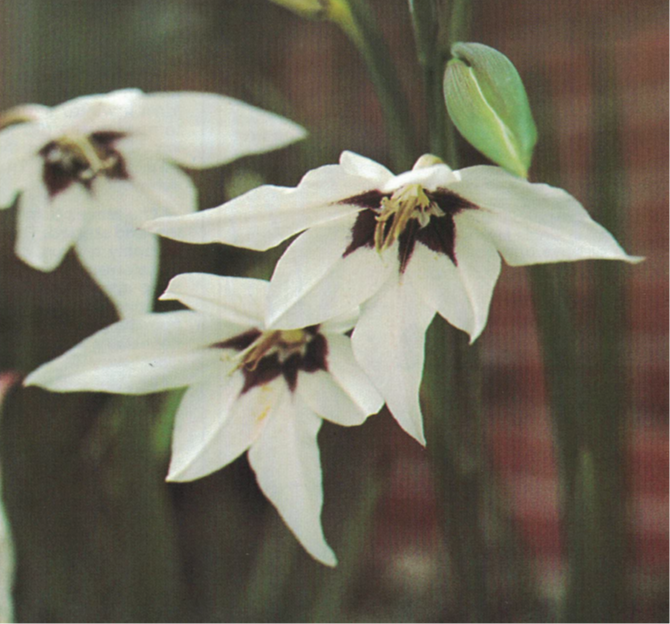
Peacock Orchid
Acidanthera bicolor
Light and Temperature
A native of Ethiopia, this plant needs full sun and plenty of heat to develop flowers. It can thrive outside in the summer against a sunny wall. In winter, store corms at 40-50°F.
Watering and Feeding
Water well in the summer and feed 4-6 times during the season. Keep corms dry during the winter.
Transplanting, Propagating and Grooming
These plants like a rich, fast-draining garden soil. If soil is poor, mix in a complete fertilizer or superphosphate before planting, but do not place fertilizer in contact with corms.
For propagating, take the small offset corms from the mother plant.
Trim off withered leaves and stems after lifting corms in the fall.
Size, Growth and Flowering
These orchids grow 2 to 3 feet tall. They're a perennial that produces new stems, leaves and flowers each year. They overwinter in the form of a bulb-like corm that cannot tolerate sub-freezing temperatures.
Plants generally bloom from July through October. The flowers are white with reddish-purple markings in the throat and on the petals. The blooms are 4-5 inches wise and are similar to butterflies in appearance.
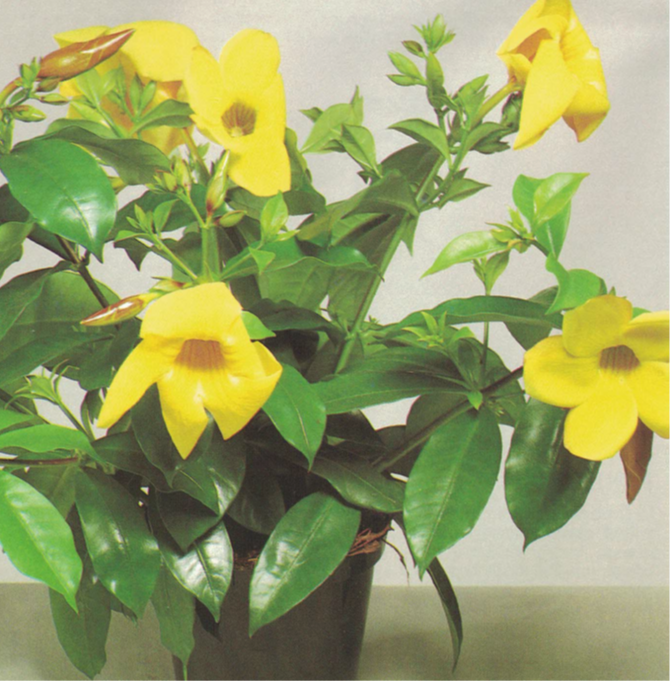
Allamanda
Allamanda cathartica
Light and Temperature
This plant loves the sun. If tropical forests it sends new shoots stretching above treetops while keeping its green leaves in the semi-shade. It needs plenty of sunlight, but preferable only of the tips of its shoots. Keep it surrounded by other plants if possible.
Keep the temperature high and high humidity is also recommended. This plant will not tolerate temperatures of less than 56°F in winter.
Watering and Feeding
When it is in the sunlight, the temperature sufficiently high, and growth in full swing, it requires lots of water. Pay particular attention to the plant's water consumption during flowering. Often it will need extra water to avoid flower loss. Feed the plant once every two weeks during active growth.
Transplanting, Propagating and Grooming
These plants like rich soil and transplanting can be difficult. Instead, apply a top dressing by removing the top 1.5 - 2 inches of soil around the root and filling in with a rich top soil. Transplant every two years. if the plant is large, so not change pot size, just trim the roots.
Groom in spring before growth resumes, by trimming out dead wood and unwanted stems.
Take cuttings in spring or fall.
Size, Growth and Flowering
This is a sturdy climber with evergreen leaves and large yellow blooms. Under suitable conditions its wines may grow 15-20 inches in length, and summer growth may be as much as 1 yard.
The yellow, bell-shaped flowers can achieve a diameter of 4-5 inches, and appear throughout the summer. If it is growing well, it may bloom until mid November or even the beginning of December. The flowers are very fragrant.
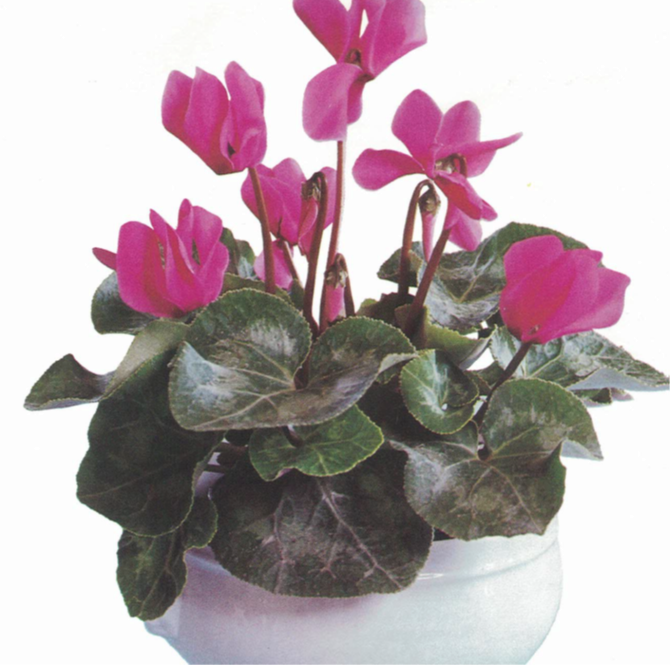
Cyclamen
Cyclamen persicum
Light and Temperature
These plants like a cool spot with some shade. They must never stand in direct light. Temperatures below 68°F are best.
Watering and Feeding
These plants enjoy high humidity. Water them carefully near the edge of the pot to keep the top of the tuber dry. Put liquid plant food in the water, but only at 1/2 strength, about once a week during the growth period.
Transplanting, Propagating and Grooming
Repotting is best carried out in April or May. Give the tuber a slightly larger pot and use fresh peat moss or potting compost.
Remove withered flowers and leaves to make room for new ones. Do this all year round as necessary.
Propagate by seed or by dividing.
Size, Growth and Flowering
Ordinary cyclamens grow about 1-1.5 feet; in the mini types to about 7-8 inches.
These plants bloom profusely from September to March. The common hybrids have no fragrance, but the mini types have a fine, faint scent.
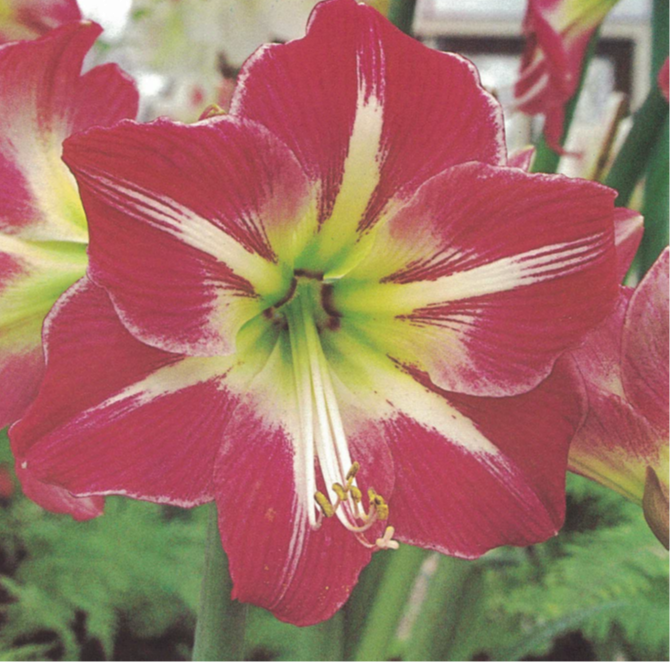
Amaryllis
Hippeastrum hybrid
Light and Temperature
In the growth period the plant needs lots of sunlight, fresh air and humidity. When it is in bloom, temperatures should not exceed 64°F and in the winter, 61°F .
Watering and Feeding
The more this plant grows the more water it needs. Feed it lightly every month until it shows signs of wanting to go dormant. From September to December keep it dry.
Transplanting, Propagating and Grooming
Repot every 3-4 years after the rest period. Use a rich potting soil with an equal amount of sand to insure draining.
The old flower stalks and leaves dry out by themselves. When repotting remove any dry foliage or stalks.
Dividing bulbs is easiest for propagation. It take 2-3 years for them to bloom though.
Size, Growth and Flowering
These plants need a lot of room when flowering. The leaves may not grow to more than 1-1.5 feet, but the bloom have reach heights of 2 feet.
Amaryllis flowers are giant sized, up to 6 inches in diameter. Colors range from white to red. It is sweetly fragrant. The white varieties are most fragrant.
Amazon Lily
Eucharis grandiflora
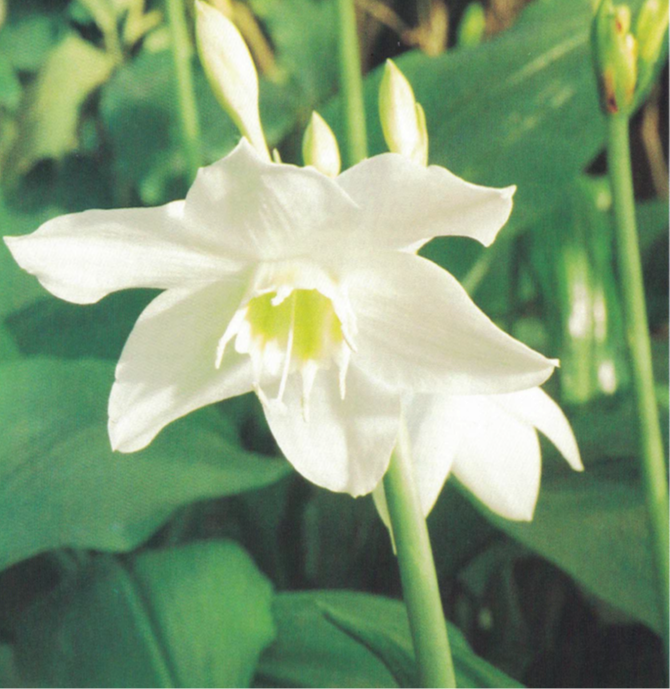
Light and Temperature
This plant like bright, indirect light except in winter when direct sunlight is acceptable. It likes high temperatures and the minimum night temperature should be 65-70°F all year with daytime temperature 10-15°F higher.
Watering and Feeding
The soil should be kept moist but never let the pot sit in water. When flowing is over cut down on watering but never let the soil dry out completely. Since this plant like a humid atmosphere, a misting now and then will be greatly beneficial. Feeding biweekly during the growing and flowering periods.
Transplanting, Propagating and Grooming
Repot or transplant only during resting periods and only if really necessary. Root disturbance during repotting can set bulbs back and they may not bloom for another year or more. Blooms best when crowded, so plant 4-5 bulbs in each out. The soil must be loose and well-draining.
No grooming is necessary except to remove faded blooms and withered leaves.
Divide older clumps or remove offsets to propagate. Again, this should only be done sparingly.
Size, Growth and Flowering
The Amazon Lily has large bulbs. The broad, shiney leaves and long leaf stalk can each a length of 2 feet. Medium growth rate.
The main flowering season is in the winter, but they can bloom several times a year if allowed wot dry out after each blood period. The white flowers have a lovely scent.
French Anemone
Anemone coronaria
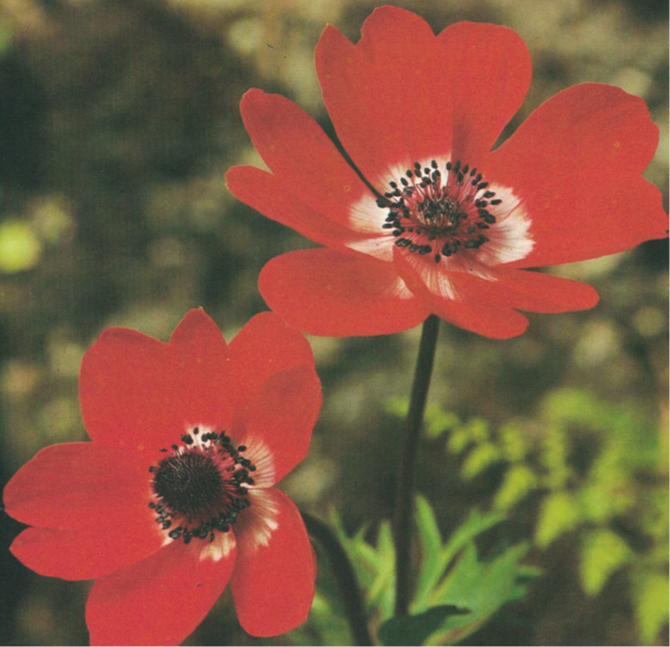
Light and Temperature
These plants need full sunlight. They will do fine in normal room temperature when forced or cut for vases.
Watering and Feeding
Once the plant is growing well, the soil should not be allowed to dry out. Water with a weak fertilizer solution.
Transplanting, Propagating and Grooming
These plants flourish is light, porous garden soil, preferably mixed with leafmold. No transplanting. Take tubers up each year, then sort and store and plant again in the fall.
Propagate by dividing the tubers or sow seeds.
Size, Growth and Flowering
Each tuber can produce several leaves and flowers, which rise to a maximum height of 12-16 inches.
Depending on when corms are plants, flowering can take place between February (forcing) and July. The flowers are in clear shades of red, white and blue. The bloom are normally single but can also be double. No real fragrance.
Coralberry
Ardisia crenata
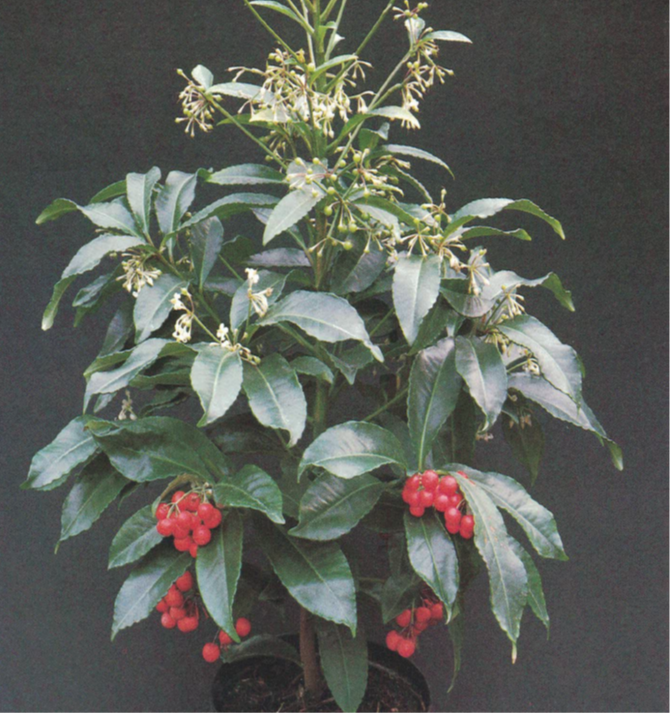
Light and Temperature
The plant prefers a shady position out of direct sunlight and temperatures in the lowers 70's. Lower the temperature to about 55°F for the winter, but no lower.
Watering and Feeding
water, feed and mist regularly during the growing season, but no misting when in bloom. Do not feed in the winter and cut down on water but continue to mist the plant often to prolong the berries. Make sure the soil id moist but not too wet.
Transplanting, Propagating and Grooming
This plant need potting every year in February/March. It like acid soil high in organic matter such as peat moss.
Young plants only need light tip pruning. Older plants can be cut back hard when potting in February.
To propagate, use semi-hard lead shoots taken when grooming the plant. Or, use the seeds from the berried when they have fallen.
Size, Growth and Flowering
This is a lovely little evergreen shrub which can reach a height of6 feet in the wild, but usually only half that in cultivation. Slow growing.
Blooms in the spring and early summer with white or pink flowers which have a fine scent. They are followed by bright red berries which last for many months.
Skimmia
Skimmia japonica
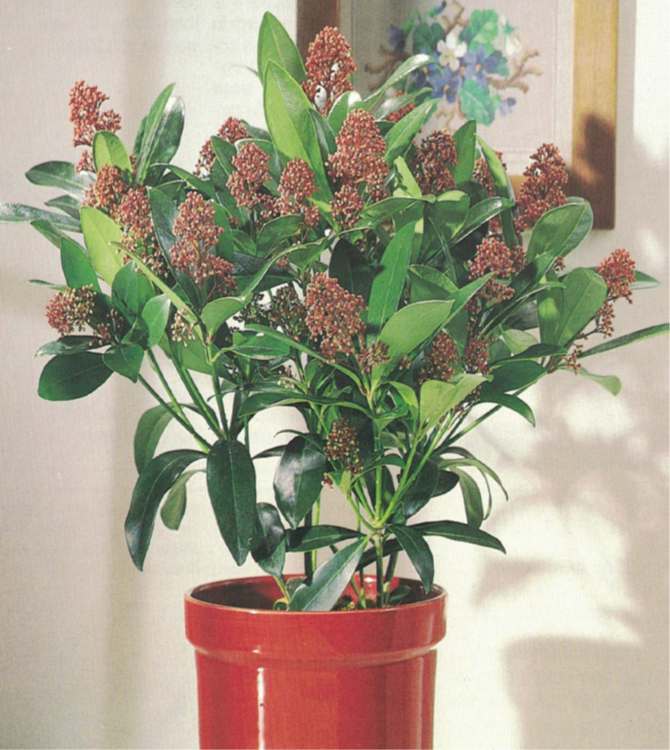
Light and Temperature
Skimmias need a bright, airy spot, but cannot stand hot sun from a south facing window. In winter, they should be kept cool, at a temperature not above 50°F.
Watering and Feeding
Water regularly, but do not over-water. Use purified water.
In summer, feed every other week.
Transplanting, Propagating and Grooming
Transplant as necessary. Skimmias require acidic soil, such as a peat-based soil mix of the type used for azaleas.
Grooming is not necessary.
The easiest way to propagate is by tip cuttings in August. Sowing seeds is slower and a little more difficult.
Size, Growth and Flowering
Skimmias are small shrubs which can reach a height of around 3-4 feet. The leaves are dark green and leathery to the touch
In May, white flowers appear in clusters, and have a delicate fragrance. If they are pollinated, red berries will appear in the fall.
Belladonna Lily
Amaryllis bellladona
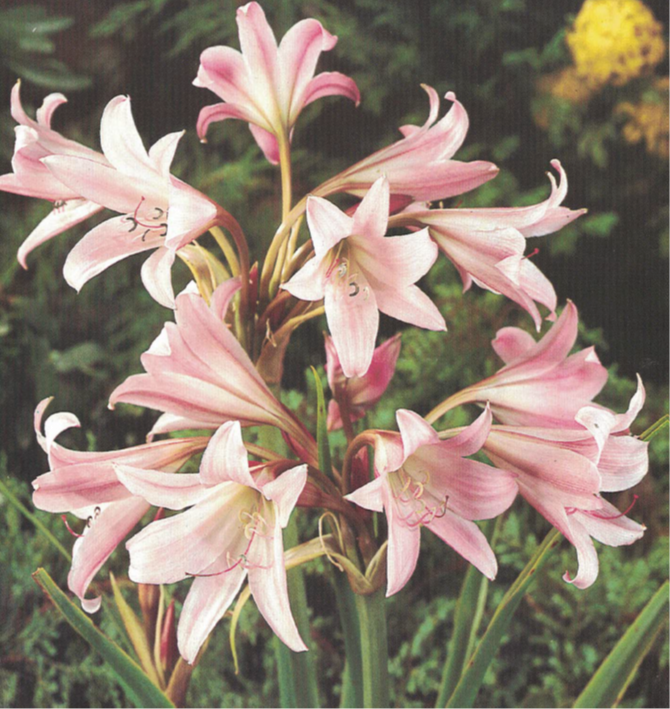
Light and Temperature
Plenty of light and warmth in the growth period. In the winter, the air and soil should be dry and cool.
Watering and Feeding
Plenty of water white the plant is growing and flowering, but never let excess water stand around the roots. Give newly planted bulbs infrequent water, and no water at all during the rest period. Feed occasionally while plants are growing.
Transplanting, Propagating and Grooming
Sometimes the mother bulb will produce small side-bulbs, Carefully pull them away and plant them in a pot of their own. They will usually take 2-3 years for these to bloom.
Remove withered leaves and spent flower stalks.
Size, Growth and Flowering
The bulbs are usually quite large; leaves are long and ribbon-like. The flower stalk grows to about 2 feet and is topped by clusters of trumpet like flower bells.
The pink, white or rosy 3-inch wide blooms have the ability to catch and reflect sunlight and make the plant appear to glitter. The flowers have a fine, exotic fragrance.
Perfumed Fairy Lily
Chlidanthus fragrans
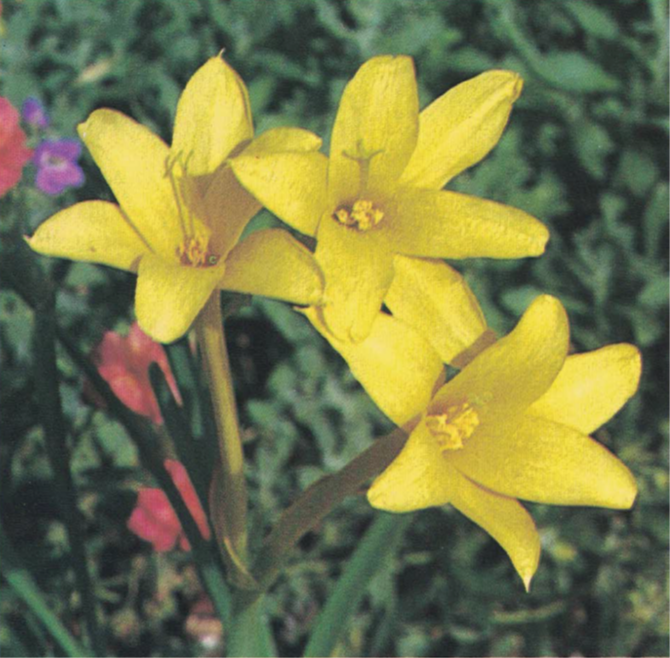
Light and Temperature
During the growing season keep in a bright spot but out of direct summer sun. Keep in a cool shaded spot during the winter rest season.
Watering and Feeding
Keep dry during the rest period of the season. Begin watering again in spring when new growth begins, sparingly at first, moderately once in full growth. Taper off water as foliage withers in the fall. Feed biweekly with dilute fertilizer.
Transplanting, Propagating and Grooming
Use a well-draining potting soil with some extra sand and perlite added. Repot every few years in spring, top-dress in other years. Be sure to provide good drainage in the base of the pot.
Remove withered foliage in the fall.
Propagate from offset bulbs.
Size, Growth and Flowering
Strap-shaped, bluish-green leaves are about 8-12 inches long and appear with the flowers.
Yellow lily-like flowers are 4-5 inches long in clusters atop a 1-2 foot stalk. Blooms in summer. They have a narcissus-like fragrance.
Firecracker Vine
Manettia inflata
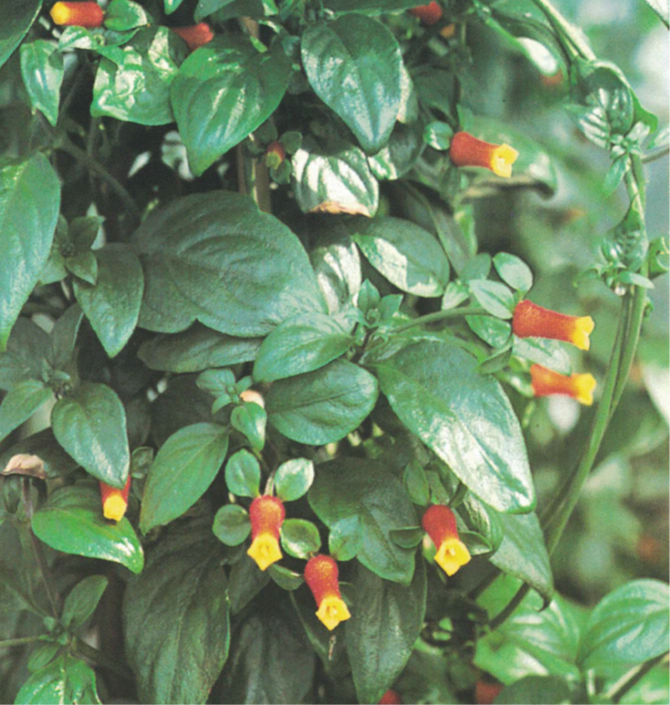
Light and Temperature
This plant likes a bright, sunny location and can take a lot of heat, providing watering chores are tended to as well as humidity. Winter temperatures should be lower, 50-55°F at night, but watch watering if temperatures are low.
Watering and Feeding
plenty of water is vital while this plant is in active growth. Use water at room temperature for both watering and misting.
Fertilizer is important for year round flowering. Use a well-balanced liquid fertilizer, diluted, every other week. If the plant rests a bit in the dead of winter, don't force it with fertilizer.
Transplanting, Propagating and Grooming
Take cuttings from mature stems in March.
After a year of growth, groom the plants back to ensure a good shape.
Size, Growth and Flowering
These plants grow to vigorously in cultivation that it must be kept in check with careful grooming. The climbing stems can grow as much as 30-32 inches per year. In a tight pot, though, it will rarely reach 6-10 inches per year.
The flowers are shaped like little red firecrackers, with bright glowing yellow tips, and bloom quite readily all year long with good care. The scent is faint but sweet.
Mariposa Lily
Colochortus luteus
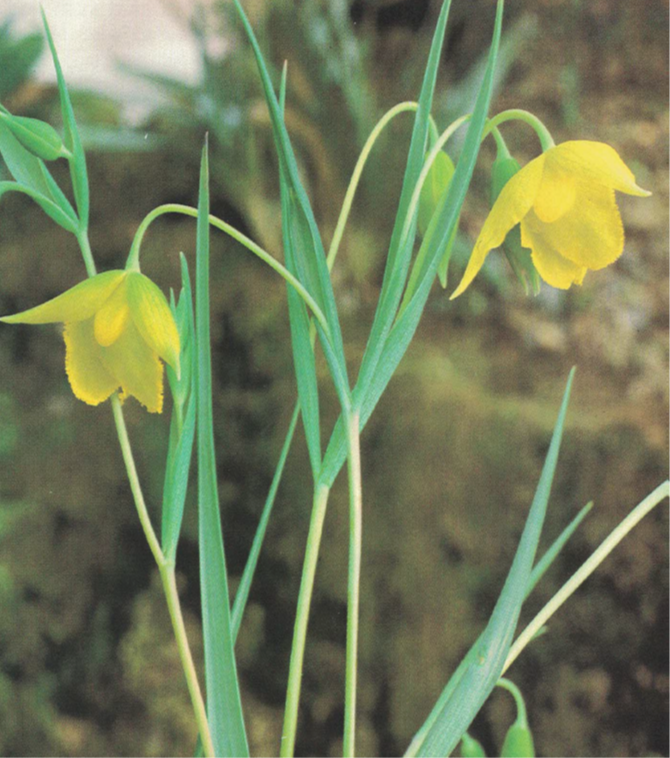
Light and Temperature
Can tolerate strong light throughout the year. Temperatures can be in the 70-85°F range, perhaps slightly cooler in the winter.
Watering and Feeding
Watering sparingly or not at all during the winter. Water sparingly in the summer, just enough to keep the soil barely moist. Add diluted fertilizer monthly in summer.
Transplanting, Propagating and Grooming
The soil should be both porous and well-draining. Use regular potting soil with extra perlite or pumice added. The bulbs can be kept in the same pot all year or lighted and dried and replanted each season.
Remove withered lease and flowers.
Propagate by offset bulbs.
Size, Growth and Flowering
These lilies have slim leaves and an upright growth with poppy-like or hanging flowers on a leafless stalk. Can reach a height of 8-28 inches, depending on the species.
Different species bloom from early summer until August-September. Some have a lovely fragrance.
Fire Lily
Cyrtanthus brachyscyphus (syn. C. parviflorus)
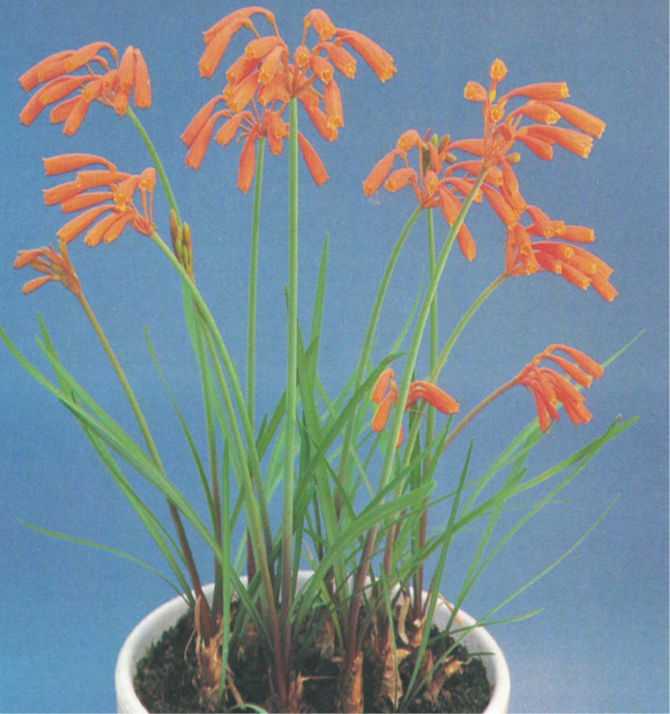
Light and Temperature
Fire lilies need plenty of light. Maintain temperatures around 65 to 75°F in the summer growth season and not below 50°F in winter.
Watering and Feeding
Water and feed generously and spring summer, sparingly in the winter. The smaller bulbs should be kept going through the winter-you can continue to feed them if you cut down on the frequency as winter approaches.
Transplanting, Propagating and Grooming
It is important to provide your plants with porous, well-drained soil. Place a layer of pot shards in the base of the pot to further aid drainage. Fire Lily should be repotted in fresh soil at the end of each winter period, use regular potting soil with extra added sand.
Remove the withered stems and leaves as they begin to dry.
Fire lilies often form small offsets. Remove them and place them in pots of their own before the beginning of the spring growth season.
Size, Growth and Flowering
Fire lilies can be from 8 to 24 inches tall, depending on the species. They are all bulb plants with sword shaped leaves. M
Most species bloom in early summer although a few blooms in the early spring or late summer. The white, yellow, pink or blood red flowers generally have a faint but pleasant smell.
Scarborough Lily
Cyranthus purpureus (syn. Vallota speciosa)
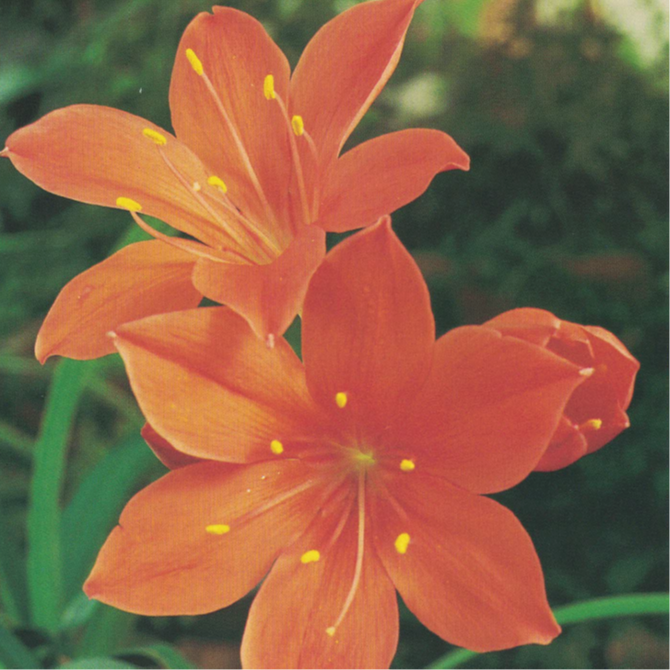
Light and Temperature
Scarborough Lily needs bright light all year round. In the winter months it should be in a cool place. In the summer it loves plenty of heat and full sun.
Watering and Feeding
Never let your Scarborough Lily dry out completely. Water just once a week in the winter but generously in the summer, preferably with some liquid fertilizer added.
Transplanting, Propagating and Grooming
If you want your Scarborough Lily to grow really large you should leave the side bulbs on the parent bulb and just transplant them all into a larger pot. The best time for repotting is in March. plant the bulbs with the top half above the soil.
Remove old, withered leaves.
To propagate carefully remove the side bulbs in March and plant them individually in rich potting soil in 4-inch pots. You will have to wait a few years for these offsets to bloom.
Size, Growth and Flowering
Unlike amaryllis, the Scarborough Lily has leaves all year. If the bulb does not split and is planted in good soil it will grow more and more flowers the older it gets.
Blooming marks the end of the summer growth period, usually occurring in September. The flowers are brilliant red orange color and there are usually 4-8 flowers on each stalk.
Periwinkle
Vinca major 'Vareigata'
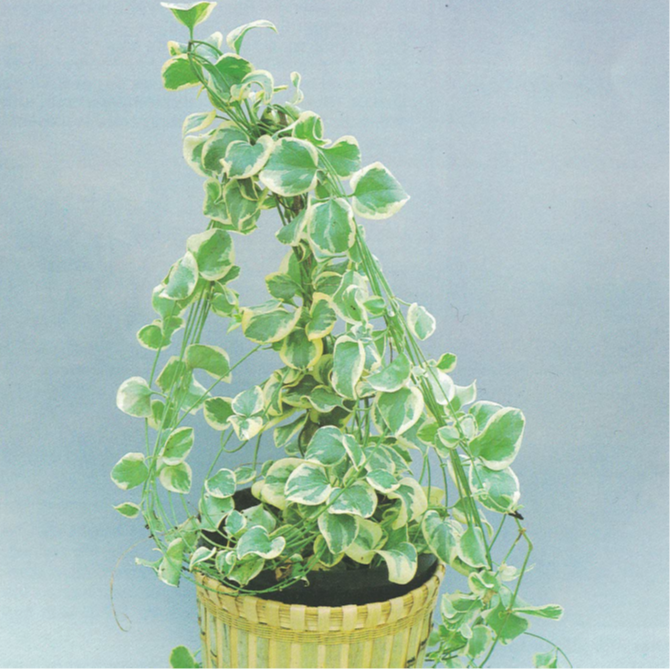
Light and Temperature
Periwinkles thrive in bright surroundings but will also tolerate half shady positions. They can easily tolerate normal indoor temperatures of around 68°F.
Watering and Feeding
Keep the soil in the pot moist and do not allow it to dry out. Dilute liquid fertilizer every other week in the growing season.
Transplanting, Propagating and Grooming
Periwinkles are not particular to soil, but a loose, nourishing soil is best. Repot in the early spring unless you want to grow this plant annually. Place overwintering plants in a cool position.
Trim the stems completely back when they get too bare and straggly. To propagate cuttings are the easiest method; use cuttings with one to three pairs of leaves and poke it down into the soil where it will root in no time.
Size, Growth and Flowering
Vinca major are a small, creeping, Evergreen shrub. The upright stems will reach a height of about 12-18 inches, but it will eagerly spread horizontally to cover the ground.
The blue flowers open early, from April onwards. There are also purple and white varieties. Almost no fragrance.
Brunfelsia
Brunfelsia pauciflora var. calycina
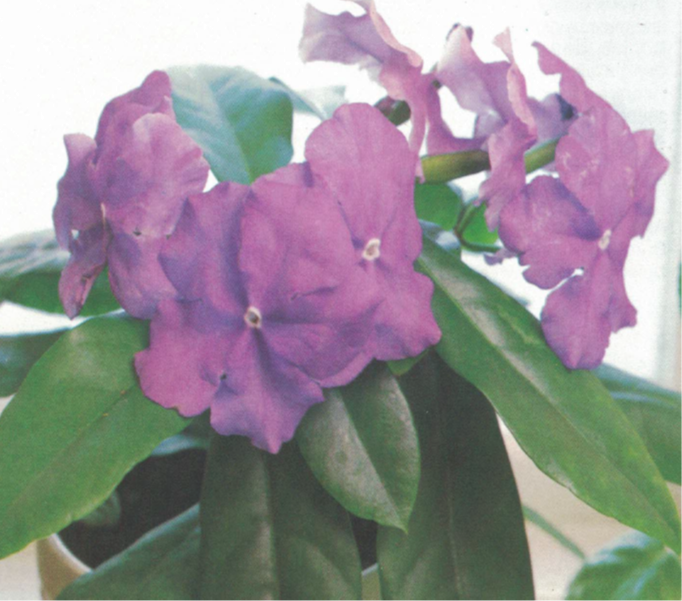
Light and Temperature
These plants are native to the damp rain forests of South America. They like a tropical mini climate as indoor plants too; high humidity and lots of warmth (68- 72°F). Keep it cooler and fall (50-59°F) so it can form buds. It needs bright light, but it can't take strong sunshine. It can take the most light during blooming.
Watering and Feeding
Always use soft, tepid water-lots in the active growing period. In spring and summer, give it half strength plant food. Reduce water in winter and give no fertilizer. If humidity is low, mist it frequently.
Transplanting, Propagating and Grooming
After flowering, your plant needs a 2–3-week rest period before repotting. Use the next size pot with a standard potting soil mixed with peat and sand or perlite.
Cut back severely at repotting. Unpruned plants grow too tall and gangly and lose too many lower leaves.
To propagate you can use a tip- shoot cutting about 3-4 inches long.
Size, Growth and Flowering
These plants tend to grow rapidly, leaving a bare stem below. By cutting back after flowering, it will stay bushy and about a foot high with no bare stems.
Some of these 25-30 plant varieties are pleasantly perfumed. This is unfortunately not the case with B. pausiflora, But the colorful flowers bloom for several months.
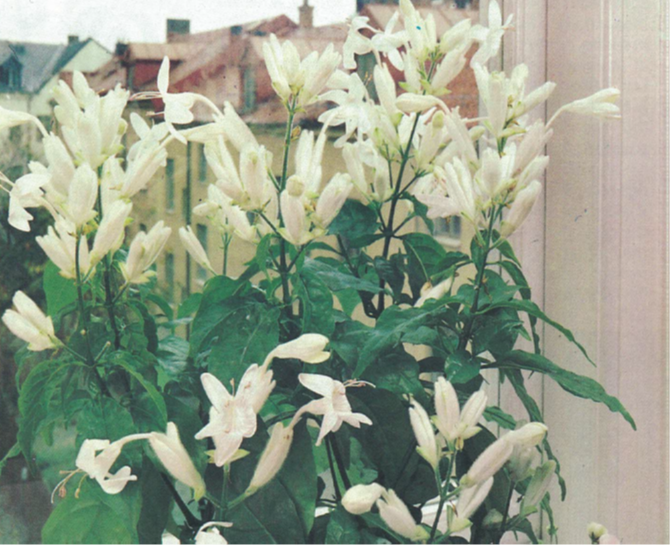
Whitfieldia
Whitfieldia longifolia
Light and Temperature
This plant grows and blooms at normal room temperatures. After blooming, during the short resting season, it should be kept at around 55-60°F. It needs plenty of light all year round, but it must be protected from excessively harsh midday sun between May and September.
Watering and Feeding
Never let the potting soil dry out. The plant doesn't mind standing with wet feet for quite a while after watering. It isn't necessary to feed it in the flowering season.
Transplanting, Propagating and Grooming
This plant thrives in a rich, fast draining potting mix. Plants are repotted after the end of the resting season.
If shoots get too long and straggly, they can be cut back after flowering, or in the spring.
To propagate this plant can be renewed by cuttings.
Size, Growth and Flowering
As a potted plant, it is compact and bushy, just the right size for the windowsill. The dark, pointed stalk-less leaves grow in opposite pairs.
White flowers form in clusters on the shoot tips. The individual flowers are tubular with flared petals and grow out of slightly sticky bracts.
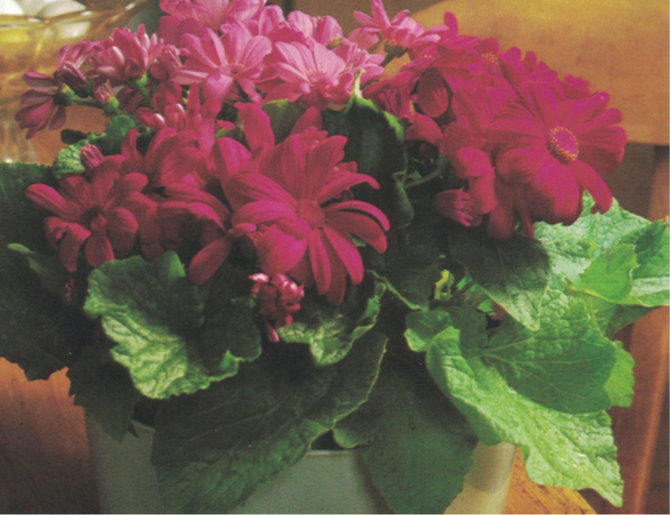
Cineraria
Senecio x hybridus
Light and Temperature
This plant can't take much direct sunlight and thrives best in a north facing window shaded by other plants. Keep it cool, preferably around 60°F.
Watering and Feeding
Never let the potting soil dry out. The plant doesn't mind standing with wet feet for quite a while after watering. It isn't necessary to feed it in the flowering Season.
Transplanting, Propagating and Grooming
For sowing, use a peat-sand blend, and for adult plants use potting compost mixed with sand and clay soil. After flowering ceases, discard the plant, because it will only bloom poorly the following year.
No grooming is necessary but remove withered blooms and leaves as they appear.
To propagate, sow seeds, but it's easier to buy new plants and they are inexpensive.
Size, Growth and Flowering
This plant is one of the plants which gardeners can stunt to ensure low, compact growth that will fit a windowsill perfectly and go well with other plants in a large bowl. This plant can be bought in bloom around 6 inches high, but there are plants around 1-1.5 feet high that are also compact and growth.
The natural blooming season is February through April. This plant is cultivated for its gorgeous colors. The blooms are Daisy shaped, single or double, often with a white Garland around the center of the flower. The colors are white, pink, red, blue, and violet.
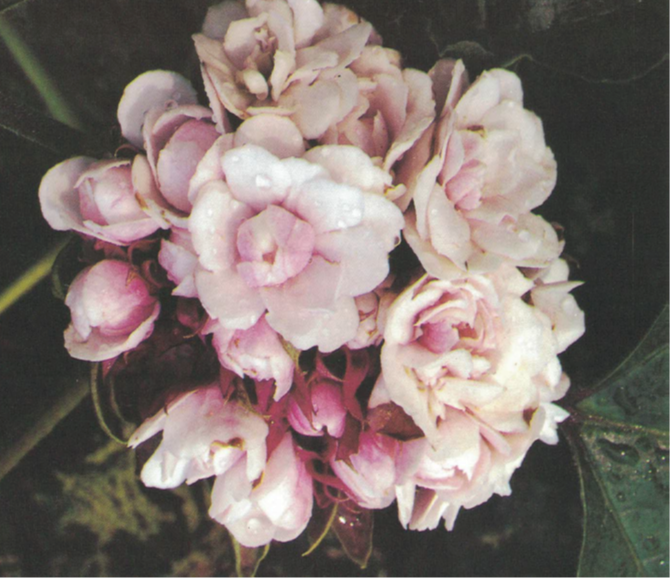
Cashmere Bouquet
Clerodendrum philippinum (syn. C. fragrans pleniflorum)
Light and Temperature
Bright light/ part sun is best, but part shade is good outdoors. Plants grow quickly in warm temperatures but tolerate cooler temperatures as well. Can recover from mild frosts.
Watering and Feeding
Feed and water generously during the growing season but reduced to overwinter. Do not fertilize when dormant.
Transplanting, Propagating and Grooming
Repot annually in the spring. Plants can be divided at this time if desired. Use regular potting soil.
Plants can be severely cut back in the spring to produce new growth period pinch and prune to shape at other times of the year.
Propagate by stem cuttings, root cuttings, or division.
Size, Growth and Flowering
Both C. bungei and C. philippinum can grow fast, and up to six feet tall when planted in the ground. They are more compact and manageable when grown in containers. Both can be spread by root suckers. Leaves are large and tropical looking. Plants are Evergreen except in cold temperatures.
C. philippinum has fully double white to light pink flowers in large terminal clusters. C. bungei has rosy-red flowers in loose, broader clusters. Both have a sweet fragrance. Flowering may occur anytime during the spring, summer, or fall.
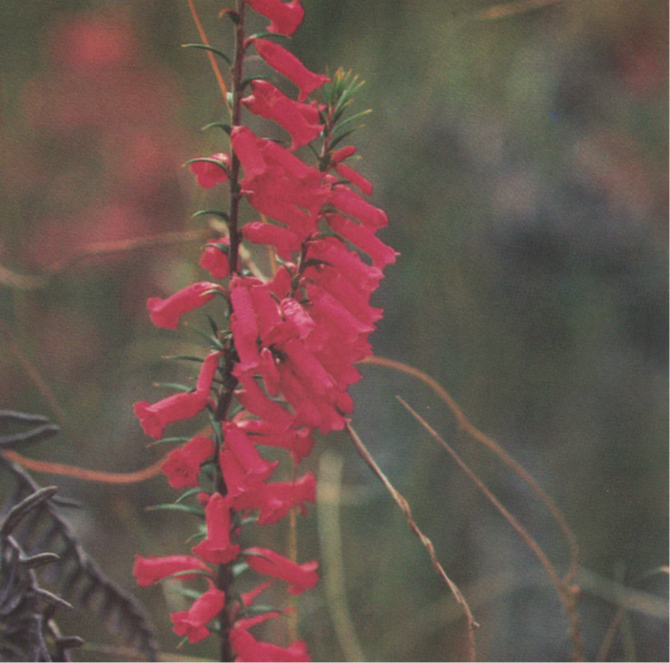
Australian Heath
Epacris longiflora
Light and Temperature
Indoors, Australian heath prefers full sun and relatively cool temperatures. Outdoors in the summer, place it in a sunny spot, but keep the roots cool with mulch.
Watering and Feeding
Lots of water and regular feeding during the summer season. Start feeding and reduce watering in the fall, but do not let the soil dry out.
Transplanting, Propagating and Grooming
Australian heath can be potted after flowering in the spring. Be careful not to disturb the roots too much. Use well-draining peaty soil containing plenty of sand.
Cut the shrub back after flowering to encourage bushy new growth in the summer and more flowers in the winter.
Propagate by cuttings in the late summer. Take cuttings or side stems in with a little heel. Plant them in moist, sandy peat over bottom heat.
Size, Growth and Flowering
Australian heath is an Evergreen shrub, either upright or spreading. Medium growth rate.
E. impressa blooms in the winter and spring. E. longiflora can bloom throughout the year. The flowers have a faint, but pleasant fragrance.
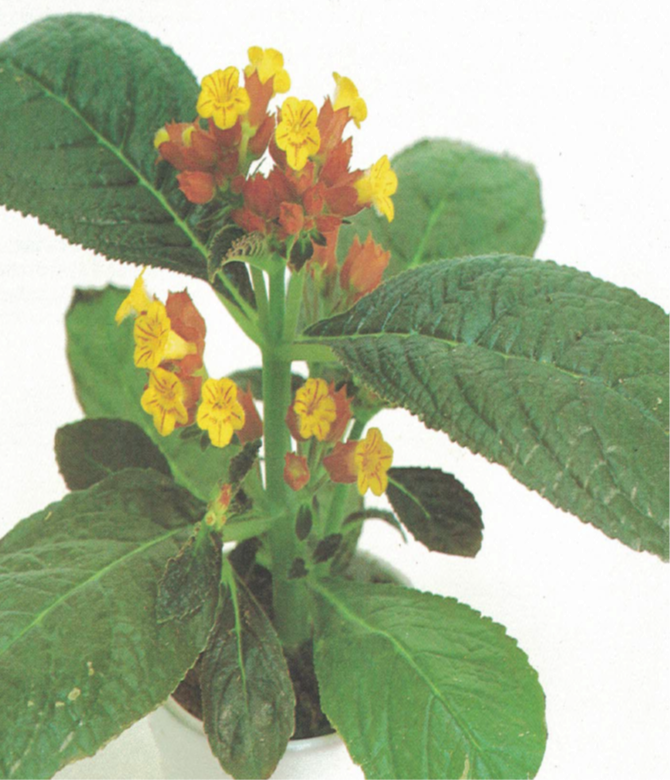
Chrysothemis
Chrysothemus pulchella
Light and Temperature
This plant is a rainforest plant and likes plenty of light but never burning sunlight. It will grow well when kept at a fairly even temperature of 65-75°F.
Watering and Feeding
Water when the soil begins to feel dry period always use water at room temperature. Feed with half strength fertilizer from March to October.
Transplanting, Propagating and Grooming
This plant will grow well in good African Violet soil. Repotting is unnecessary since the plant is renewed by cuttings or tubers.
Grooming is unnecessary.
Propagate from cuttings or divisions of the tuber.
Size, Growth and Flowering
Both the size and the way in which this plant grows reminds us of gloxinia, but otherwise it is different in every way. The leaves are a bronze- brown and our spear shaped with clearly defined veins. The flowers grow from the leaf axils. Older plants can be quite tall, but young plants are small and compact.
The five yellow petals of the flower rest on top of an orange- red cup. They can last for only 5-6 days and can then be removed with a sharp snap. The colorful cups remained for several months afterwards. The flowers have a faint, sweet scent.
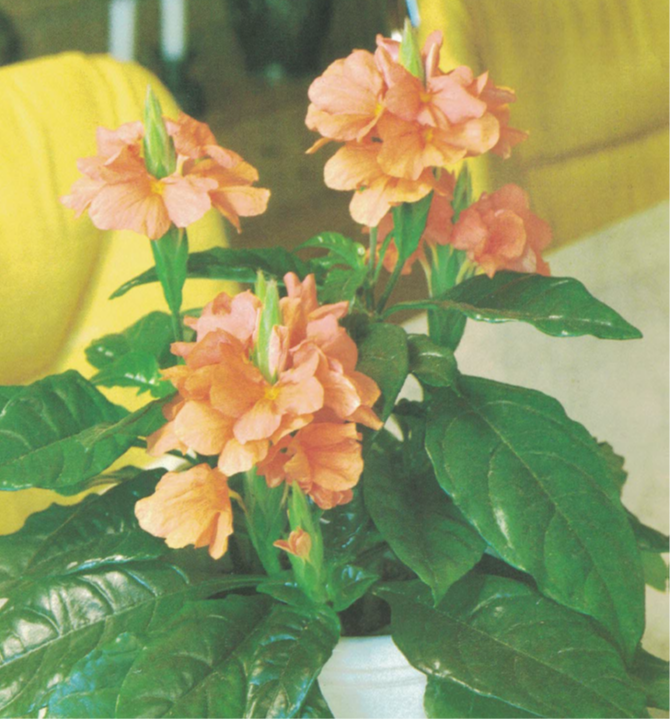
Crossandra
Crossandra infundibuliformis
Light and Temperature
This plant can stand in a window facing S if protected from strong midday sun. Once it blooms, temperatures of 60- 64°F are sufficient; the plant will keep longer and its colors gain intensity. In winter, keep it warmer than 55°F. Humidity must always be high.
Watering and Feeding
Keep the soil slightly moist in summer, but water less in winter period cold water induces a state of shock, and it may die. From April to August, feed it every two weeks and mist it lightly if humidity is a problem.
Transplanting, Propagating and Grooming
When keeping the plant for more than one year, repot in spring. Use standard potting soil and provide adequate drainage. Use a shallow pot.
Grooming is necessary to keep the plant looking beautiful. Pinch back withered flower clusters.
Propagate by taking cuttings and spring. Propagating from seed is also possible, but difficult.
Size, Growth and Flowering
The plant doesn't grow very high; Just 6-8 inches. With good care it will grow into a dark green, glossy bush.
The flowers are usually flat and salmon pink, sometimes orange or red, and about 1.5 Inches in diameter. They sit at the top of the spray and sheath like clusters. From April to October, new blooms appear constantly but unfortunately, they have no fragrance.
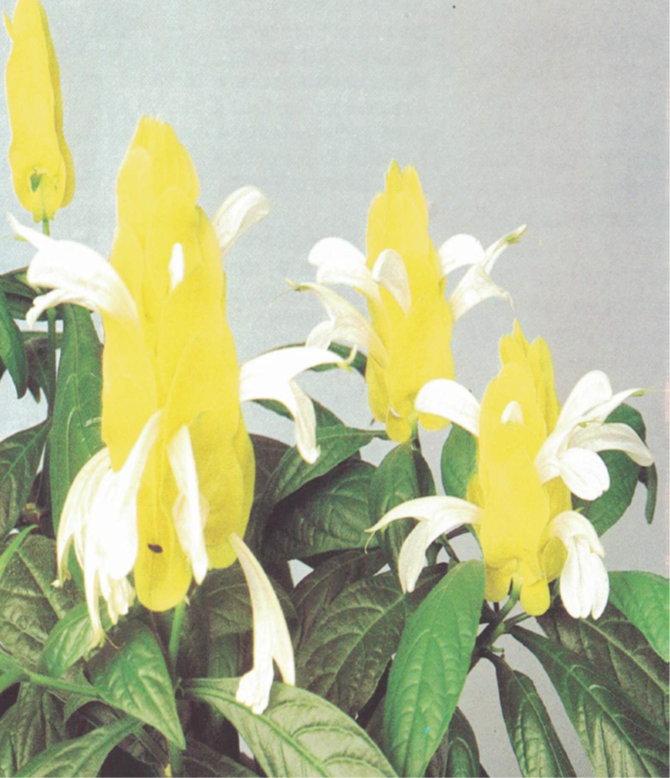
Golden Candle
Pachystachys lutea
Light and Temperature
Bright indirect light is best. Neither strong sunlight nor deep shade suit this plant. Normal room temperature is fine, but a cooler winter temperature around 55°F, is to be preferred.
Watering and Feeding
Water with warm water from May to October and give nitrogen-based plant food once every 14 days. water only enough to keep the soil barely damp in the winter. Humidity is a must.
Transplanting, Propagating and Grooming
Commercial potting soil or peat-based soil are suitable for this plant. Repot in spring. Put a layer of gravel or shards at the base of the pot to ensure good drainage.
Cut back every spring when repotting.
Propagate with cuttings from non-flowering shoots.
Size, Growth and Flowering
The plant should not be allowed to grow too tall. Plants keep their shape when kept under 12-14 inches. This plant can grow about four inches per year.
The yellow flower head is made up of spade-like leaves. The true, white, tongue-like flowers grow from between the spades. The flowers have no scent.
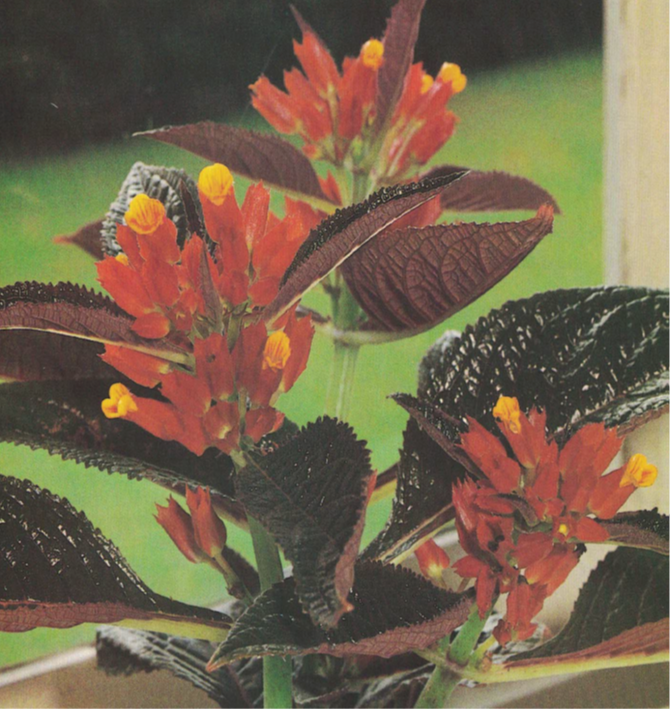
Goldfish Plant
Alloplectus nummularia
Light and Temperature
These plants cannot tolerate strong sunlight and should therefore be placed in AN- facing window or in a spot out of the sun in a heated location. Even temperatures in the 70-80°F range are to be preferred although the plant can tolerate rather high temperatures.
Watering and Feeding
Those with hairy leaves may be damaged by water and should not be misted or sprayed. Water right at the soil surface to avoid getting water on the leaves. Do not allow the soil to dry out. Room temperature water is important, as cold water can harm these plants.
Transplanting, Propagating and Grooming
Repot in commercial potting mix but only when the roots are pushing their way out of the pot.
Trimming the plants to obtain cuttings can be done at any time.
Propagate with cuttings over bottom heat oh 75-85°F. It is also possible to grow new plants from seed.
Size, Growth and Flowering
Upright growth with 24–32-inch stems, depending on the species. Good for hanging baskets.
The scentless flowers are yellow and red or orange- red and are followed by black berries.
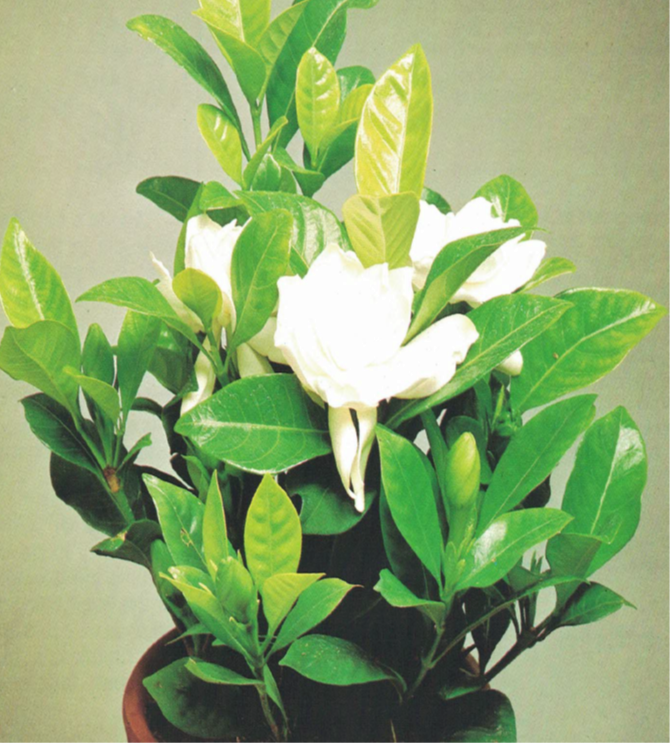
Gardenia
Gardenia jasminoides
Light and Temperature
The temperature should never go under 65°F unless the gardenia must bloom at a special time. Then place it in a bright, warm spot in August. When the flower buds have appeared, move it to a cooler position until it has bloomed out.
Watering and Feeding
The gardenia needs high humidity and should be kept misted frequently. Keep the soil evenly moist, using rainwater or boiled water that is cooled to room temperature. The water should never be cold.
Transplanting, Propagating and Grooming
Gardenias need to be repotted every other year in early spring. Use a soil mixture of equal parts peat, sand and hummus or leaf mold.
If the plant has becomes leggy, it should be trimmed back in March- April. Use this opportunity to take cuttings.
Propagate by cuttings.
Size, Growth and Flowering
The gardenia can grow to three feet tall with ideal conditions. It normally grows to about 16-20 inches with an annual growth of 4-6 inches.
The gardenia canned flour often on all year long, but the main season is may through September. The creamy white flowers have a strong fragrance and are reminiscent of Jasmine.
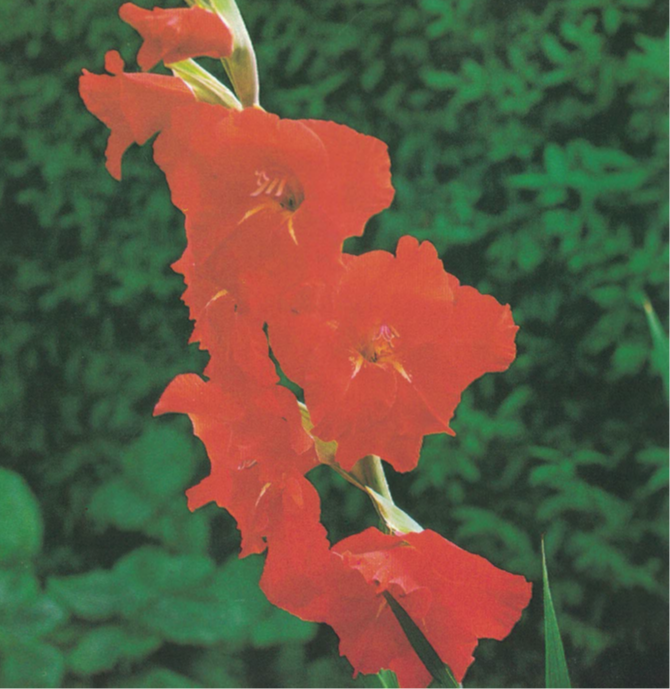
Gladiolus
Gladiolus x hortulanus
Light and Temperature
Gladioli should be planted in a place with plenty of sun but should be sheltered from the wind. It is not a good plant for cold, raw places.
Watering and Feeding
The plant grows rapidly and needs plenty of water. Feed every second to third time it is watered.
Transplanting, Propagating and Grooming
Plant in a well-drained, light, and nourishing loam. Transplanting is unnecessary.
When taking corms up in the fall there may be small offsets on the parent plant. Overwinter these in sand and plant them out in the spring in a cold frame or in the garden. Take them up in the fall, overwinter them again and plant them out in the following summer. It takes 2 years for new corms to start flowering.
Size, Growth and Flowering
Most gladioli grow to 3-4 feet in one season. Some European varieties are only half this size.
The Gladiolus is grown for its overwhelming display of flowers. Most of them only have a faint scent.
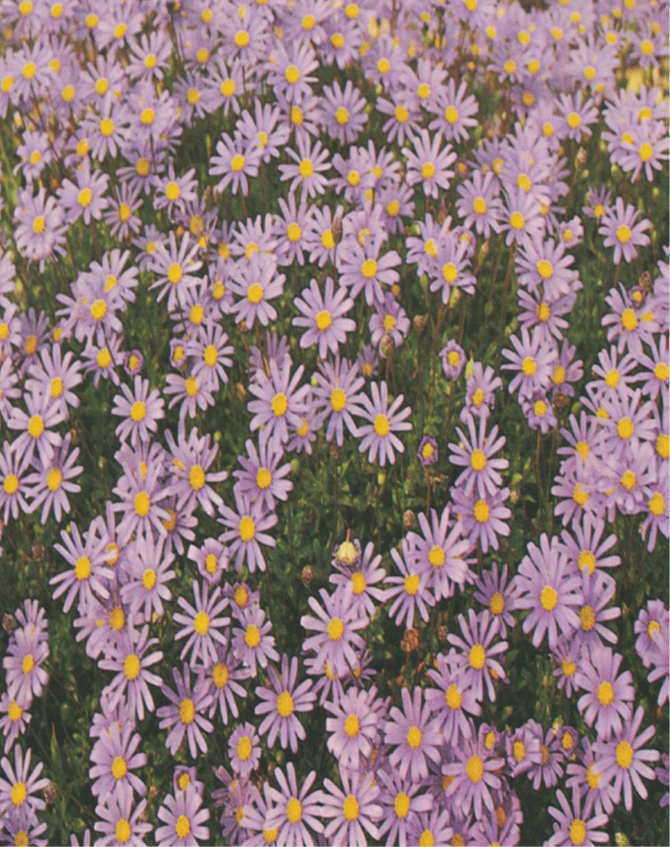
Blue Marguerite
Felicia amelloides
Light and Temperature
This plant best thrives in an airy, sunny spot. The perennial species should overwinter in a bright and cool place at about 50°F.
Watering and Feeding
Water regularly, keeping the soil evenly moist. Feed every two weeks during the spring and summer with a liquid fertilizer.
Transplanting, Propagating and Grooming
The short-lived annuals need not be repotted, whereas the perennials can be repotted in regular potting mix every spring.
If you frequently trim the side shoots the plant will grow bushier and bear more blossoms.
Propagate by seed or cuttings.
Size, Growth and Flowering
Depending on the species, the plants grow between 4 and 20 inches tall. The small oval leaves have either toothed or curled back edges and rough hairs.
The flower heads grow at the end of a long, wiry stalk above the leaves and have a diameter of 3/4 inch to 1 1/2 inch. They are various shades of blue. The flowering season also depends on the time of cultivation. The flowers are not particularly fragrant.
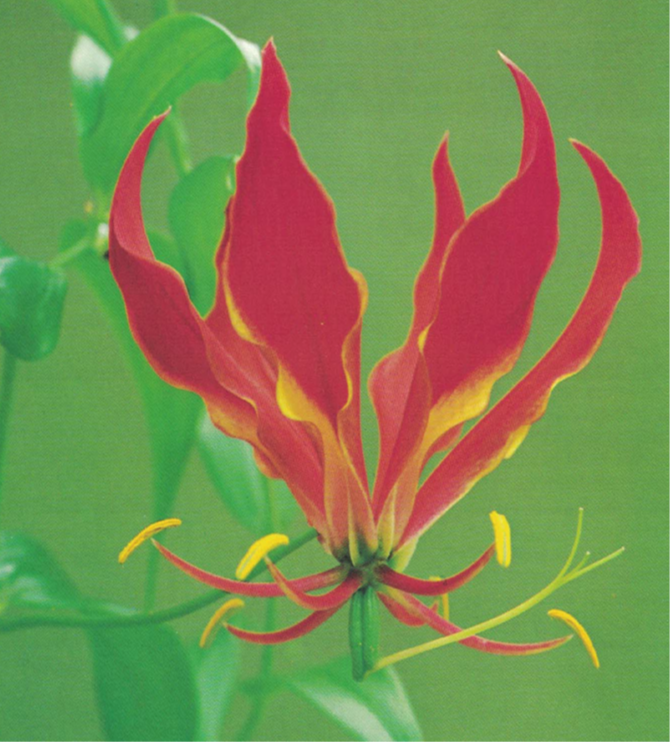
Gloriosa Lily
Gloriosa rothschildiana
Light and Temperature
Gloriosas need warmth and sun but give them some shading from the hot midday sun. Night temperatures should fall no lower than 65°F.
Watering and Feeding
These plants thrive in the company of other plants which increases the humidity around them. Growing them on a wide saucer of damp pebbles and misting frequently will raise the humidity as well.
Transplanting, Propagating and Grooming
A light, porous, and nutritious soil is the ideal. An African Violet type soil is a good choice or make a mix with equal parts of potting soil, peat, and coarse sand.
Gloriosa lilies are tidy plants and need little grooming, but don't be afraid to cut away waxy flowers. Cut the blooms last as well.
Small tubers are formed from the mother tuber. With good care, they can be raised to mature plants within a year. They respond well to the right amount of water, warmth, and nourishment during active growth. Watch so they don't dehydrate during the winter dormancy.
Size, Growth and Flowering
A frail climber with yard long stems that need a trellis or frame to climb to.
It blooms 2-3 months after the bulb has been planted. The flowers grow 3-4 inches in diameter but have no distinctive fragrance.
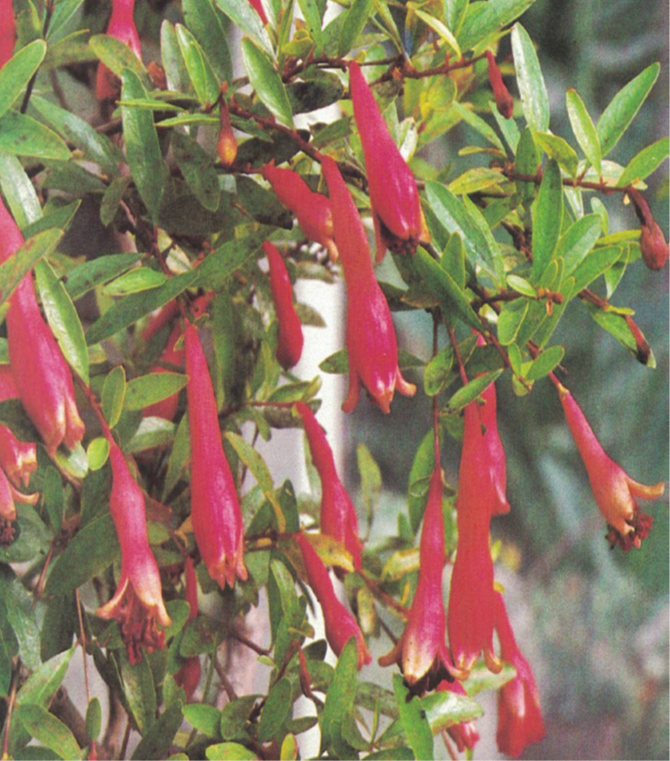
Pomegranate
Punica granatum
Light and Temperature
The plant needs plenty of sunlight for lots of flowers all summer long. It needs fresh air and benefits from being outdoors in summer. At a temperature no lower than 64°F is best in spring and summer. When flowering ceases in fall, move the plant to a cool spot and let it winter at about 45°F. Don't be alarmed if it drops its leaves in late summer or early fall. It is only time for it to go dormant.
Watering and Feeding
Throughout the growth period from early spring to fall keep the plants moist and give them biweekly doses of half strength plant food. During winter dormancy, water sparingly and withhold all food.
Transplanting, Propagating and Grooming
Repot in March before the real growth starts. Choose a nutritious, light potting soil with good drainage.
Prune and thin out your plant prior to repotting. This will ensure better branching at the crown.
The most common propagation method is by using cuttings-in spring use woody cuttings, and in summer use herbaceous ones.
Size, Growth and Flowering
The dwarf righty, which is suitable as a window plant, grows to about 18 inches. Standard varieties are best suited to growing in tubs in a solarium or greenhouse since they can grow to three feet in all directions.
The pomegranate bears lovely reddish- orange flowers and groups of three at the tips of its stems. Older plants begin to flower in June while young ones start a month later. The flowers have no particular fragrance.
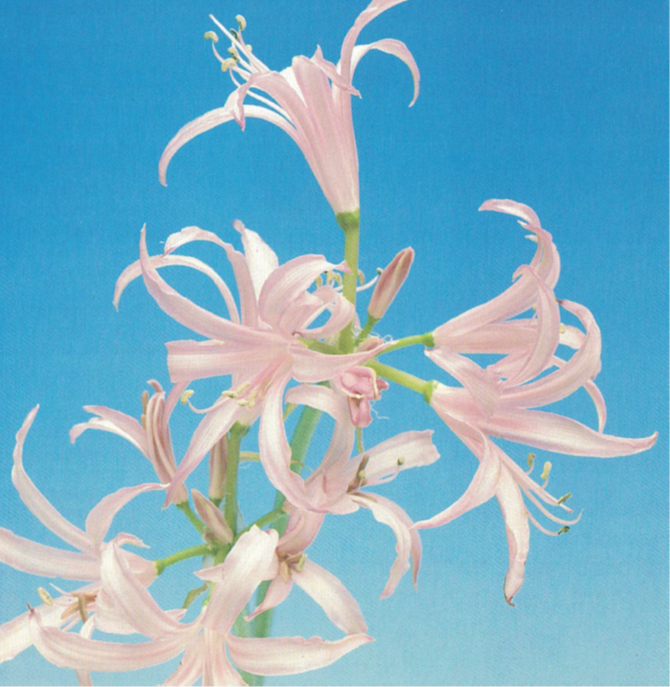
Nerine/Diamond Lily
Nerine
Light and Temperature
Bright light with some sun during growing and blooming season. When in bloom, place plants where sun can hit the flowers for the sparkling effect. Cold temperatures are best during the winter- spring growing season, with gradual warming in spring.
Watering and Feeding
Water regularly, keep evenly moist from when the flower spikes and or foliage appears in fall until leaves wither in late spring, when watering should be decreased. Water once or twice during dormancy. Fertilize sparingly only during the growing season.
Transplanting, Propagating and Grooming
Experts differ on the best soil mix. In nature, diamond lilies grow in very poor soils. One point is certain: the soil must be well drained. One good mix is half part coarse sand, quarter part peat moss, quarter part standard potting soil. Repot at several year intervals as plants resent root disturbance.
Remove weathered leaves in early summer.
Offset bulbs can be removed when repotting. Easy, although slow, to grow from seed, which should be sown fresh in fall. Treat the seedlings as mature plants.
Size, Growth and Flowering
Slow; long strap like leaves, in the winter and spring. Dormant in summer.
Flowers appear in fall before the leaves diamond Lily and its hybrids have flower clusters in various shades of white, pink, and red. Excellent, long lasting cut flowers. No fragrance.
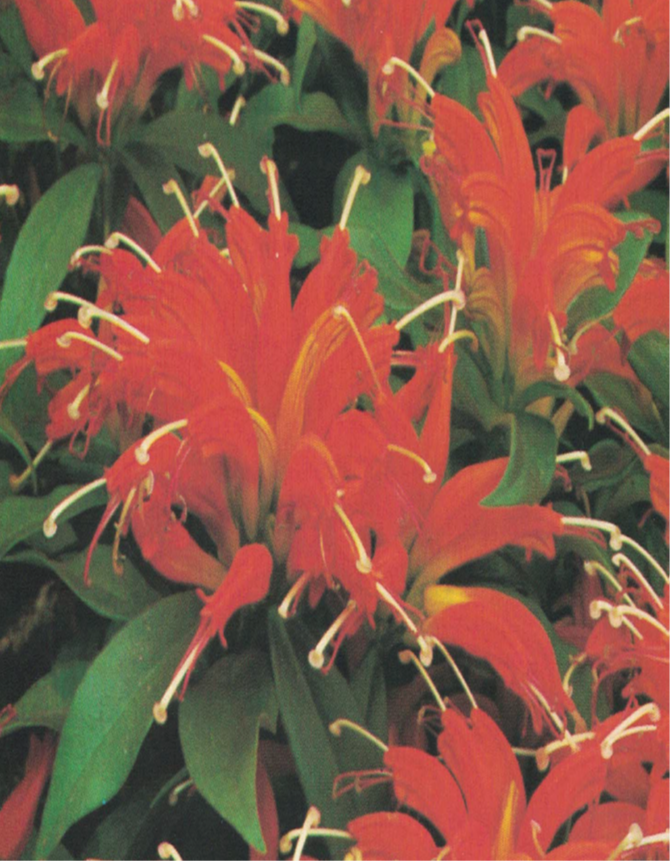
Aeschynanthus
Aeschynanthus evrandii hybrid
Light and Temperature
The plant should be a bright spot but not in burning sunlight. In the summer it does best with plenty of heat but can usually manage at an ordinary room temperature. The temperature in the winter shouldn't be lower than 60-65°F.
Watering and Feeding
Water regularly during the growing. And give an occasional shower. The soil can be allowed to dry out somewhat between each watering. Water sparingly during the winter rest. Using only room temperature water as cold water can damage the plant.
Transplanting, Propagating and Grooming
The soil must be light, porous, and rich in organic matter. Repot in the spring.
This plant can be pruned if the plant begins to lose its shape and becomes straggly.
You can use the new cuttings from spring pruning to grow new plants. Plant them in a light potting mix and maintain the temperature at around 70-75°F.
Size, Growth and Flowering
Upright types of this plant seldom grow to more than 16 inches in height or 12 to 16 inches in diameter.
If the new upright hybrids get enough light, they can flower the whole year round. The bright orange flowers have no fragrance.
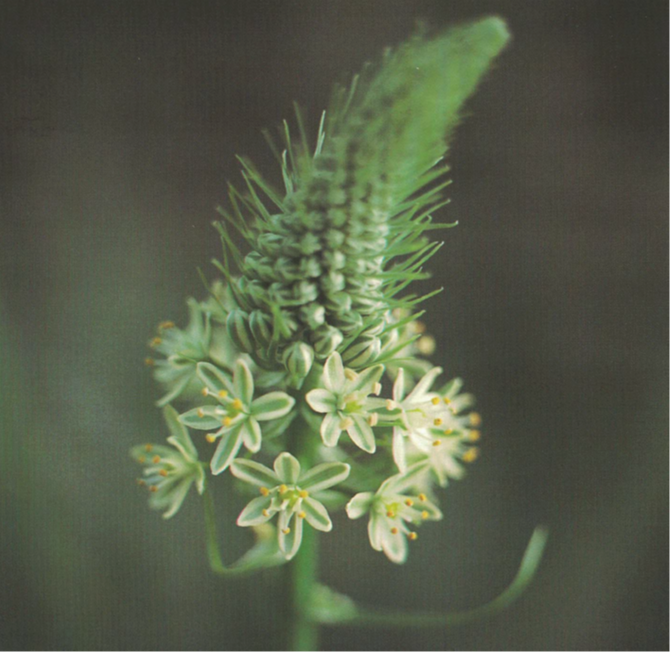
Chincherinchee
Ornithogalum thyroides
Light and Temperature
All species need full sun except in desert areas where light shade will do. The species that are winter Hardy can be left in the ground, but tender ones must be dug up and put in storage for the cold season.
Watering and Feeding
Water well in the growth season, a couple of times a week. Water potted plants thoroughly and pour off excess water. Feed plants and pots at every second or third watering, using a complete liquid fertilizer.
Transplanting, Propagating and Grooming
These plants prefer rich, well-drained soil. They need no transplanting in the garden, except when a new clump is desired. Simply dig up mature bulbs, break off a few large offsets and replant.
Remove withered foliage in the fall.
These plants are easy to increase through propagation. They grow small side bulbs, or offsets, during the year. Remove them and plant them in pots of their own or in another place in the garden.
Size, Growth and Flowering
Plants grow from 1-3 feet tall, depending on the species, with arching green leaves. Most grow, flower, and wither back to ground level over the course of a year, but indoor plants may remain evergreen.
The enchanting white flowers normally emerge in late spring or early summer. The scent is faint but pleasant. The flowers smell like ripe apples.
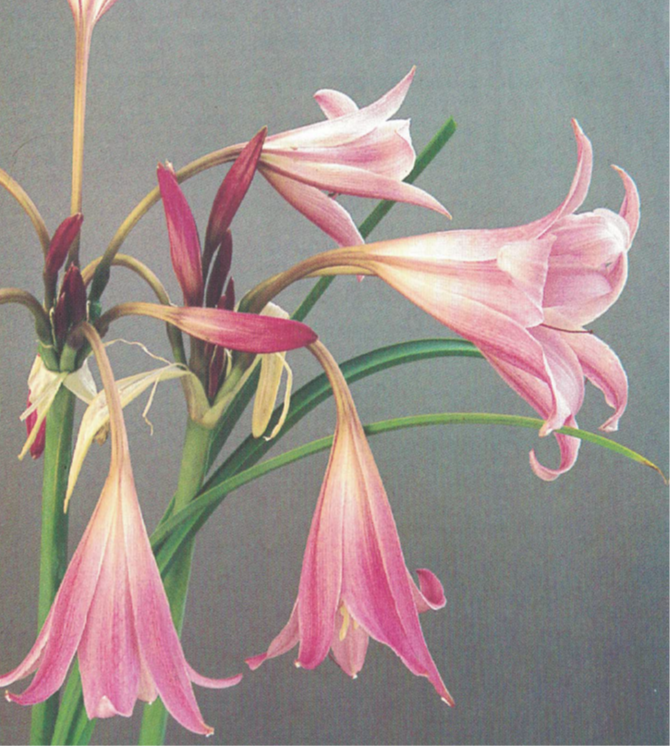
Crinum
Crinum moorei
Light and Temperature
Loves light and sunshine, but not burning sunlight.
Watering and Feeding
Plenty of water during the growth period, but let the soil dry out between waterings. Reduce the amount of water towards the end of summer when the plant should begin to enter its breast season. If the leaves stay green, then water them sparingly.
Transplanting, Propagating and Grooming
Ordinary potting soil in a large pot. Young plants should be repotted in the spring, but older plants do not need this every single year.
No grooming is necessary.
Propagate normally with side shoots.
Size, Growth and Flowering
Crane grows from a large bulb with an extremely long neck. The leaves are long, and curve over backwards, which means that this plant needs a lot of room.
Crinum blooms in the winter, spring, or summer with elegant, bell shaped, white, or pale pink flowers. Delightful scent.
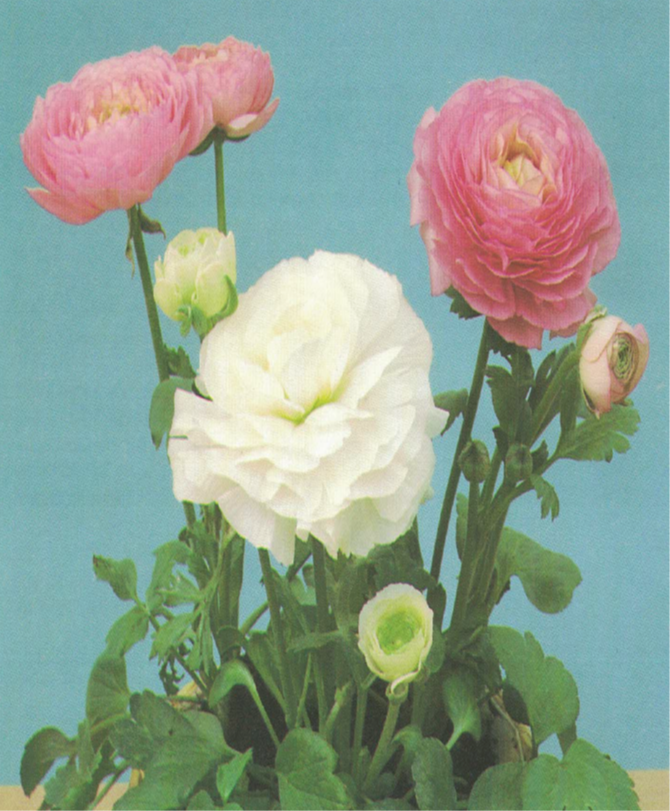
Garden Ranunculus
Ranunculus asiaticus
Light and Temperature
These plants love a combination of sun and shelter and a maximum summer temperature of 72°F. Plant indoors in a bright spot at spring temperatures of 50-60°F.
Watering and Feeding
Add liquid plant food to water once a week in the summer. Water regularly, never allowing the soil to dry out, except in the fall as the plant begins to die down, when watering should be stopped.
Transplanting, Propagating and Grooming
Good, ready mix soil is fine. Use new soil every spring when repotting for the new season.
No grooming is necessary.
Propagate by root division in the spring or fall.
Size, Growth and Flowering
These plants have a bushy growth and can reach a height of 16 inches.
The flowers are generally doubled and have only a faint fragrance. They could be white or a large variety of yellow or red shades.
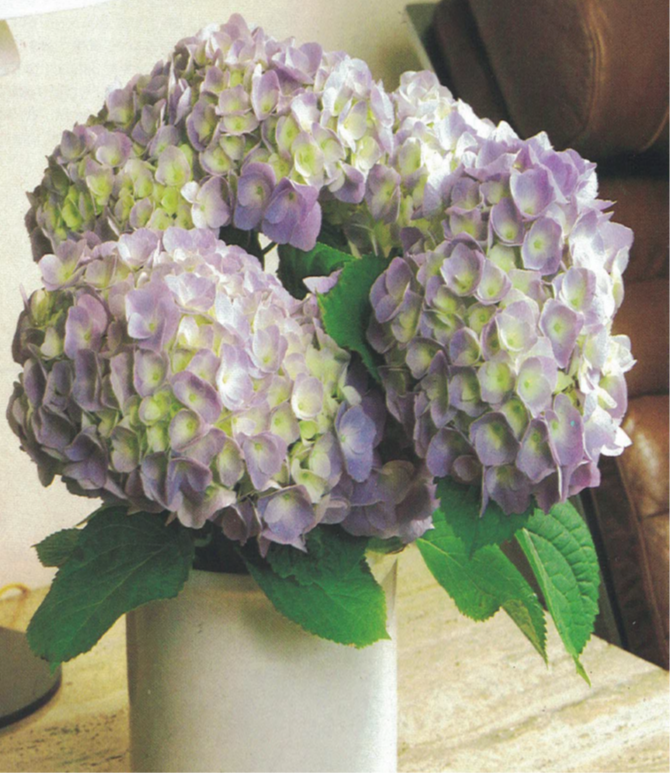
Hydrangea
Hydrangea macrophylla
Light and Temperature
Choose a cool, light spot, try in east or West facing window, or place on the patio in the shade of other taller plants. Give a winter rest around 40°F. The temperature should not be much over 68°F in the summer.
Watering and Feeding
Give only enough water to keep the plant from drying out in the fall and winter, but water daily after the first flower buds have appeared. Add 2 grams of sulfate of ammonia per quart of water until it has finished flowering. Water twice a day if it is very hot.
Transplanting, Propagating and Grooming
The hydrangea thrives best in a mixture of potting soil and sphagnum which should be well drained and with a pH of less than seven. Repot in January.
Cut back when repotting in January.
Propagate with vegetative cuttings in June and July.
Size, Growth and Flowering
Large leaves and big flower clusters. Fast growing.
Forced hydrangeas can bloom in April and stay in flower until September period overwintered plants won't bloom until summer. The scent is fresh, but not very strong.
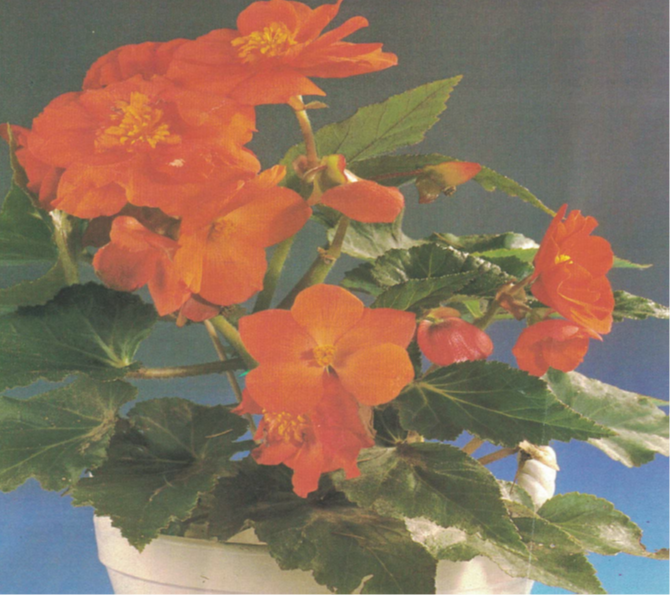
Tuberous Begonias
Begonia x tuberhybrida
Light and Temperature
Start the tubers at around 68-75°F. Do not plant them outdoors until the frost is gone. The plants will grow and bloom when the days are long and stop as the days shorten again.
Watering and Feeding
Regular watering is necessary to keep mildew at bay. Weekly feedings will encourage tuber growth.
Transplanting, Propagating and Grooming
Tuberous begonias have a weak root and need light, peaty soil.
The vegetative, flexible stems need no grooming, but taller plants may need a small stake for support.
Tuberous begonias can be increased from seed grown in a greenhouse, or from purchased tubers. Another method is to divide older ones before they are planted out for the new season.
Size, Growth and Flowering
Tuberous begonias have a rather soft growth and are 12-16 inches tall. There are both hanging and upright hybrids.
The flowers grow from the leaf axles during the warm days of summer. The colors range from white through yellow and orange to red. The blooms may be either double or single, occasionally with fringed petals.
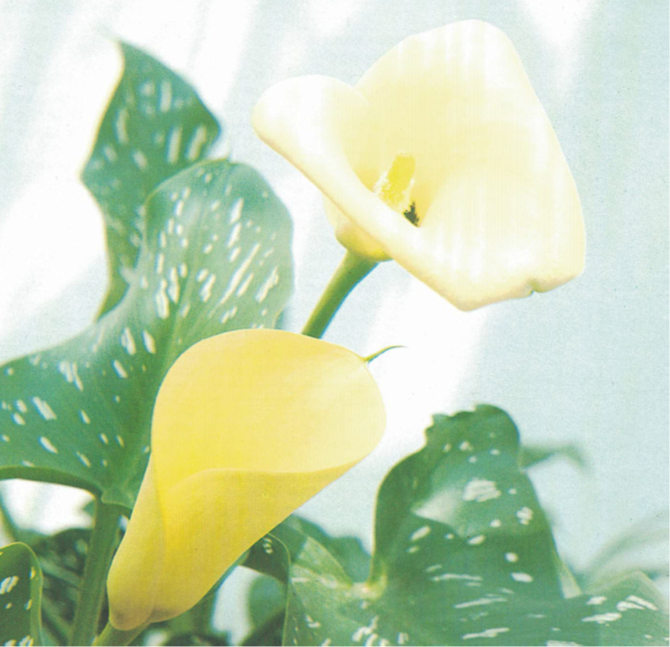
Yellow Calla Lily
Zanthedeschia ellottiana
Light and Temperature
During the growth season the yellow calla Lily needs full sunlight and a temperature of about 72-77°F. During the winter it should be kept at about 42 to 47°F, and in the spring the temperature should be raised to 60-65°F.
Watering and Feeding
During the growth period the yellow calla lilies should be regularly fed and watered often, preferably with lukewarm water. The tuber must be kept dry in the winter.
Transplanting, Propagating and Grooming
The potting soil should be nourishing and porous. A mixture of normal soil and peat should be fine. Take the tuber up after the plant has withered, remove any loose soil, and keep it in a crumbled peat for the winter.
The tuber cannot be divided remove only discolored or withered leaves and flowers with a sharp knife.
Propagate by sowing seeds in January but it is easier to take when the small side tubers when the plant has withered down in the fall.
Size, Growth and Flowering
The yellow color Lily has large leaves and extensive root network and must have a large pot it is normally about 20 inches high, but it can reach twice that height.
The Cowling can bloom from May to August depending on when it starts to grow. The flowers are long lasting. The spadex has a faint scent but the rest of the flower has none.
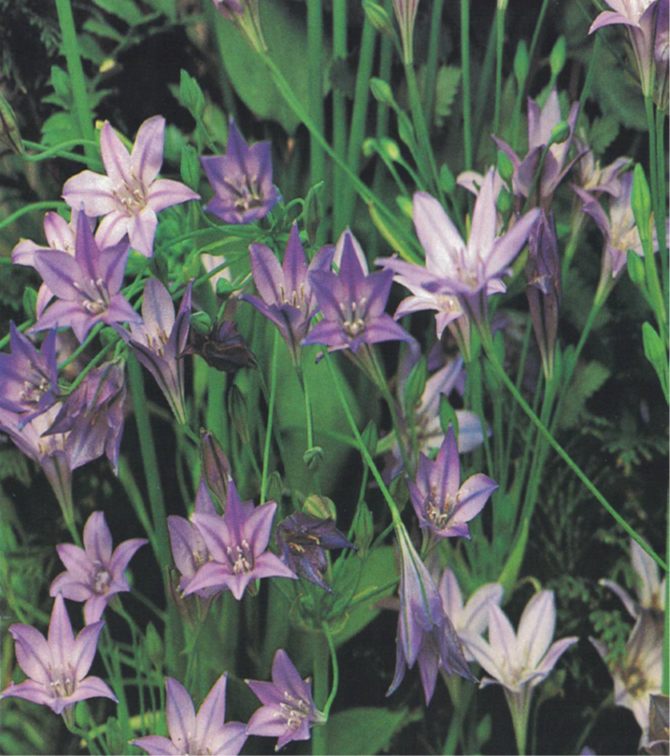
Grass Nut
Tritelia laxa (Brodiaea laxa)
Light and Temperature
Grass nuts need good light while they are growing and flowering. Insufficient light will result in pale leaves that break easily in a poor show of flowers. Keep cool temperatures during the growing and the dormant seasons.
Watering and Feeding
Water generously during the falls to spring growing Season. Keep dry during the rest of the season. Feed regularly every week during the growing season. Use a well diluted solution of liquid fertilizer.
Transplanting, Propagating and Grooming
Plant new corms during September in a well-drained potting soil. Repot during the summer after the flowers and leaves have died down.
Remove withered leaves and flowers as the plants go dormant.
Propagate by removing offset bulbs when repotting.
Size, Growth and Flowering
Cormous Plant with narrow leaves 8 to 15 inches or more. Dormant in summer.
Bluish purple flowers are long stalked umbles atop a 2 to 2 1/2-foot-tall stem. Blooms in spring no fragrance.
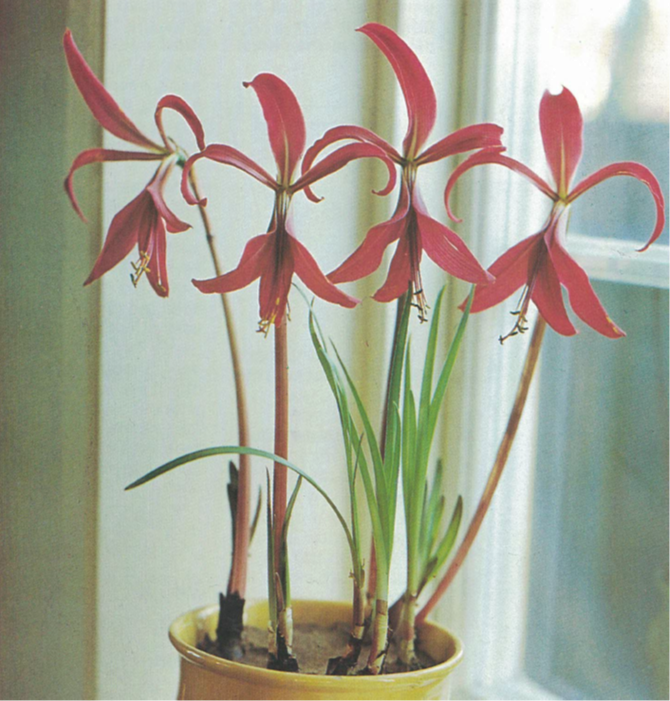
Aztec Lily
Sprekelia formosissima
Light and Temperature
During the rest season in February through March, the bulb should be kept at 45°F at around 60-65°F the rest of the year. When in flower and leaf the plant should be placed in a warm, sunny spot with plenty of light.
Watering and Feeding
The Aztec locally needs a great deal of water when in flour. Later, after it has produced three to four green leaves, it should be fed once every 14 days until August. Keep dry and withhold fertilizer during the rest season.
Transplanting, Propagating and Grooming
This plant needs a well-drained, rich potting soil. Plant the bulbs in March so that they are completely covered by the soil.
No grooming is necessary.
You can use seed if you have the time and the patience, but the most usual and easiest method is to take offset bulbs from the mother plant.
Size, Growth and Flowering
The Aztec Lily is a bull plant with 12- to 15-inch-long narrow leaves and a single decorative flower on the end of an upright 12-inch-long stalk.
The four-inch-long flowers resemble large, glowing red orchids. Outdoor plants will bloom in June while indoor plants will flower earlier. No particular fragrance
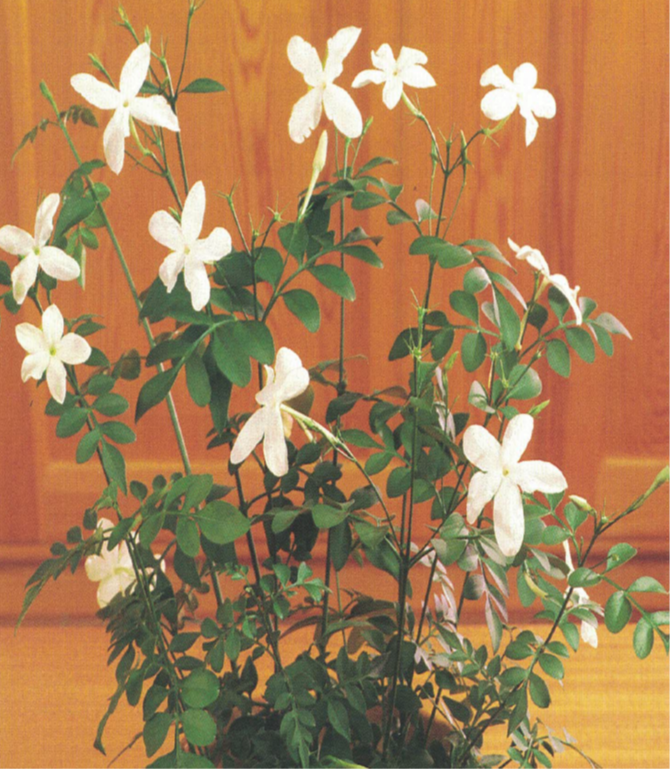
Spanish Jasmine
Jasminum grandiflorum
Light and Temperature
Spanish Jasmine can grow outside all year where winters are not severe. If grown as a pot plant, it needs a great deal of light and sunshine. It flourishes in normal room temperature all year long.
Watering and Feeding
Give the plant plenty of food and water through the summer but water less than the winter and do not feed.
Transplanting, Propagating and Grooming
Pot after flowering or in early spring. Use rich, fast draining potting soil.
The long stem should be cut back to the desired shape after flowering.
Use stem cuttings taken in the spring. Cover the pots with plastic for the first four to six weeks and keep them at 65-70°F until they strike root.
Size, Growth and Flowering
Spanish Jasmine is a rather bigger shrub with long, vining branches. The form affine has a more upright growth with arching branches.
The white flowers grow in upright clusters of three- 9 blooms. They have a strong but pleasant fragrance. In many countries they are used in the manufacture of Jasmine perfume. Outdoor plants will bloom July through August and indoor plants July through October.
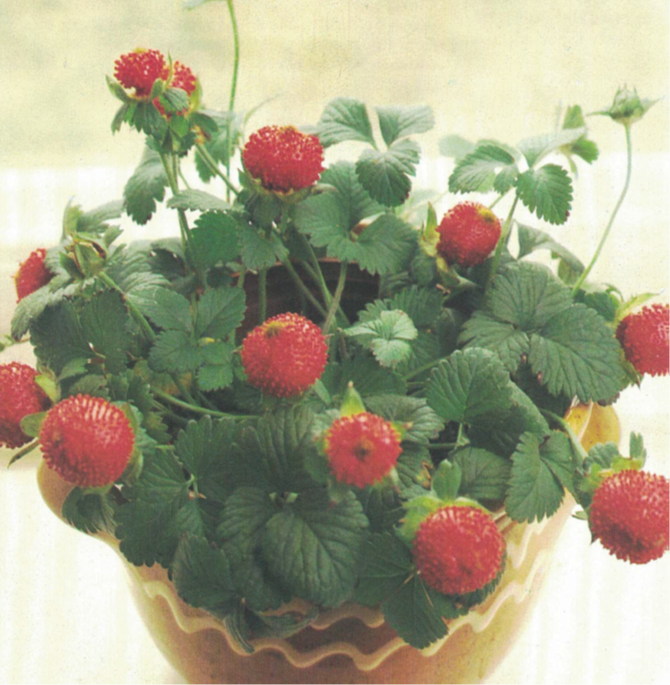
Indian Strawberry
Duchesnea indica
Light and Temperature
These plants prefer the half shade and will drive indoors or outdoors in all but the coldest climates.
Watering and Feeding
Never allow the plants to dry out while they are producing flowers and fruit. Feed with liquid plant food once a week.
Transplanting, Propagating and Grooming
Discard pot container grown plants in the spring using a rich soil mix. Discard old plants every few years and start new ones from runners.
Remove ugly and withered parts of the plant and old flowers and fruit. Pinch off overly long runners.
For propagating and use runners or seeds
Size, Growth and Flowering
Indian strawberry has a low, creeping growth and is both grown as a ground cover and a hanging plant. The plants are perennial and send out runners each year.
The pretty buttercup yellow flowers have a light, fresh scent. The false fruits which are really swollen ovaries, are extremely decorative. Flowers and fruit appear together through most of the summer the fruit is edible but has little taste.
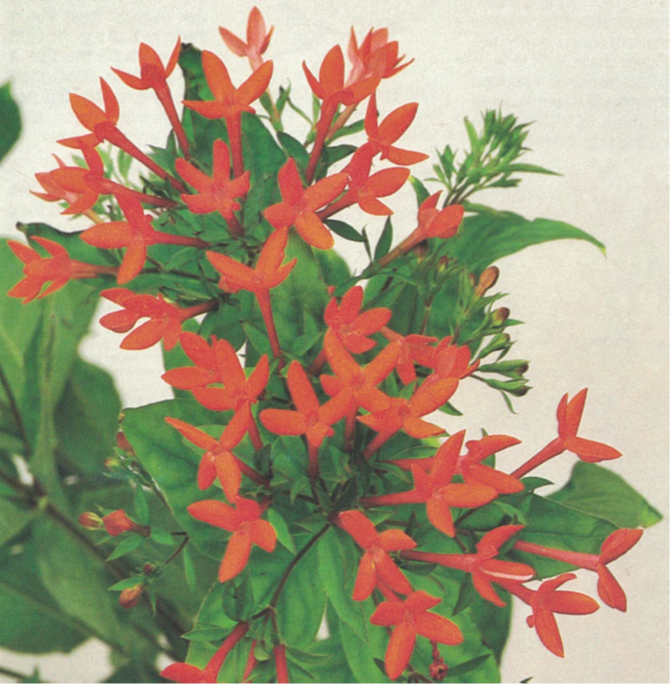
Bouvardia
Bouvardia x hybrida
Light and Temperature
A plant for the cool greenhouse, preferring temperatures around 55-60°F. It can tolerate even colder temperatures in the winter, but it cannot tolerate frost. Prefers full sun or light shade.
Watering and Feeding
Water regularly and do not let the soil dry out. Feed once a week during the summer growing season and continue feeding all through the flowering Season.
Transplanting, Propagating and Grooming
Report each year, trimming the roots if necessary. Use rich, well drained potting soil.
Cut back after flowering the young stems can be used for cuttings. Pinch back young plants once or twice in spring to promote bushiness.
To propagate, take root cuttings in February through march and stem cuttings in the spring.
Size, Growth and Flowering
This plant is a bushy plant which normally reaches a height of about two feet tall. It can be taller, up to four feet, if grown in a Conservatory or sun porch. Medium growth rate.
Blooms from September through December with clusters of long tubular white and yellow or red flowers some varieties have a sweet, Jasmine like fragrance.
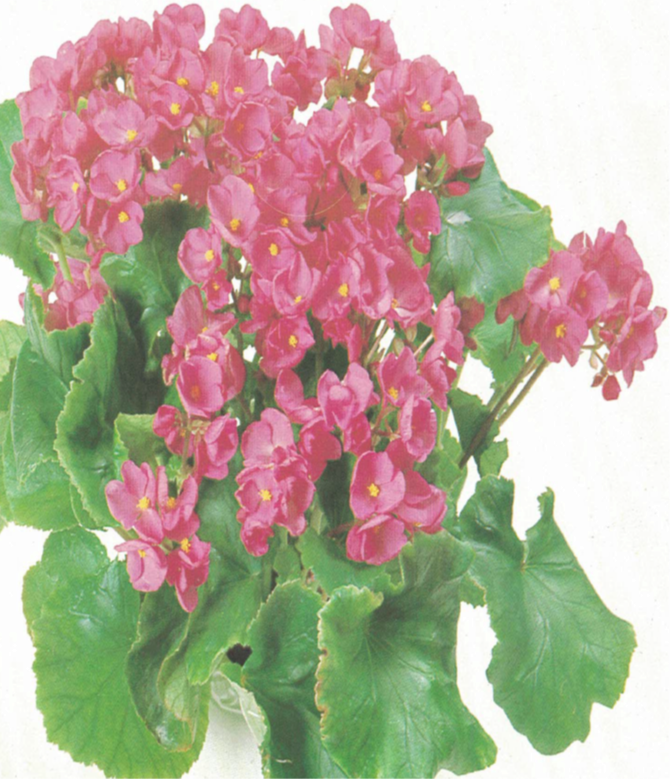
Christmas Begonia
Begonia x cheimantha
Light and Temperature
Always give it plenty of light but not direct sunshine, which can scorch the leaves. It should be kept cool, preferably 60-70°F during most of the year. Temperatures between 62-65°F during the winter assure an abundance of flowers.
Watering and Feeding
The plant actively grows in summer and not during the winter, even though winter is when it blooms.
Transplanting, Propagating and Grooming
Begonias are healthiest after blooming in well-drained, peaty soil. Transplant only during propagation or if overwintering an old plant.
Remove flowers as they fade. Remove dead leaves to prevent mildew. Pinch out tips of young plants to promote bushiness.
Propagate by leaf or tip cuttings.
Size, Growth and Flowering
Christmas begonias are usually 10 to 14 inches tall. Their growth depends on temperature, water and feeding.
A profusion of flowers is produced in wintertime when no other begonias bloom. The flowers are scentless.
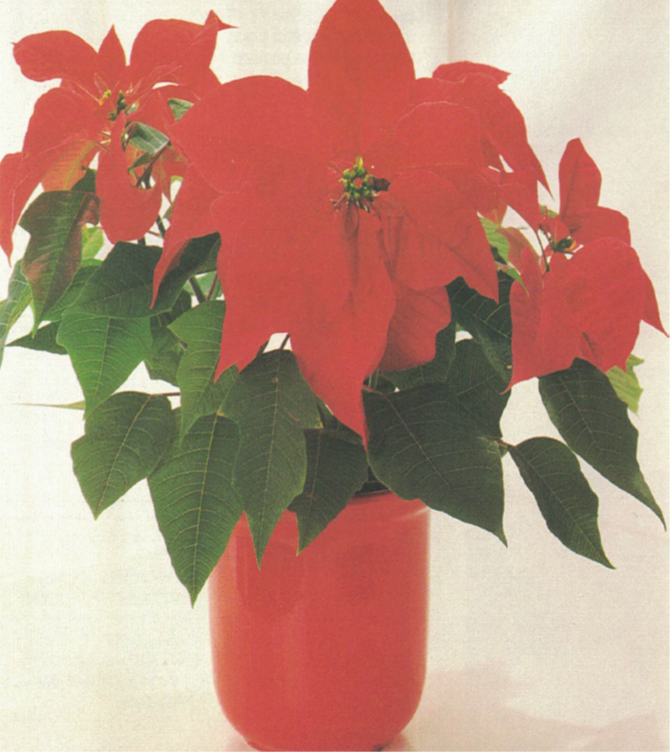
Poinsettia
Euphorbia pulcherrima
Light and Temperature
Normal light will result in the most attractive flowers. Regular indoor temperatures are fine, but the plant will last longer if the temperature can be held at around 60-65°F.
Watering and Feeding
Water regularly and thoroughly about once a week not a little every day. No feeding necessary.
Transplanting, Propagating and Grooming
Poinsettias thrive in a rich potting soil mixed with sphagnum. No potting on or transplanting if the plant will be discarded after one season. Otherwise, once every other year.
No grooming is necessary.
Propagate by cuttings.
Size, Growth and Flowering
After it has flowered, a poinsettia can be kept as a house plant, but many discard their plants as soon as the red leaves have dropped.
The true flowers are tiny and modest. They are yellow and high between the colorful leaves. They have no fragrance.
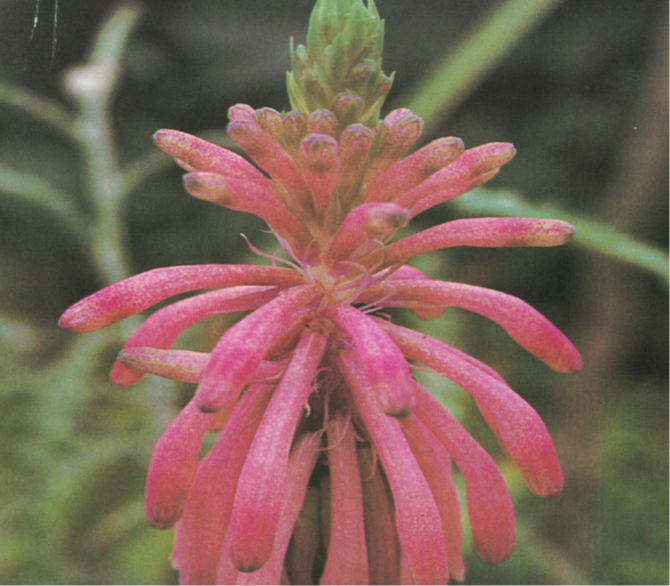
Valtheimia
Valtheimia bracteata syn. viridiflora
Light and Temperature
This plant needs a lot of light but not very much heat. Around 60°F is the ideal temperature for both flowering and growth period after flowering the bulb can be kept cool but frost free.
Watering and Feeding
Whole leaves and flowers are growing, water and feed regularly but do not allow the soil to remain waterlogged. Continue feeding your plant after it has flowered- it is still growing-but gradually cut down as spring progresses. Give no food or water from July until September when the plant rests.
Transplanting, Propagating and Grooming
Plant the bulb in regular potting soil with 1/3 added perlite or sand. After the rest Season repot the bulb with the tip at the surface of the soil.
Remove the foliage as it Withers during the resting phase.
Propagate with offset bulbs.
Size, Growth and Flowering
This plant is a bulb plant with an attractive rosette growth. The leaves are 12-15 inches long and one to four inches wide with wavy edges.
The 12- to 20- inch- tall flower stems shoot up from the center of the rosette and bear 1-2-inch-long trumpet shaped flowers. The lowest flowers hang downwards, the metal flower stands straight out, and the top flowers point upwards. The flowers are typically pink with yellowish tips, but they can also be white with red or violet markings, depending on the variety. The scent is sweetish and is strongest in the paler flowers.
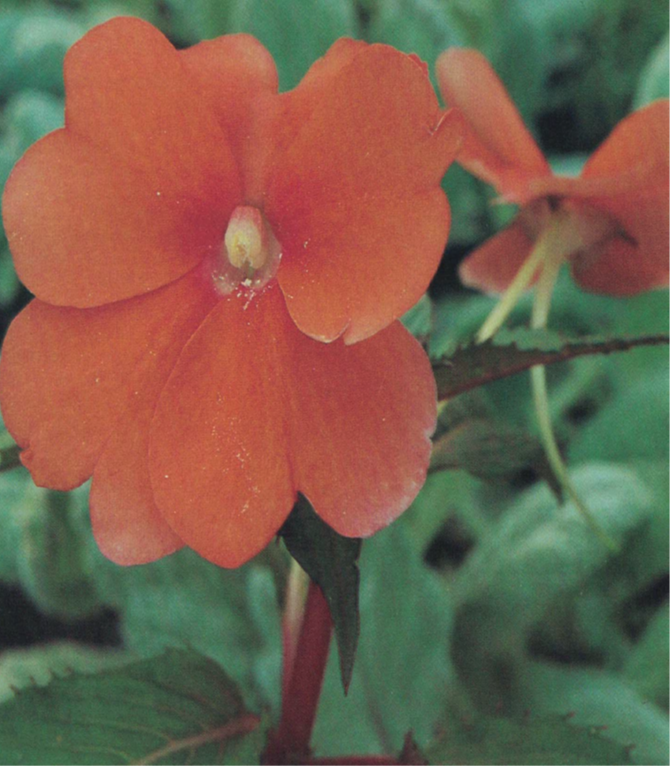
Congo Cockatoo
Impatien niamniamensis
Light and Temperature
Bright light, but no direct sun unless humidity is fairly high. Shade two-part shade outdoors. Ideal temperatures are 70 to 75°F during the day and about 10°F cooler at night. Plants may be wintered over at 50-55°F. These plants are tendered frost.
Watering and Feeding
Regular watering and feeding in the summer but reduce watering and don't feed in the winter if temperatures are cool.
Transplanting, Propagating and Grooming
Light, fast draining soil is best. Repot once a year in the spring. Plants don't mind being pot bound, if they are well watered.
Pinch and prune lightly to maintain a pleasant, bushy appearance. Cut back hard as growth picks up in the spring and use the cuttings to start new plants.
Propagate easily from cuttings.
Size, Growth and Flowering
Congo cockatoo has a thick, succulent, upright stem about 18 inches tall and grows rapidly several plants planted together make the best display in a six inch or 9-inch pot.
Show me clusters of exotic looking cornucopia shaped flowers are bright yellow and orange red in one variety and all red in another. Flowers are produced continuously in warm temperatures. No fragrance.
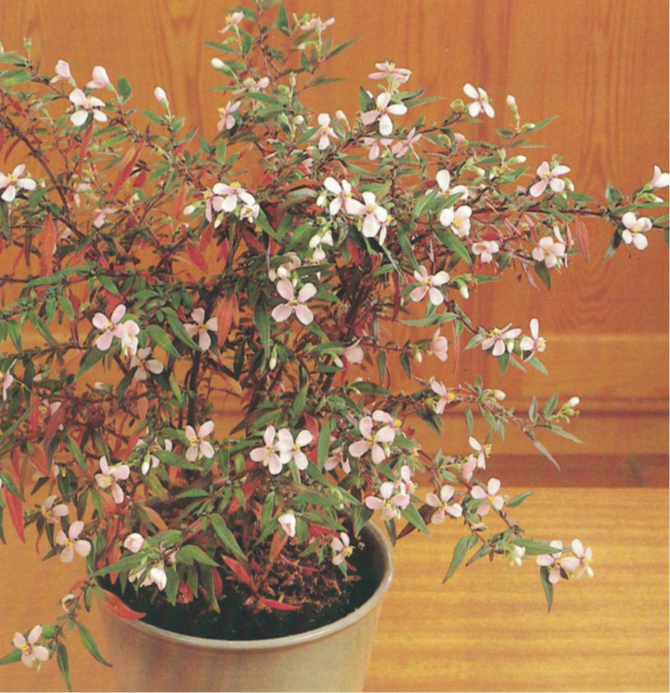
Centradenia
Centradenia inaequilateralis
Light and Temperature
This plant needs bright and warm conditions throughout the year. It will not thrive in direct sunlight. It has no particular rest period but slows down growth a little to gather strength in the early summer before starting to bloom in fall and winter.
Watering and Feeding
Keep the soil moist. It must never be allowed to dry out, but on the other hand, must never be soaking wet. The plant dislikes hard water so if you live in such an area use purified water only. Feed during the spring and summer months with half strength liquid fertilizer.
Transplanting, Propagating and Grooming
Use a potting mix rich in peat Moss, making sure it drains well. Free pot in spring when the flowering is over.
Grooming is rarely necessary. If you wish to renew an older, less attractive plant, you can cut the plant back and spring after it has flowered.
Propagate by renewing older plants with tip cuttings.
Size, Growth and Flowering
This plant will not reach a height of more than 6-12 inches with either an upright or cascading, hanging Grove habit depending on the variety. The narrow, dark green leaves are covered with fine hair on the surface and have purple undersides.
The star shaped flowers are pink with yellow stamens. Each individual flower will last for only a couple of days, but new ones appear all the time. No particular fragrance.
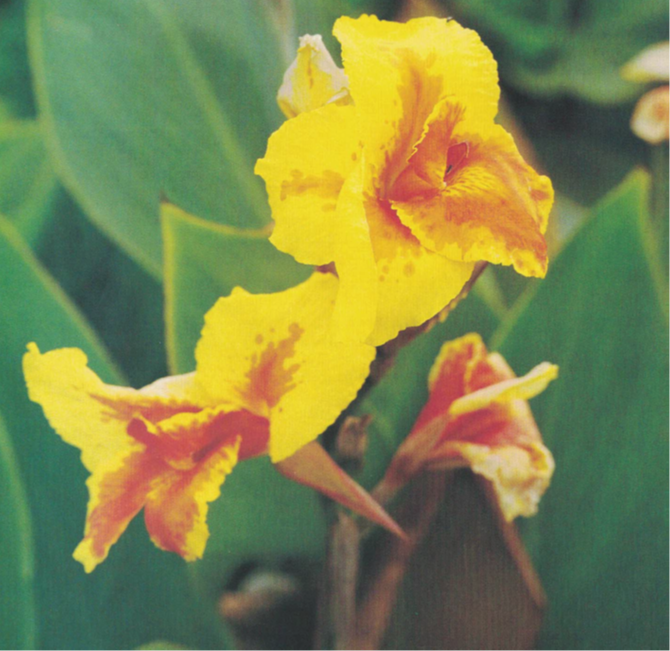
Canna
Canna x generalis
Light and Temperature
These plants grow best outdoors and are happiest in full sun, in the lee of the wind, at about 60-70°F. Dwarf varieties growing indoors should be placed near a sunny window.
Watering and Feeding
Once the plant is growing well in the spring, water well and feed once a week. No watering in the winter when tubers are lifted and stored in a dry area.
Transplanting, Propagating and Grooming
Plant in fresh soil every spring over wintering. Ideal soil mix is equal parts hummus, compost, and coarse sand. Regular potting soils are also fine if it has plenty of organic matter.
Remove yellow leaves and flower stocks after all the flowers have faded.
Divide tubers or so seeds in February through March for propagating.
Size, Growth and Flowering
Normally a tall, upright growing plant. Most hybrids grow 5-6 feet tall but there are also dwarf varieties only growing to 2 1/2- 3 feet tall. Fast growing plant.
This plant normally blooms in summer, or even all year in warm climates. The flowers come in a wide range of colors, most often yellow, orange, red, and sometimes bicolored. No scent.
Camellia
Camellia japonica cvs.
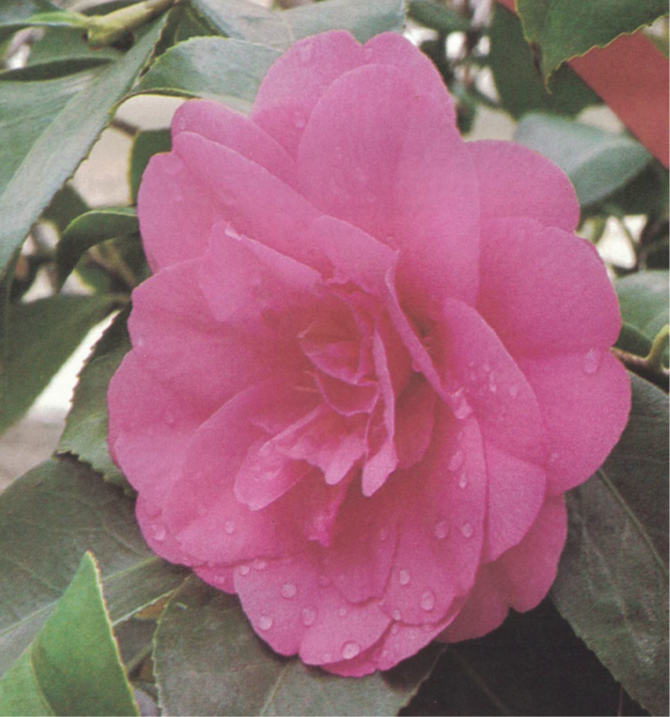
Light and Temperature
This plant demands a place that is bright but out of the hot, direct sun. Temperatures should be on the cool side, especially in winter when they should be in the upper 40s or 50s.
Watering and Feeding
Quarter to millions throughout the year but never let them dry out during the growth period, when flower buds are forming, fertilize frequently with a weak solution mixed with the water.
Transplanting, Propagating and Grooming
The best soils for camellias are woody and nature containing lots of peat Moss or compost or leaf mold. Camellias rarely need repotting, certainly not more than every three to five years.
Errant branches can be pruned at flowering time, and put in a vase, where they will last about 8 days. The plant is naturally bushy but a little Twiggy as well.
Size, Growth and Flowering
Depending on the variety, camellias can grow from four to seven feet tall. All are bushy plants.
Flowers come in a great variety of colors and forms, though most are white or some shade of pink or red. Most have a slight fragrance.
Kohleria
Kohleria amabilis hybrids
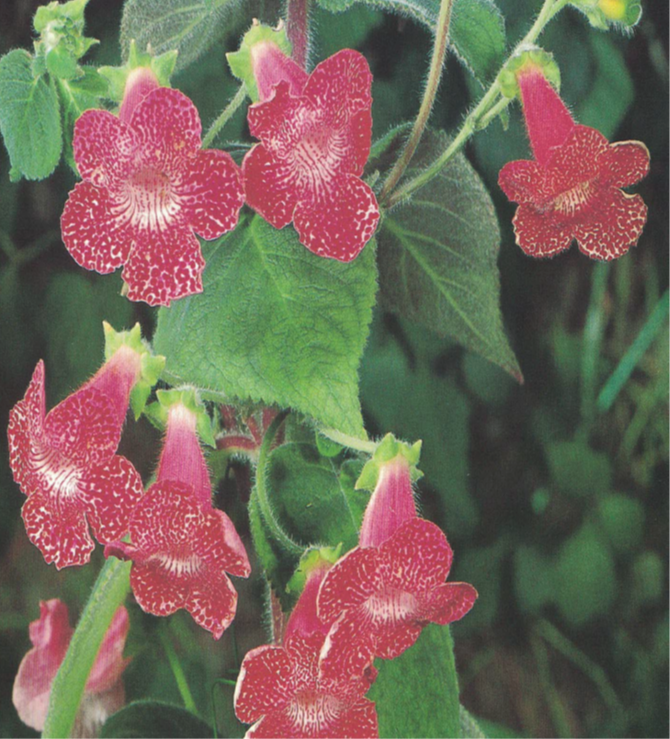
Light and Temperature
This plant requires this spot with high humidity and a lot of warmth, in summer at least 70°F and in the winter at least 60°F is enough. The location should be slightly shady.
Watering and Feeding
In spring and summer, the soil should be kept moist, but not wet. In the winter months water only sparingly. During the growing season feed about every two weeks with liquid fertilizer.
Transplanting, Propagating and Grooming
Every spring the rhizomes should be repotted in fresh potting soil. African Violet mix is a good choice.
This plant does not need trimming. Remove the withered foliage and fall.
This plant can be propagated by seed, tip cuttings, or division of the rhizomes.
Size, Growth and Flowering
This plant can grow up to 20 inches tall. Leaves and stems are densely hairy and often spotted. Leaves vary from Oval to elongated depending on the species.
The orange to red colored flowers are always tubular and spotted on the inside. Each flower grows on a short stem. Blooming time is Midsummer. No particular fragrance.
Chenille Plant
Acalypha hispida
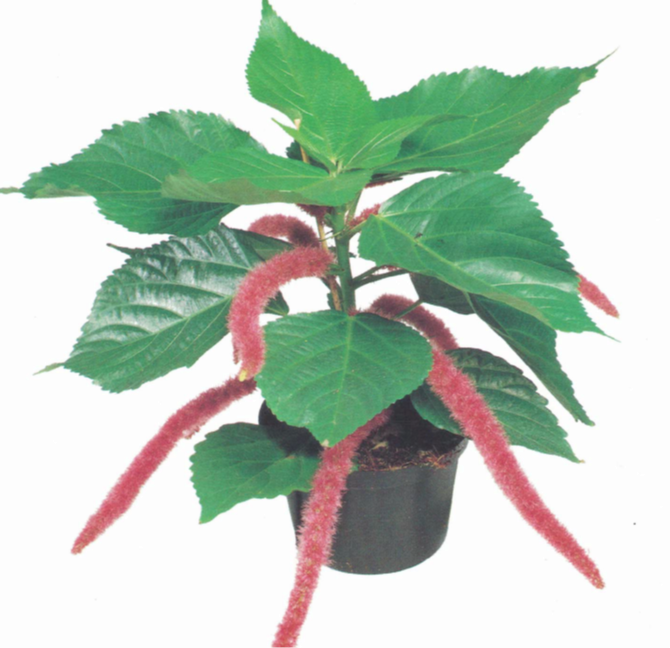
Light and Temperature
This plant likes sunny surroundings but give them some shade during the midday sun. The temperature must not drop below 59°F in the winter, while 70°F or higher is ideal for summer. Direct heat from radiators dries the plant and encourages spider mites.
Watering and Feeding
Always give the pot a good soaking, but don't let water stand. The plant grows best if kept evenly moist. That means lots of water during the summer, but less in the winter. Humidity should be kept high by misting regularly. Feed your plant half strength liquid fertilizer every two weeks throughout the growing season. Don't feed in the winter.
Transplanting, Propagating and Grooming
Cuttings do best and a mixture of peat and sand. Transplant to a good potting soil when they have developed a good root system. Plants need repotting and heavy pruning every year in March or April.
When repotting, also prune and save the cuttings for propagation.
Size, Growth and Flowering
Normal size for an indoor plant is 2-4 feet, but in its natural habitat can grow up to 10 feet high. Provide a stake to support the plant if necessary.
If the plant is growing well, it will develop many flowers over spring and summer. Each tassel consists of many tiny flowers which grow together and an 8-12 inch long hanging tassel. When a tassel has finished flowering, cut it off so that it doesn't go to seed. No fragrance.
Kaffir Lily/Clivia
Clivia miniata
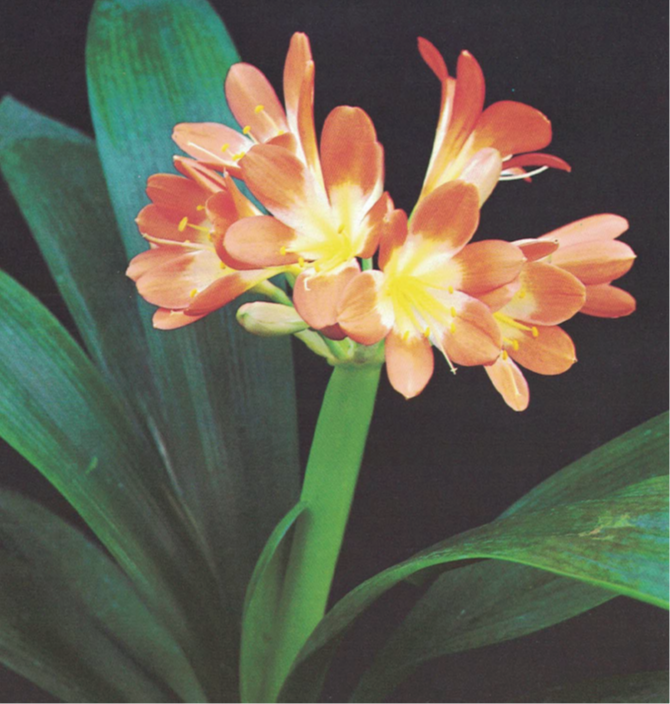
Light and Temperature
This plant doesn't need much light and thrives in bright shade. In summer, the temperature should be around 65-68°F, well winter temperatures should be down to 52-57°F.
Watering and Feeding
Water and temperature go together, as far as this family of plant is concerned. During the growing period, water almost every day, but in winter very sparing. Feed every two or three weeks in the growing season.
Transplanting, Propagating and Grooming
This plant likes rich, well-drained soil and can be left undisturbed for years period when transplanting, moved to a pot only slightly larger.
Only remove old yellowing leaves. In spring, scratch away the top few inches of soil and top dress with fresh soil.
New shoots often appear at the base of leaves after flowering is over. Cut them off carefully and plant them for propagating.
Size, Growth and Flowering
This plant can grow 1 1/2- 2 feet tall.
This plant blooms every year from April to June period only healthy plants from dense orangey- red flower clusters.
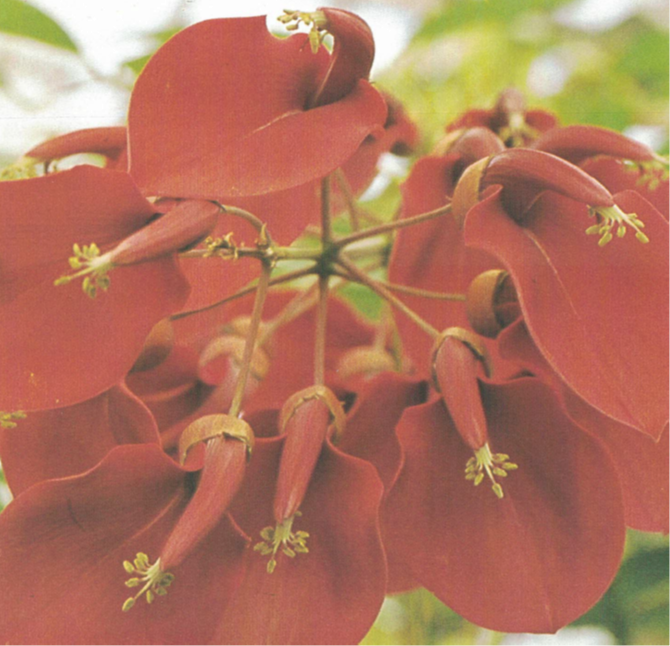
Coral Bush
Erythrina crista-galli
Light and Temperature
Full sunlight is needed for the best results. The roots can be stored frost free through the winter the same way as dahlia tubers. Start growth in spring by moving the roots into the light at 50-60°F.
Watering and Feeding
Container grown plants should be kept dry during the winter dormancy. Resume regular watering in the spring and fertilize lightly but regularly.
Transplanting, Propagating and Grooming
Coral Bush needs a rich porous soil with good drainage. Use commercial potting soil mixed with coarse sand. Repot the roots and new, fresh soil each spring before growth gets underway.
Cut coral Bush back at the end of the summer. The space is a problem, then plants out in spring by cutting newly emerging shoots back to the base. Old plants are improved by the occasional thinning out.
Propagate by division, stem cuttings, or seeds.
Size, Growth and Flowering
Coral Bush has an extremely vigorous growth. In one season it will reach a height of about five feet and will produce 3 to 8 stems.
The flowers appear on the end of the mature stems after 2 to 2 1/2 months of growth. They are coral- red and quite distinctive. The seed pods which follow are twisted around the seeds. Only a light scent
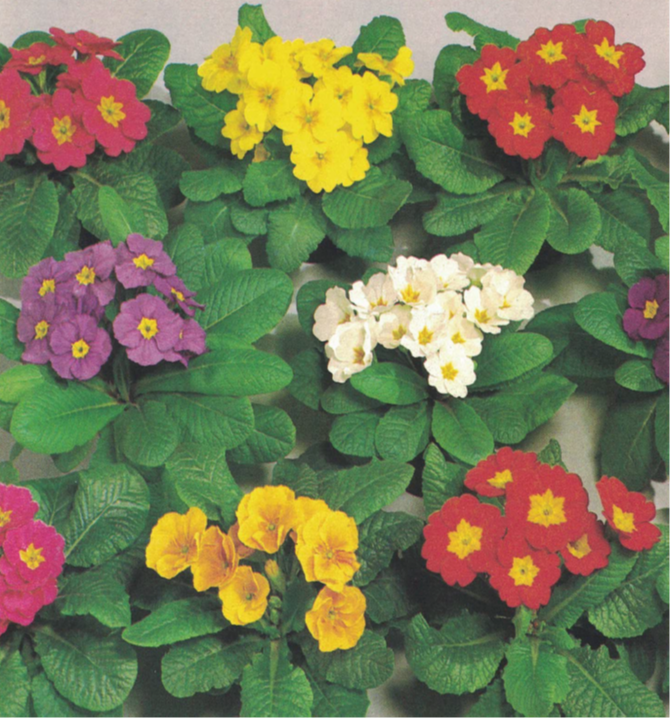
Primrose
Primula vulgaris 'Grandiflora'
Light and Temperature
All indoor primroses are forced early period to maintain blooming for as long as possible, therefore, they must stand in a sunny, but not too warm room or window facing South or West preferably around 60- 64°F.
Watering and Feeding
The most attractive growth is the result of careful watering and feeding. Moisture is a prerequisite for luxuriant primroses. Water thoroughly once or twice a week and add a little plant food every two weeks or so.
Transplanting, Propagating and Grooming
From its origins in the wild, the primrose is used to lean soil, and it grows most attractively even if sometimes neglected. The soil should consist of a light sand corporate soil blend. Potting every year after blooming
When flowering ceases, cut off flower stems and seed capsules.
After flowering, the plant can be divided into several smaller specimens for propagation. Or pollinate the flowers and sow the seeds.
Size, Growth and Flowering
All primroses are small plants. Throughout the flowering season, the leaves hardly grow at all, but soon afterwards, healthy growth will be noticeable. At this stage the plants can be planted outdoors, this will improve the blooms to come.
The primrose’s rich color doesn't merely look like spring, its fragrance resembles spring too.
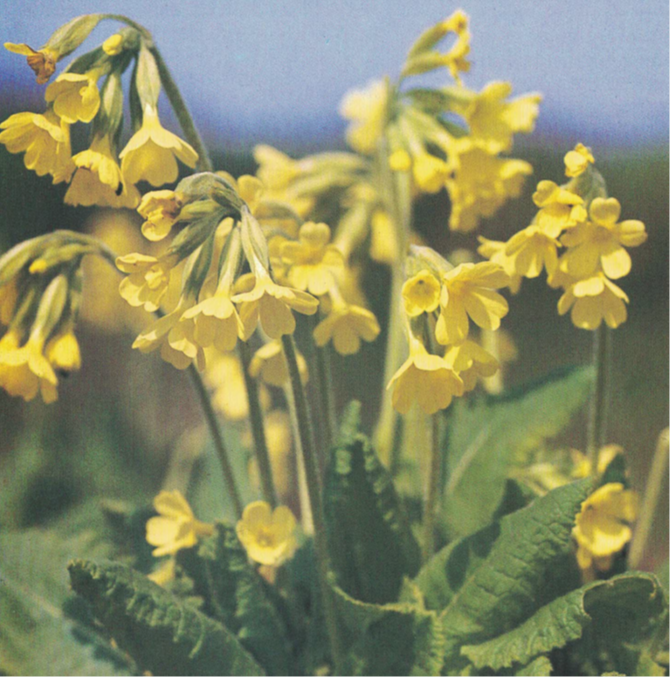
Primrose
Primula veris
Light and Temperature
The plant should be in a bright, cool place. This will make the flowers last longer period the temperatures can be between 60 and 65°F.
Watering and Feeding
Keep the soil moist but never wet. Start feeding only after flowering is over.
Transplanting, Propagating and Grooming
You can transplant immediately after flowering into a mixture of equal parts hummus, peat and sand, or regular potting soil.
Unless you are planning to propagate from seed you should remove faded blooms immediately after they have finished flowering.
You can propagate by division or from seed.
Size, Growth and Flowering
Primroses are perennials with tongue shaped green leaves and flower stalks from 8 to 10 inches tall.
This variety has a lovely scent, unlike most other primroses. Its yellow flowers appear in May and June.
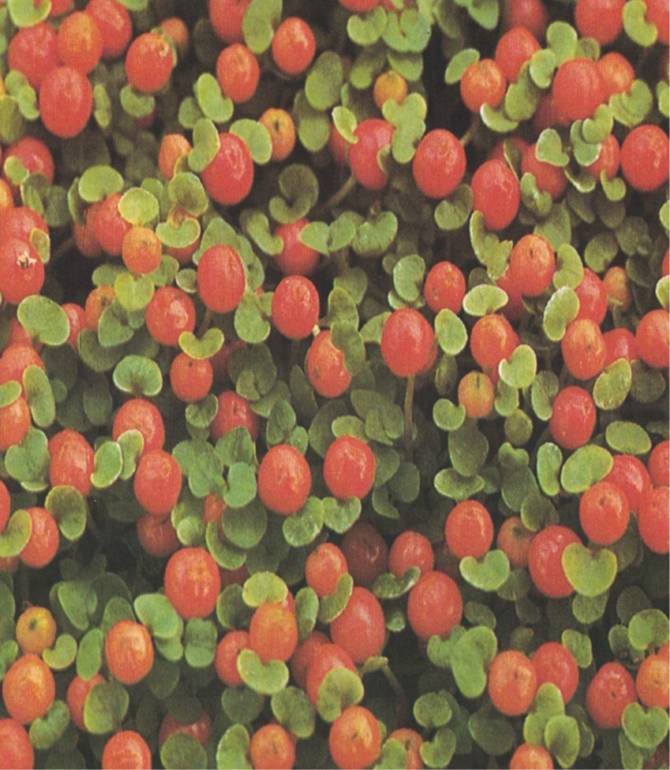
Bead Plant
Nertera granadensis
Light and Temperature
These plants need light but not direct sunlight. An east or north facing window is ideal location temperatures should not rise over about 60°F during the summer, nor dip below 50°F in the winter.
Watering and Feeding
Soil should be kept moist but never wet period water from the base; water droplets on the plant after flowering may inhibit fruit development. Feed twice a month during the growth period with water soluble fertilizer
Transplanting, Propagating and Grooming
Repot after dividing plants in August. Use moist porous soil or make a mix from 1/2 peat Moss and 1/2 commercial potting soil.
No grooming is necessary.
Propagate by growing from seed or dividing the mother plant.
Size, Growth and Flowering
The bead plant is a low, cushion-like perennial with fine, pale green leaves. It is rarely more than 4-6 inches tall. It is grown for its red berries.
Unobtrusive, quarter inch greenish white flowers in May through June with no particular scent. Orange- red berries will last for several months if the plant is kept cool.
Scarlet Plume
Euphorbia fulgens
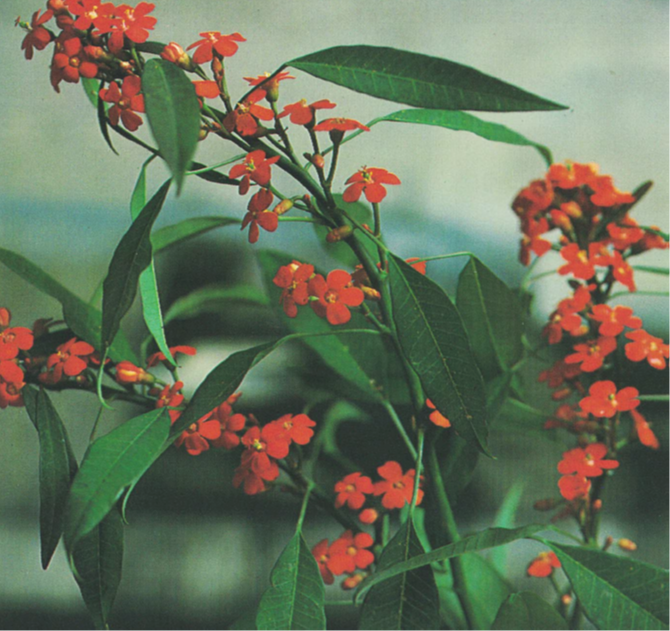
Light and Temperature
The best temperature is around 70°F at any time of the year. Scarlet plumes can take a lot of light but need protection from strong rays of the sun during spring and summer.
Watering and Feeding
Scarlet plumes cannot tolerate under or overwatering. The soil should always be moist but never wet period feed only when the plant is in bud, and in the spring and summer when the flowers have died.
Transplanting, Propagating and Grooming
The soil should be well drained, porous, and peaty. Repot after flowering.
The longest stems should be cut back after flowering and the tips can be used for cuttings.
Size, Growth and Flowering
Scarlet plume has a long, arching stem with dark green long stemmed elongated leaves. It is seldom more than about 20 inches tall in cultivation, but in the wild it can reach a height of around 7 feet tall.
It can bloom at any time of the year given short day treatment, at least three to four weeks with 13 to 14 hours of darkness every day. It will bloom naturally in midwinter. No fragrance.
Jerusalem Cherry
Solanum pseudocapsicum
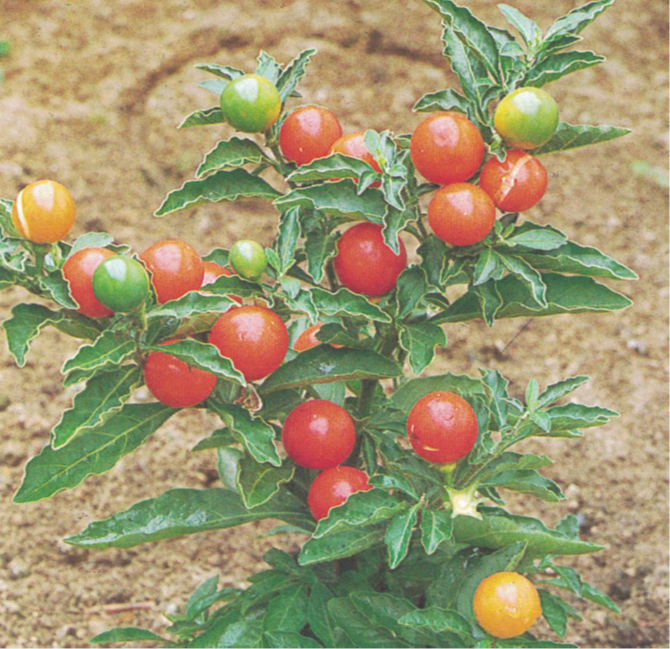
Light and Temperature
Although the Jerusalem cherry can take direct sunlight, it prefers the temperature of around 70°F. During the winter it can only survive temperatures down to 50-54°F.
Watering and Feeding
Water well during the growth period but reduce watering during May and June to encourage the formation of flower buds. Never let the soil dry out. Feed from May through June.
Transplanting, Propagating and Grooming
Overwinter plants should be repotted in April in standard potting soil.
When repotting in April, pinch out growth tips to promote bushiness.
Sow seeds in February through March.
Size, Growth and Flowering
The Jerusalem cherry is a small, bushy plant which can grow one to two feet tall.
The plant produces small, white, unscented “tomato” flowers during June through July and decorative red or orange berries in September through October.
Cape Cowslip
Lachenalia aloides
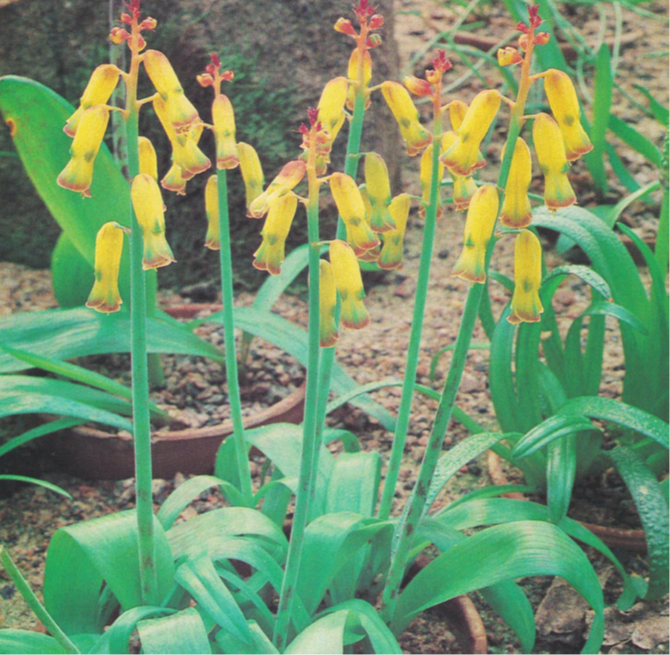
Light and Temperature
Cannot tolerate being forced before the days are bright enough. The bulbs like high summer temperatures until they are planted again in the fall. 50-55°F is best for the winter. Bright light gives the best results during the growing season.
Watering and Feeding
After the bulbs have been planted, they should be watered only when the soil is dry, but once the leaves develop, water should be increased once a week. Later, when the flowers appear, watering should be stepped up even more. Reduce watering once flowering is over and allow the leaves to wither, after which watering should be stopped. Add special bulb fertilizer when planting.
Transplanting, Propagating and Grooming
No grooming is necessary, although the bulbs can be tidied up before planting.
The small offsets can be separated and should be placed in 5–6-inch pots with plenty of room for growth. After cool brooding. They can be brought into light and warmth from March onwards and fed and watered until growth ceases. New bulbs will normally flower after two seasons.
Size, Growth and Flowering
This plant has spotted, 4-inch-long leaves which hang over the edge of the pot. The flower stems are 6-8 inches tall. No leaves from July through November.
The flower stems grow from the center of the plants and have 15-20 pendulous, tubular flowers. No scent.
Kangaroo Thorn
Acacia armata/ A. paradoxa
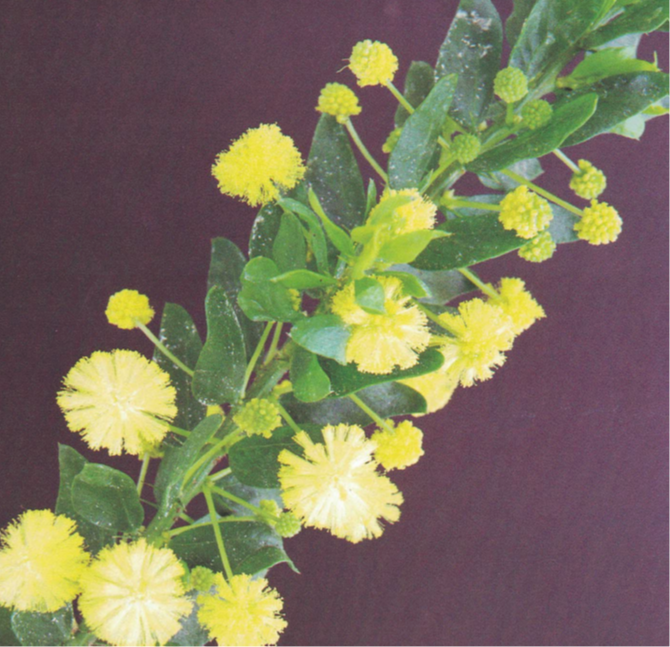
Light and Temperature
Full sunlight is best, it prefers to be outside in the summer and can take quite low temperatures in the winter. It can also be grown permanently indoors or in a winter garden or sun porch. Indoors it prefers a winter night temperature of 40-50°F and 10 degrees higher in the daytime.
Watering and Feeding
Water well in the summer and feed once a month; less water and no feeding in the winter.
Transplanting, Propagating and Grooming
Pot each year after flowering and once growth has started again. Use well drained sandy soil.
After flowering shear back the previous seasons growth by about 1/2. This will keep the plant bushy and help promote new growth.
Propagate with semi hard cuttings in late summer or early fall. Seeds are also easy. Soak them overnight in hot water and plant in sandy soil they usually germinate within a week.
Size, Growth and Flowering
The kangaroo thorn is a large, broad shrub and can reach a height of 10-15 feet in the wild. In cultivation it grows slowly to a height of 6-10 feet.
The golden- yellow flowers are in round clusters at the axles of the phyllodes. They have a very faint scent. The plant blooms from March through April.
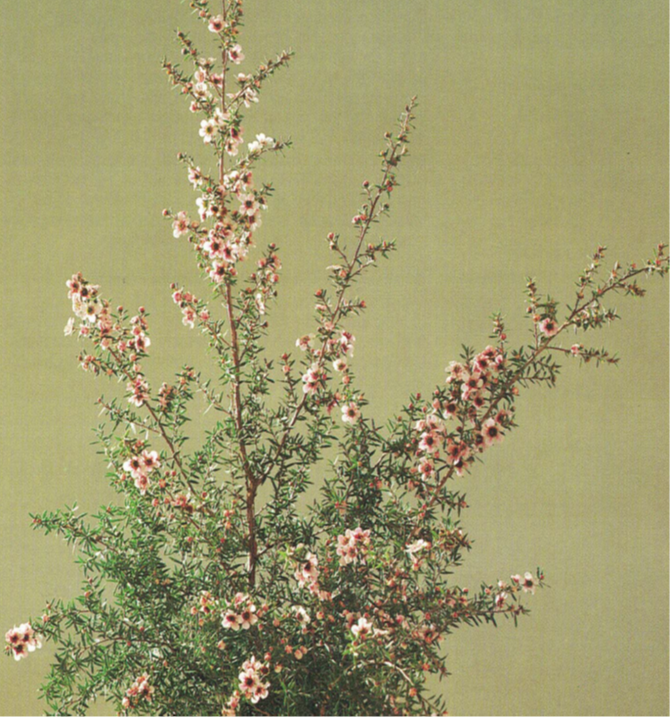
New Zealand Tea Tree
Leptospermum scoparium
Light and Temperature
This plant prefers to grow in the sun, preferably outdoors in the summer. The temperature should not be lower than 40-45°F.
Watering and Feeding
Water evenly throughout the year. Water every other week with liquid fertilizer during the flowering season and through the summer.
Transplanting, Propagating and Grooming
This plant likes well drained soil slightly on the acid side. Add a little extra peat and sand to regular potting soil. Pot each spring.
Trim to shape after flowering.
Use either seeds or cuttings to propagate.
Size, Growth and Flowering
Dense, bushy growth to a height of about 3 feet. Medium growth rate.
Blooms from January through May. The flowers are shades of pink, red, or white. They have almost no fragrance.
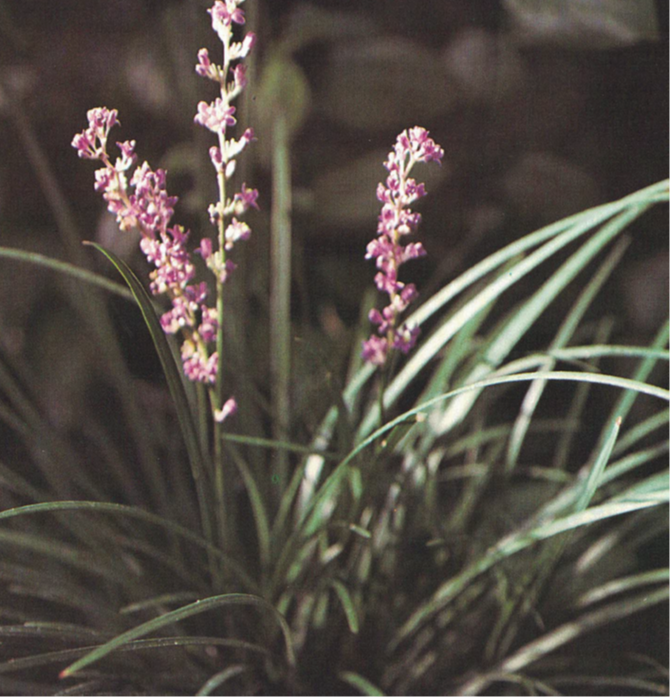
Lily Turf
Liriope muscari
Light and Temperature
Lily turf can tolerate part sun to full shade, but dislike sustained freezing. It prefers temperatures of 68-75°F in the summer and 45-50°F in the winter.
Watering and Feeding
Give plenty of water in the summer with added liquid plant food. Water sparingly in winter and do not feed. This plant cannot tolerate misting.
Transplanting, Propagating and Grooming
The soil should be light and porous, preferably with a little added peat. Repot in fresh soil in spring.
Remove the flower stems immediately after the flowers die; Remove any withered leaves.
Lily's turf can be divided in spring. You can also try selling the black berries.
Size, Growth and Flowering
The 12-16-inch-long leaves are fountain shaped. The flower stems can be up to 20 inches long.
Lily turf blooms towards the end of summer, but it is mostly grown for the sake of its leaves. The sweet, scented flowers are clustered around a central spike.
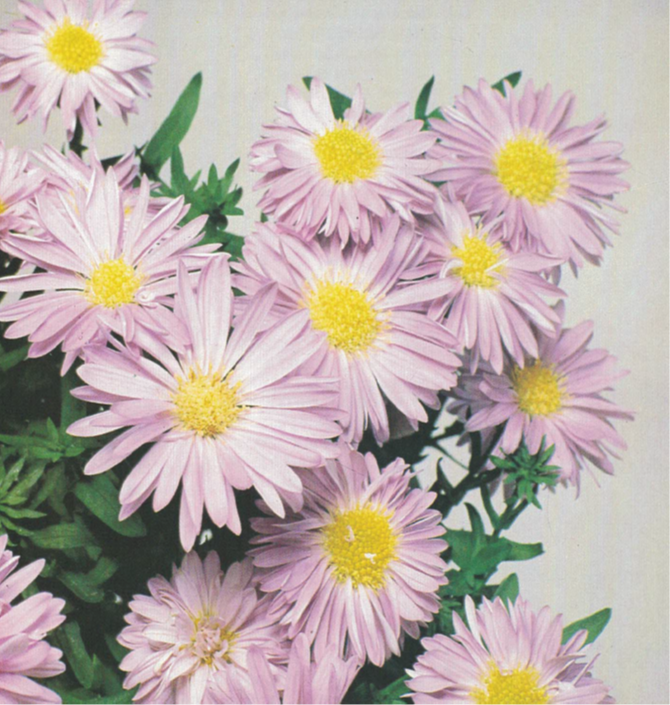
Michaelmas Daisy
Aster novi-belgii
Light and Temperature
Thrives in normal outdoor conditions where it is Hardy and prefers full sun. As a house plant it grows best with plenty of light around 60-70°F.
Watering and Feeding
Water regularly and never lets the plant dry out, especially when in bloom. Keep water off the foliage. Add a weak fertilizer solution to the water each time.
Transplanting, Propagating and Grooming
Good garden soil is fine if the soil is too hard, and clayey, add some sand. These plants do well when planted outdoors in the garden after flowering indoors in a pot.
Remove flowers as soon as they fade. Encourage bushier growth by pinching out during the summer. Cut stems back after flowering.
Propagate by division in spring or fall.
Size, Growth and Flowering
Anywhere between 1-4 feet, depending on whether the plants have been treated with growth retardants. The effect of this hormone treatment gradually disappears, and the plants will eventually become taller. These plants have a bushy growth. Fast growing.
The flowering season is from September to November. The colors vary between blue, Violet, pink, red, and white. The centers are yellow. No scent
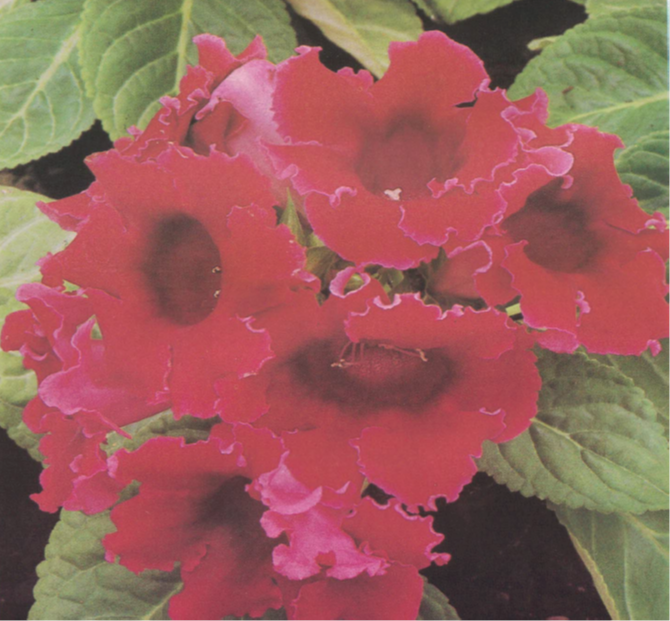
Gloxinia
Sinningia speciosa
Light and Temperature
This plant does best in half shade; Strong sunlight burns its leaves. Choose a warm spot in summer, 68-72°F is just fine. In winter, the tuber rests at about 59°F. Avoid cool nights or drafts.
Watering and Feeding
High humidity is essential. Use a humidifier or put the plant on a wide saucer of damp pebbles. You can mist around the plants but never on the leaves. In spring and summer, it needs a lot of water, less and less from September on. Feed 1/2 strength liquid fertilizer, high in potash, during active growth.
Transplanting, Propagating and Grooming
You don't really need to repot this plant. Plant your dormant tubers and fresh soil, a slightly acidic standard potting soil, in February.
The leaves wither by themselves in fall. Just rinse the tuber in spring.
You can propagate from seed, leaf cuttings, or by dividing.
Size, Growth and Flowering
This plant is a tuberous plant. Its leaves are about 6 inches long on short stems and are so dense that they almost look like a rosette. Flowers bloom from the center of the rosette.
The beautiful velvety trumpet flowers appear from May to September period they are available in white, red, Violet, spotted, or veined.
Slipper Gloxinia
Sinningia speciosa
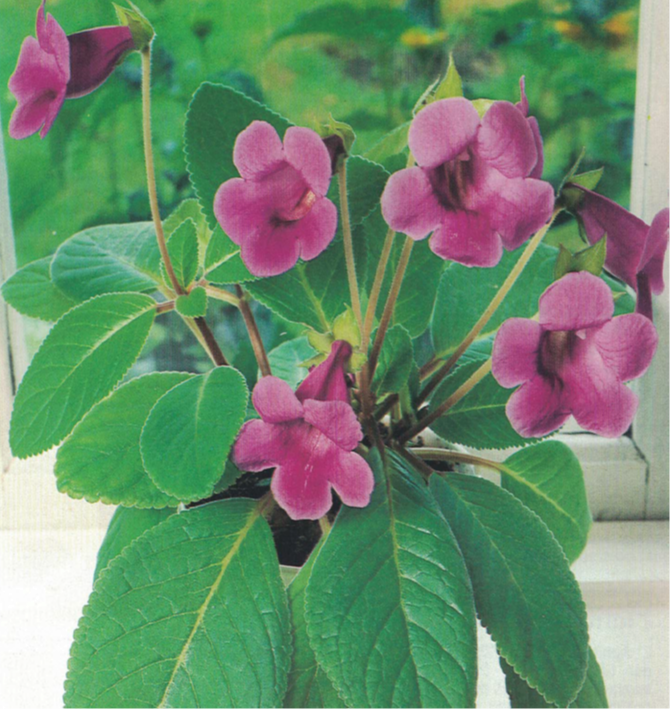
Light and Temperature
This plant thrives in window positions if it is protected against the hot, burning sun. S facing windows can be too hot in summer. A temperature of 70-75°F is about right. During the winter storage season, the best temperature is between 50-60°F. Store tubers in a dark place in barely moist peat Moss.
Watering and Feeding
Start watering gradually in the spring to wake the tuber to life again. Increase watering as the plant grows. Start to feed when leaves have appeared. Stop feeding in September to October and reduce watering. Keep tubers from drying out completely during dormancy.
Transplanting, Propagating and Grooming
A peat Moss/ perlite/ vermiculite soil mix (1:2:1) is the best for growing medium for the slipper gloxinia. Plant them in new soil each year as growth begins. No repotting during the growing season.
Little grooming is necessary. New leaves grow each spring and die back in fall.
Divide large tubers or break off offsets. You can also take leaf and stem cuttings to propagate.
Size, Growth and Flowering
This plant is an attractive flowering tuber which blooms during the brightest months of the year. It is ideal for the window positions. Smaller than the more common gloxinia. The leaves are Oval with serrated edges and have clearly defined veins.
The lovely slipper shaped flowers come in shades of purple, pink, and cherry red. They are on slender stems, nodding gracefully towards the leaves. No special fragrance.
Mackaya
Mackaya bella
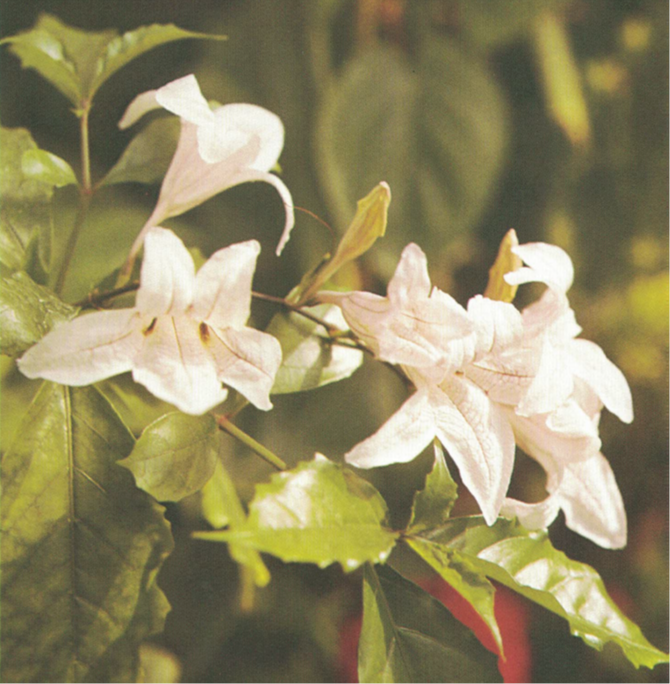
Light and Temperature
This plant should be placed in a bright and warm position out of direct sunlight. It thrives anywhere above 50°F.
Watering and Feeding
Feed and water regularly through the growing season. Never allow soil to dry out. In the rest season, water sparingly and do not feed.
Transplanting, Propagating and Grooming
Standard potting soil is fine. Repot in March.
Cut back after flowering. The more plants are trimmed and pinched out the bushier they will be.
Propagate with four-inch cuttings in spring. Use standard potting soil with bottom heat.
Size, Growth and Flowering
Normally quite shrubby. Under the right conditions, this plant can reach a height of about 40 inches.
Blooms from June to August, earlier in warm climates. The large lilac blue flowers are two inches in diameter. No special fragrance.
Sapphire Plant
Eranthemum wattii
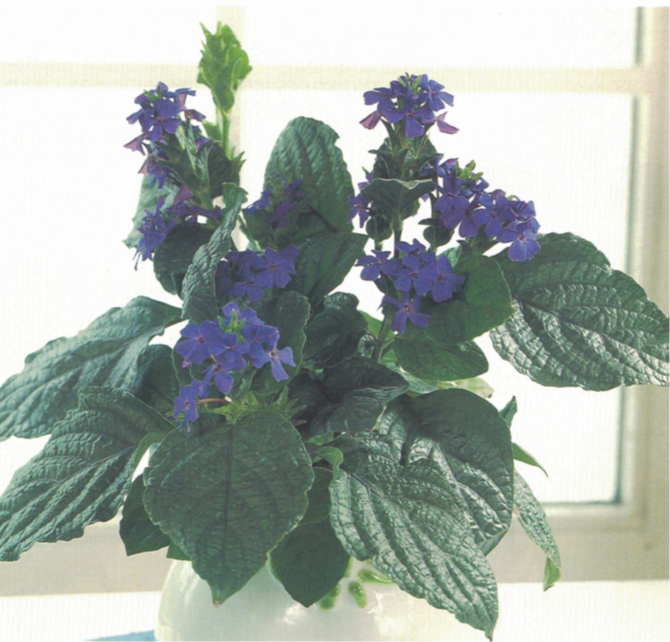
Light and Temperature
This plant thrives at normal room temperatures and can grow in any window if protected from the hottest part of the sun.
Watering and Feeding
Water regularly, depending on temperature and light. Sapphire plants should not be overwatered but cannot tolerate drying out either. Feed regularly during the summer months but stop feeding after flowering.
Transplanting, Propagating and Grooming
Rich, well drained potting mix is best. Repot in the spring two weeks after pruning.
Cut plants back by half in spring. Pinch out young plants to encourage bushy growth.
Propagate by cuttings or seed.
Size, Growth and Flowering
The sapphire plant normally grows to a height of 12-20 inches but may grow taller if planted in a Conservatory. The four-inch oval leaves are dark green with a metallic sheen.
Flowers are produced in upright clusters and are deep blue- Violet in color. The individual blooms last for only a couple of days but new ones open to replace them. No particular fragrance.
Marguerite
Chrysanthemum frutescens
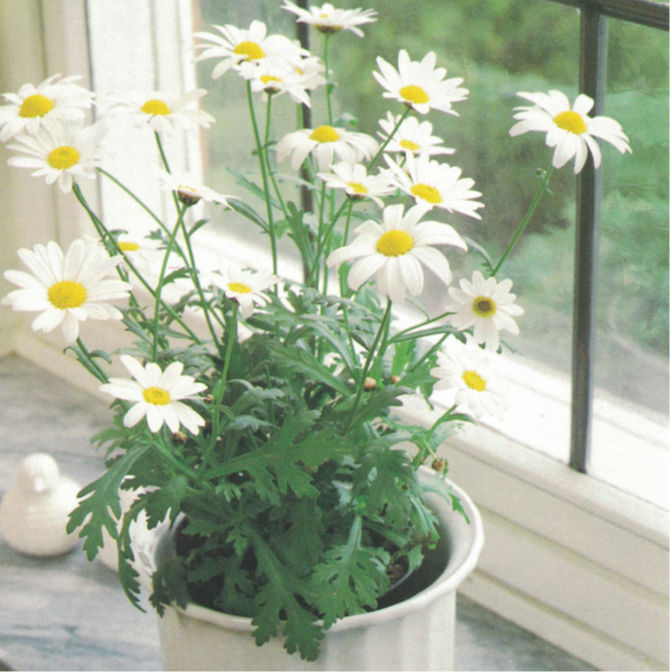
Light and Temperature
Margarites flower best in full sun and our best kept out of the wind. They love the summer warmth but need to be kept cool in the winter.
Watering and Feeding
Potted marguerites need regular watering. If planted in the ground the soil can be allowed to dry out slightly each time. Water sparingly and no feeding in the winter period feed once a month at most throughout the summer. Too much nitrogen fertilizer will give lush foliage but few flowers.
Transplanting, Propagating and Grooming
Margarites grow well in regular potting soil or not too rich, sandy garden soil. Pot over winter plants in the spring.
Bought plants need no grooming except to remove faded flowers, which will prolong blooming. Plants grown from cuttings should be pinched out while they are young.
Take cuttings with a “heel” in September or early spring. Plant them in moist potting soil. Seeds can be sown in early spring.
Size, Growth and Flowering
Marguerites can be between 2-4 feet tall and have a compact, rounded, Bush growth period fast growing.
Marguerites have a typical Daisy flower with yellow centers and white, yellow, or pink ray petals. If grown in a sun porch or greenhouse they can bloom all year long, but often take a break in the middle of winter. If growing margarites as summer flowers, either discard the plants at the end of the season or store them in a frost-free place until the following season. The flowers and foliage have a sweet, musky scent.
Medinilla
Medinilla
magnifica
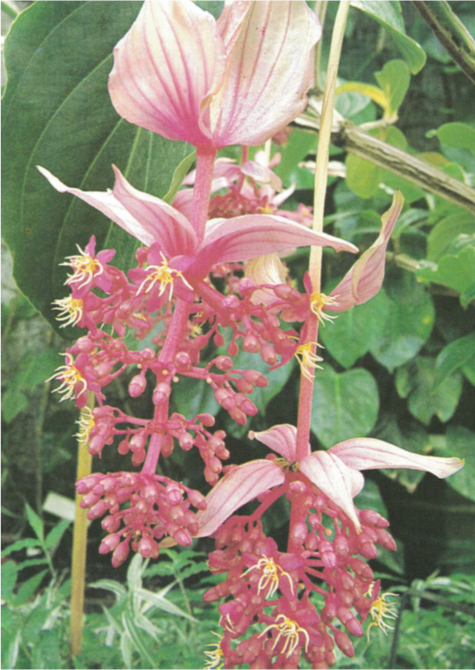
Light and Temperature
This plant needs plenty of light and warmth but protect it from the strong sunshine. Keep the temperature around 70-80°F During the growing season and around 50-60°F in the winter period humidity must be high at all times.
Watering and Feeding
Water well and regularly during the growing season. Purified water is best. Never let the soil dry out. Feed once a week. Frequent misting is beneficial. Reduce watering and cease feeding in the fall and winter.
Transplanting, Propagating and Grooming
This plant prefers to be slightly pot-bound, so repot only if it has really outgrown its pot. Do this in early spring before flowering. Using acidic potting soil containing plenty of peat Moss.
No regular pruning is needed. Cut back all the stems after flowering if necessary. Pinch stem tips of young plants to promote bushiness.
Propagate with cuttings, but it is very difficult for an amateur. The cuttings need high bottom heat to root.
Size, Growth and Flowering
In the wild, this plant can grow 3-5 feet. It is bushy with a sturdy, squarish stem. The large oval leaves are leathery and shiny with a prominent pattern of veins. This plant grows relatively quickly if the temperature and humidity are high enough.
The flowers are produced in long, hanging clusters. Both the flowers and the bracts are pink, and they can appear anytime between February and August. They have no fragrance.
Sensitive Plant
Mimosa
pudica
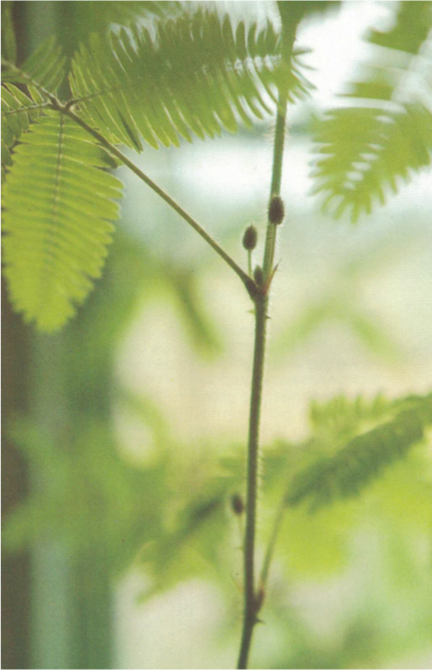
Light and Temperature
Mimosa needs a light spot to grow in but should be protected from blazing sunshine. It requires a room temperature of 68°F.
Watering and Feeding
Keep the plant moist. Mist from time-to-time period this prevents pests. Feed regularly from spring until flowering ceases.
Transplanting, Propagating and Grooming
If mimosa is grown as an annual plant, don't repot. So, seeds and good peat mulch or hummus, and replant an ordinary potting soil.
Grooming is not necessary.
Mimosa can be propagated from seed. Cuttings require greenhouse conditions.
Size, Growth and Flowering
Mimosa is a perennial, but it is often treated as a seasonal plant. It's a thin leafed, slightly bushy plant which grows gracefully and daintily. The leaves grow in pairs and look like ferns.
The blooms are rose or Violet, small, and ball shaped. Mimosa can bloom over a long period, from May to September period the flowers have no particular fragrance.
Butcher's Broom
Ruscus
hypoglossum
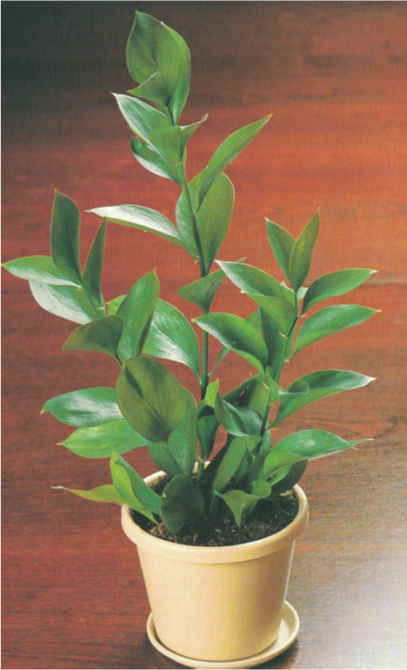
Light and Temperature
This is not a fussy plant. It can thrive in a shady spot or in bright sunshine and can grow outdoors all year in mild climate areas. Indoors, normal room temperature is fine throughout the year, but somewhat cooler temperature is needed during the winter.
Watering and Feeding
Water a couple times a week in the summer and feed 2-3 times per month. Iron chelate may be necessary if plants become chlorotic. Cut the watering in half in the winter and do not feed.
Transplanting, Propagating and Grooming
Grows best in heavy, clay, acidic soil. Pot in February but only if really pot bound.
Thin out if the shrub is too bushy.
Divide older plants when repotting for
propagation. Sow seeds in September
Size, Growth and Flowering
The erect, unbranched stems grow to about 3 feet tall. It has sharp pointed leaf-like branches called cladodes. Fairly slow growing.
Poems in the spring with tiny, greenish- white flowers. They are either male or female and have a faint scent. After pollination the female plant will produce a shiny red Berry in the center of the cladodes
Myrtle
Myrtle
communis
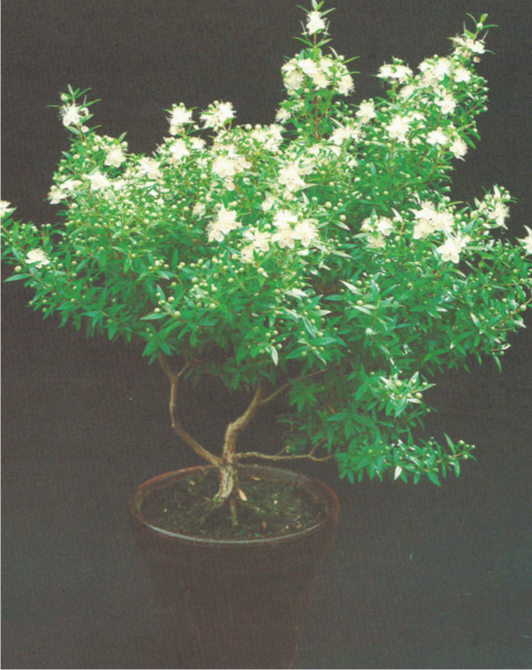
Light and Temperature
Myrtle grows best in sunny positions, but it can also thrive in an east or West facing window. Keep your Myrtle in a cool, bright, and airy spot for the winter but don't let the temperature drop to under 30°F.
Watering and Feeding
Myrtle needs regular watering during spring and summer when it is growing and should be given a week dose of fertilizer every week. No feeding and less water in winter.
Transplanting, Propagating and Grooming
Young plants are happiest in a light soil, such as potting soil mixed with a little perlite or pumice. Older plants like a little heavier soil. Repotting is only necessary if the plant has outgrown its pot. This is best done in spring.
Myrtle can be groomed to shape by tip pinching. It little tree with round crown can be very decorative. Pinch young plants out frequently during the summer however, the more you pinch the fewer the flowers.
Propagate by cuttings.
Size, Growth and Flowering
Myrtle is seldom more than 2-3 feet tall when grown in pots or tubs. It is an Evergreen shrub with dense foliage and two-inch-long opposite leaves. Medium growth rate.
Myrtle blooms from spring through fall. The flowers are white with many yellow tipped stamens growing like a brush from the center. They have a sweet fragrance. The foliage is also strongly aromatic when crushed.
Goldfish Plant
Nemantanthus
‘Tropicana’
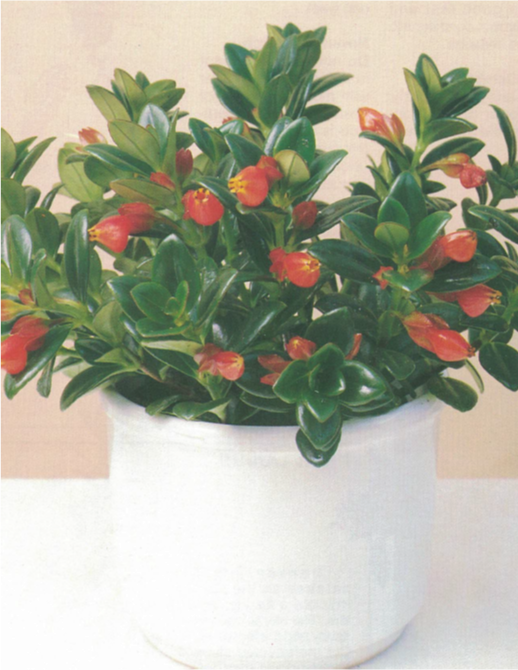
Light and Temperature
This plant loves bright and sunny spots and will grow well in a South or West facing window. It can also thrive in light shade. Keep it in the lower 70s in the summer and cooler in the winter.
Watering and Feeding
Water regularly but in small amounts. Feed once every 14 days in the lighter months of the year. Water just enough to keep the roots moist in the winter
Transplanting, Propagating and Grooming
Use commercial potting soil with added peat Moss. Pot after overwintering.
Cut back the longest and most leggy stems before the new season begins.
Take tip cuttings in the spring and they will strike root at around 70°F.
Size, Growth and Flowering
The goldfish plant grows vigorously with long, hanging stems. The leaves are an attractive dark green. The plant should achieve a diameter of 12 to 16 inches.
Long lasting flowers in July through September period the flowers are about 3/4 of an inch long and are puffed up so they resemble small goldfish with pouting mouths. They are orange- red with brown markings and have only a faint scent.
Oxalis
Oxalis
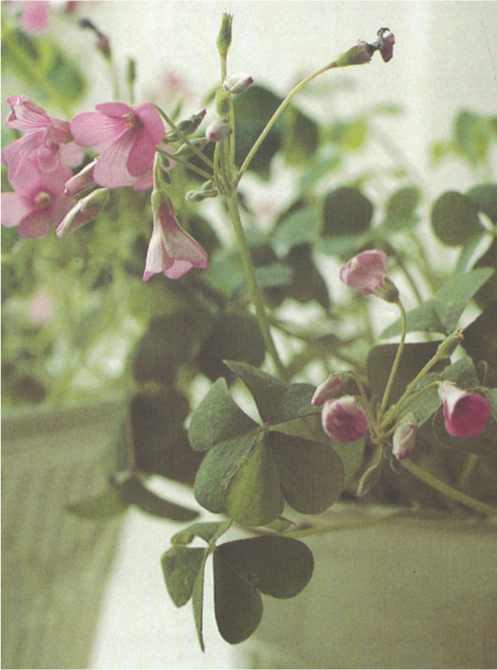
Light and Temperature
All types of oxalises like to be in bright, sunny spots, but you can move them to a darker, cooler place in the winter months.
Watering and Feeding
Water regularly to keep the soil damp. Feed once a week from spring to fall but stop feeding your plant and reduce the amount of water as the summer draws to its close. Give no water during the plant's resting season.
Transplanting, Propagating and Grooming
Repot in standard potting soil in February. Older plants can manage with just the top dressing and repotting every two to three years.
Grooming is not necessary, but you should remove withered flowers and leaves.
Oxalis has small bulbs or corms. These can be divided in February and put into new pots. You can also remove the new tubers from the parent plant before you put them away for its winter sleep. Keep them dry and cool and plant them in spring.
Size, Growth and Flowering
All varieties of oxalis are small and graceful. There are many different leaf types which can be divided into three or four sections.
The oxalis blooms all spring and summer long with pink, bell shaped flowers. Try planting the tubers and damp soil in September, and if you keep the soil moist enough your oxalis flour just after Christmas.
Snow Oxalis
Oxalis
regellii
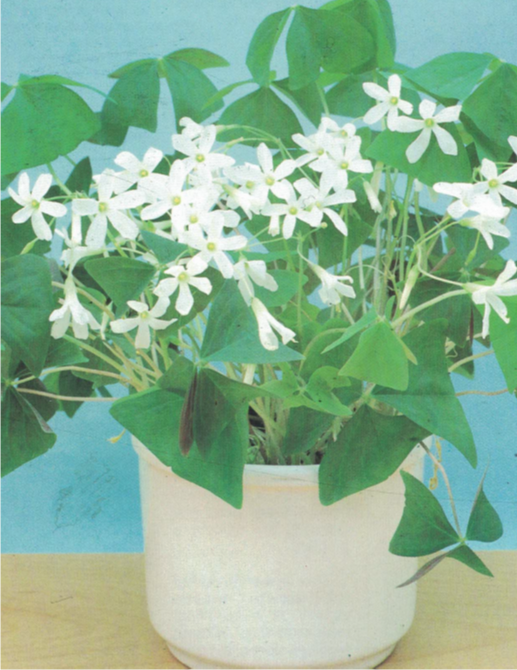
Light and Temperature
The snow oxalis prefers partial or dappled shade. It thrives in cool air and will do well in a north facing window. It needs a winter rest and should be overwintered in a dark, dry, and cool condition.
Watering and Feeding
Water regularly throughout the entire growth season. Drying out will mean a stop in flower production. Start to cut down on watering in October and allow the plant to dry out for its winter rest. Water as usual after the February repotting.
Transplanting, Propagating and Grooming
A porous, sandy potting soil is best. Plant in new soil each February
Remove the weathered leaves during the season and before the plant begins its winter rest.
End time, snow oxalis will grow small offsets that can be separated and planted themselves. Otherwise divide the entire root clump with old and new rhizomes mixed together when repotting in spring.
Size, Growth and Flowering
Snow oxalis has three parted triangular leaves that grow on long stalks from below ground rhizomes. Fast growing, deciduous in winter.
The flowers are small, white, and trumpet shaped with five petals. They are long and sit on slender stems and have a light fragrance.
Bird of Paradise
Strelitzia
reginae
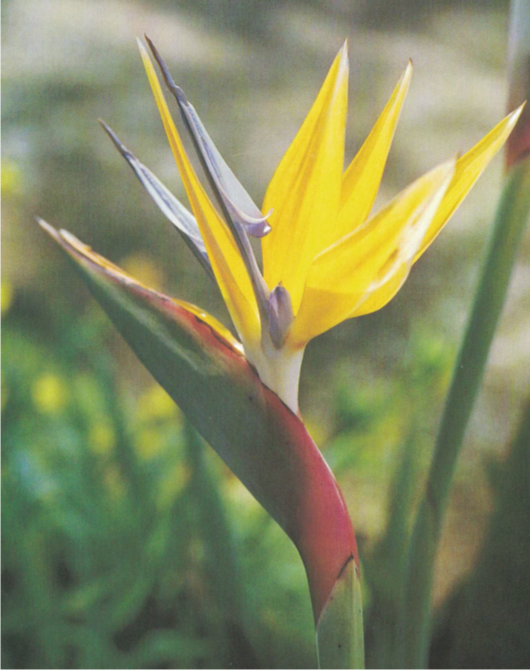
Light and Temperature
Prefers plenty of light. This plant loves the full sun outdoors in the summer. Overwintering temperatures should be around 50-55°F.
Watering and Feeding
Water regularly during the warm months, but the soil should be allowed to dry each time. Feed every week. Water sparingly in the winter and do not feed.
Transplanting, Propagating and Grooming
Bird of paradise will grow well in a large tub of well drained commercial potting soil with added pumice or perlite. Pot in the spring, only, if necessary, as the plants bloom best when crowded.
Send out leaves at the base if the pot is too crowded.
Propagate either by seed or division of a larger plant in the spring.
Size, Growth and Flowering
Upright growth with large banana like leaves. Strelitzia reginae Is normally 3-5 feet tall, but other species are twice the size. Young plants grow slowly and increase their growth rate with age.
Will normally bloom in the winter and spring, or intermittently throughout the year in greenhouses or outdoors in warm climates. The striking flowers are yellow- orange and blue and emerged from a green big white spathe. No scent
Pavonia
Triplochlamys
multiflora (syn. Pavonia multiflora)
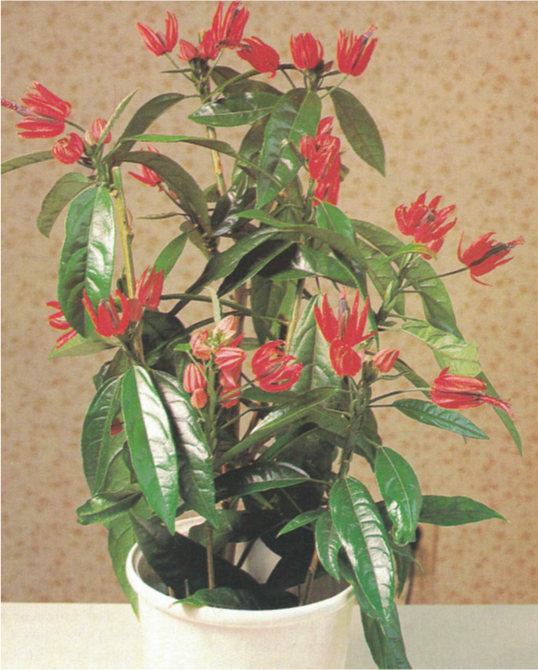
Light and Temperature
As much light as possible in the winter but keep it out of the glaring rays of the spring and summer sun. It thrives best at around 70°F but needs a cooler rest period after flowering, about 60-65°F.
Watering and Feeding
Pavonia appreciates plenty of food, water and misting when it is flowering and in growth. Water less during the resting season.
Transplanting, Propagating and Grooming
A neutral compost or regular potting soil. Pot in April or May.
Groom only when cuttings are needed.
Propagation is easiest with cuttings in April through may. Plant them in damp soil at about 70°F with some bottom heat.
Size, Growth and Flowering
Pavonia is seldom more than 16-20 inches tall in cultivation indoors. It is an Evergreen with a rather open growth and seldom bushes out. It is easy to see its relationship to the hibiscus.
This plant blooms all year. The attractive red flowers have no scent.
Star-Cluster/Pentas
Pentas
lanceolata
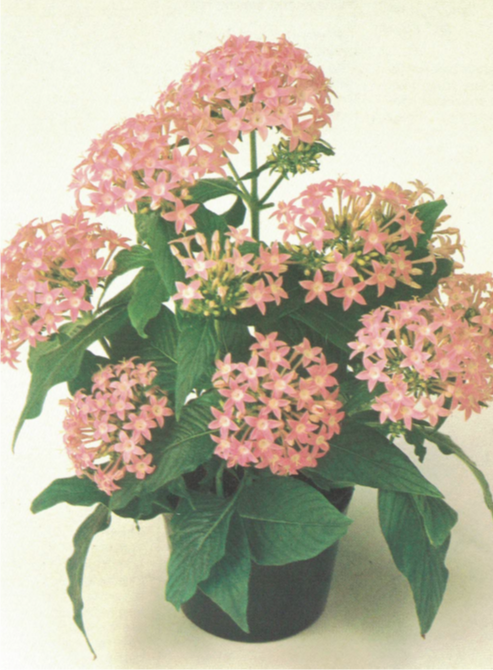
Light and Temperature
Indoor plants need bright light to flower. It could be moved outdoors in the summer where it will be fine and light shade or part day sun. Because it is frost tender, it should be kept indoors in the winter in all but the mildest climates.
Watering and Feeding
This plant should never dry out. Water several times a week, perhaps even daily, during the summer and feed once a week from April through September period in the winter water only enough to keep the plant from drying out completely.
Transplanting, Propagating and Grooming
Commercial potting soil is fine. Pot anytime in the spring or summer. Older plants need to be repotted about every two years.
Pinch out tips of young plants regularly to keep them bushy. Cut back about half the growth of older plants in the spring. Remove flower clusters as they fade.
Propagate by using tip cuttings in February through April.
Size, Growth and Flowering
This is a fast-growing plant. A young one can grow into a bushy, 12–16-inch plant and one season. Older plants can be up to three feet tall.
The flowers have no scent and are produced from spring through fall and sometimes winter period the typical species has pink flowers, but the newer cultivated varieties have a range of colors from red through pink to white and even bicolored.
Martha Washington Geranium
Pelargonium x domesticum
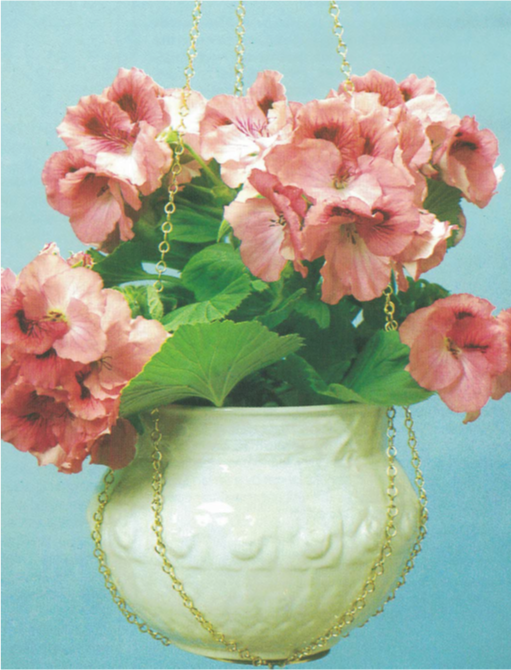
Light and Temperature
This plant needs plenty of light, but not direct sunlight, this will give the best plants. Keep the summer temperatures in the low to middle 70s, and the winter temperatures between 50-60°F.
Watering and Feeding
Because of its vigorous growth in the summer months, the indoor geranium needs plenty of water, about two to three times per week. In the winter, once or twice every two weeks is sufficient. Add liquid fertilizer to the water at the very most twice a month, and then only in the summer.
Transplanting, Propagating and Grooming
Nearly all geraniums like well drained, nourishing soil. Compost is fine but you can use standard potting soil or peat. Do not try to repot a large geranium, it is easier to make new plants from cuttings.
It often pays to cut back the indoor geranium when it has bloomed. Trimmed to three or four shoots above the root.
It is easiest to take cuttings at the same time as it is being pruned for propagating.
Size, Growth and Flowering
The indoor geranium grows quite vigorously. It can reach 2 feet in a single season.
The indoor geranium does not have quite such a profuse flowering as the more well-known outdoor varieties, but on the other hand, the flowers are more lovely, and it can be encouraged to flower all year round.
Philippine Violet
Barleria
cristata
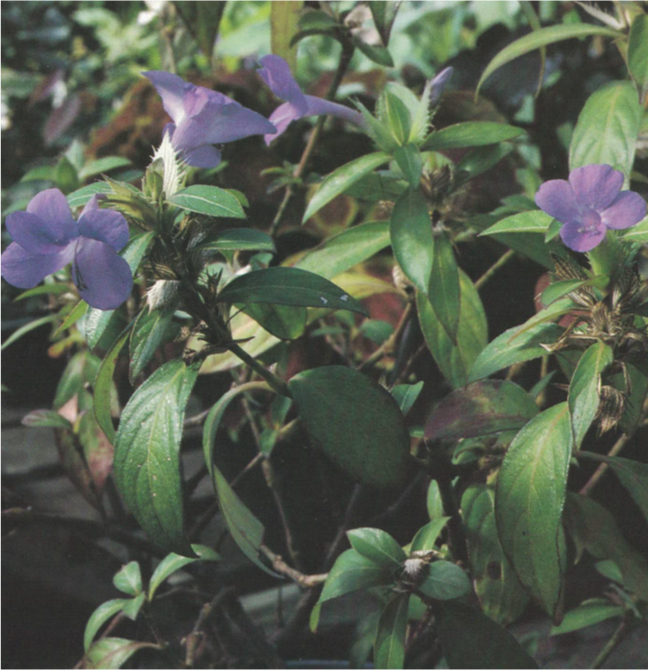
Light and Temperature
Please plants like brighter light indoors, and part shade outdoors. Daytime temperatures of 65-75°F with cooler nights are ideal, but plants will tolerate greater extremes and are cold hearted to around 27°F.
Watering and Feeding
Regular watering and feeding. Keep humidity up indoors through regular misting.
Transplanting, Propagating and Grooming
Repot in the spring using regular potting soil.
Pension. Regularly to keep the plants compact and bushy.
Propagation by cuttings is easy.
Size, Growth and Flowering
Both the Philippine Violet and Blue Barleria are fast growers.
Lavender- purple flowers of Philippine Violet appear all year, whereas Blue Baleria is a seasonal fall to winter bloomer. Flowers are not fragrant.
Chinese Primrose
Primula
sinensis
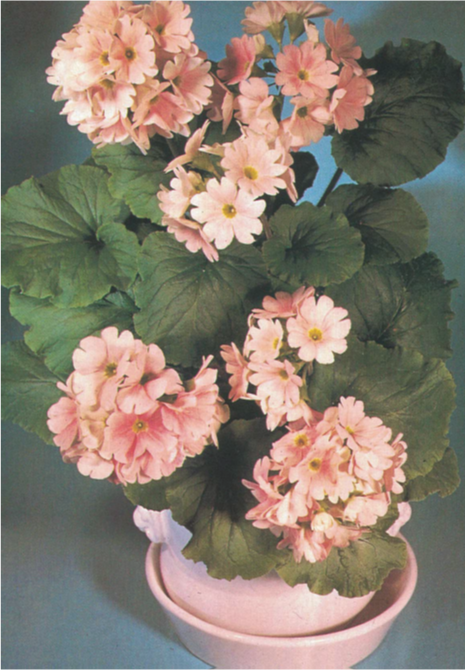
Light and Temperature
The Chinese primrose is better able to tolerate indoor air and temperatures than common English primrose, but the flowers will last longer if the plant is provided with plenty of light and kept a little on the cool side.
Watering and Feeding
Water in the dish to avoid wetting the crown of the plant. Mist seedlings instead of watering them. Feed once every 14 days from the time the plants are large enough to handle.
Transplanting, Propagating and Grooming
Chinese primrose has very weak roots and needs light porous soil.
No grooming is necessary except the occasional tidying up of withered leaves and flowers.
Easiest to grow from seed.
Size, Growth and Flowering
The heart-shaped leaves have five to seven lobes and are about two to four inches long period flowers are 1 1/2 inches or more in width.
The flowers appear in winter and spring in strong, clear shades of white, blue, or red. They grow either in clusters of 10 to 12 blooms or spread over two to three tiers. The whole plant is slightly aromatic but the flowers themselves have no special scent.
Pride-of-Barbados/Dwarf Poinciana
Caesalpinia
pulcherrima
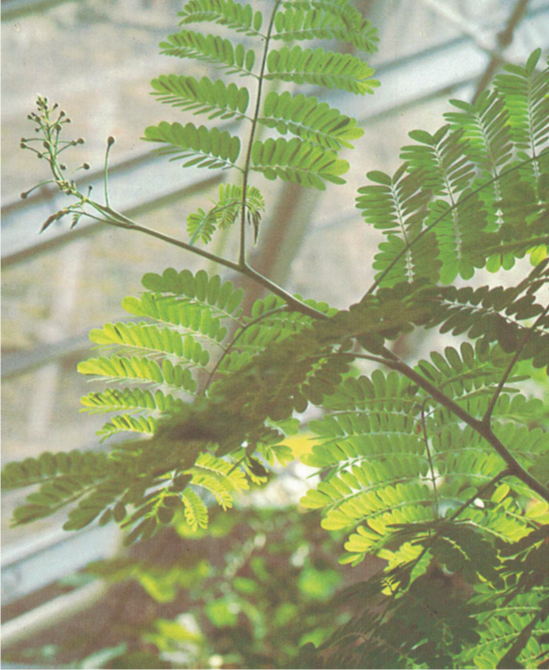
Light and Temperature
This plant thrives in normal room temperature and prefers a sunny position. If you grow your plant in the window in the summer, make sure that the temperature behind the glass does not get too high. If it does you must move the plant.
Watering and Feeding
The plant should be watered regularly in the summer, and it should not be allowed to dry out. Water sparingly in the winter. Feed only in the spring and summer.
Transplanting, Propagating and Grooming
This plant prefers A nourishing and porous soil repot in February through March, using soil with a lot of peat and some sand.
Grooming is only necessary if the plant becomes too large. You can cut it back in February through March.
Use seeds in April through may. The best germination is achieved at around 75-77°F with bottom heat.
Size, Growth and Flowering
This plant can grow as tall as six feet or more. It has a bushy growth but can be made into a standard tree. The leaves are a fresh, fern- green.
This plant flowers in the summer, producing red and yellow flowers. They have an interesting shape but have no scent.
Brazillian Edelweiss
Sinningia
leucotricha
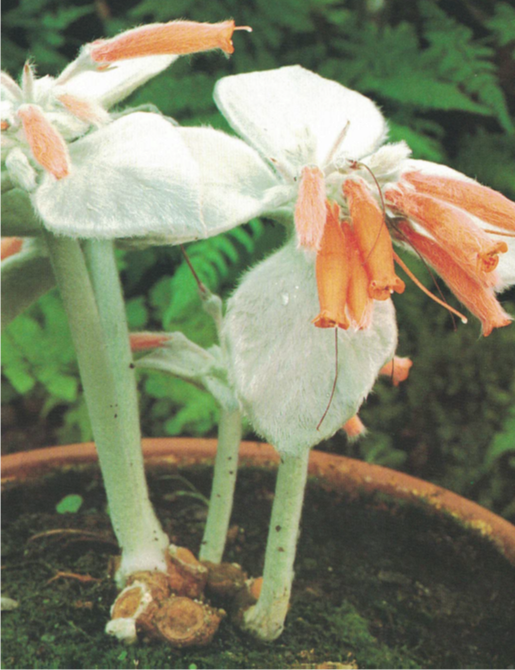
Light and Temperature
Brazilian Edelweiss thrives best at temperatures around 75°F during the growth Season. Normal room temperature is fine the rest of the year. It needs bright light but not direct sunlight.
Watering and Feeding
Water with lukewarm water. Use purified water if tap water is alkaline. Water thoroughly and then allow the soil to dry out each time. Feed with half strength for liquid fertilizer twice a month during the growth season.
Transplanting, Propagating and Grooming
Use fast draining, commercial potting soil. Add 25% perlite and 25% peat Moss. Allow the tuber to rest in its old soil. Take it up in the spring and start it off on moist sphagnum.
When growth has begun, plant the top of the tuber level with the surface of the soil.
No grooming is necessary.
Large tubers can be divided. When dividing the tuber, make sure there is at least one stem to each piece. Allow the sections to dry out for a day before planting, then brush the wound with powdered charcoal. You can also take cuttings later in the season. Splice them together with a little bit of tuber and brush the end with powdered charcoal.
Size, Growth and Flowering
Brazilian Edelweiss is an 8-12-inch-tall plant. The velvety leaves are 4-6 inches long and the two-inch-long flowers are bright red and grow from short stems in a ring around the stalk.
The flowers appear in summer, or 7-8 months after sowing seeds for new plants. New buds keep coming for a long time, so the flowering season lasts for quite a while. The blooms have no fragrance.
Plant

Light and Temperature
Watering and Feeding
Transplanting, Propagating and Grooming
Size, Growth and Flowering
Plants that Bloom all Year
Plant
Light and Temperature
Watering and Feeding
Transplanting, Propagating and Grooming
Size, Growth and Flowering
Climbing and Hanging Plants
Lipstick Plant
Aeschynanthus
radicans
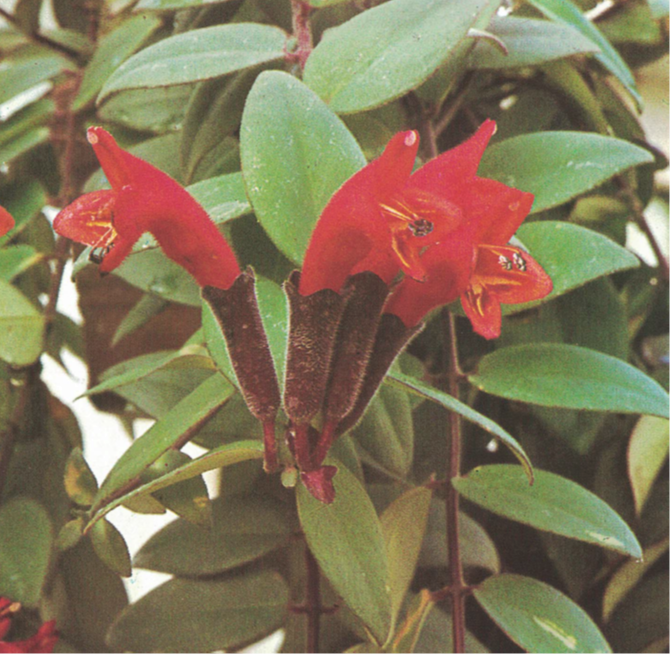
Light and Temperature
This plant should stand in a spot with plenty of light, but not in direct sunlight. The plants like heat in summer, but they can grow well in a normal living room temperature. The temperature in winter should be about 60-65°F.
Watering and Feeding
Water and feed the plant often in the growing season and mist it regularly. It can tolerate slight drying out in between waterings. Water more sparingly in the rest of the season.
Transplanting, Propagating and Grooming
These plants do not need large pots, but the soil should be airy and rich in plant matter. Repot in the spring.
This plant can be trimmed back if the stems are too long.
Use the trimmings as cuttings. Put them in a light, nourishing soil in the spring and keep the temperature at about 72-75°F.
Size, Growth and Flowering
Most of these plants are grown as hanging plants and can have vines up to two feet long. However, many of the new hybrids have more upright growth, and are also suitable for the windowsill.
Most varieties flower in the summer, but many of the new hybrids can flower all year round as long as they get enough light. Aeschynanthus marmoratus Is chiefly grown for its foliage since its flowers are small and inconspicuous. In general, the flowers have little scent.
Basket Grass
Oplismenus
hirtellus
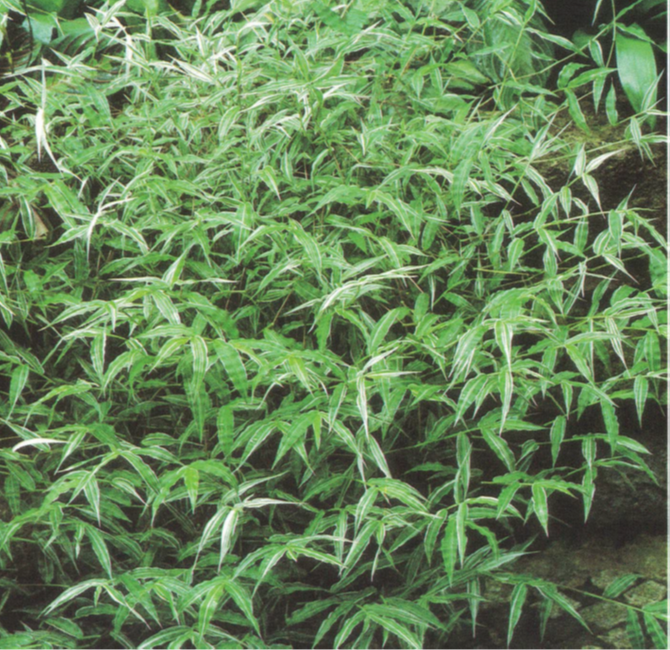
Light and Temperature
Basket grass needs plenty of light, especially in the winter period which gives the plant a bright spot in spring and summer but keep it out of the strong sun. Normal room temperature is fine with a slightly cooler temperature in winter period never let the air temperature drop below 50°F.
Watering and Feeding
Water frequently in spring and summer, less in winter period never let it dry out completely. Feed with a weak liquid fertilizer now and then in the summer, but never when the soil is dry.
Transplanting, Propagating and Grooming
Standard potting soil is fine. Repotting is not usually necessary since the plant is renewed each year. Young cuttings may need repotting once they are fully grown.
Cut back the bear strands to the edge of the pot to keep it looking bushy.
Propagation is best done with cuttings each year. Use young tip shoots and put several in each pot to make a nice bushy plant.
Size, Growth and Flowering
A light and airy plant with long hanging stems. The pretty leaves are green variegated with white stripes that have a faint pink cast. It grows very quickly to make a full bushy plant.
Basket grass is grown for its hanging stems and variegated leaves. The flowers are insignificant in any older plant will produce the typical grass flowers on upright stems.
Hanging Peperomia
Peperomia
obtusifolia
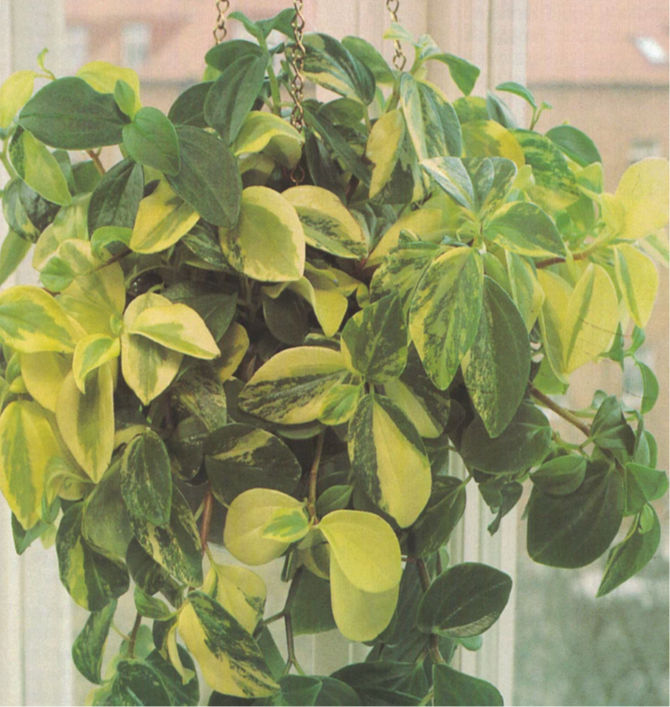
Light and Temperature
Peperomia needs bright filtered light but turns pale in strong sunshine. Plants need summer temperatures in the 70s or 80s and nothing under 55-60°F in the winter.
Watering and Feeding
Water moderately in the summer and even less in the winter. Feed infrequently in the summer and not at all in the winter.
Transplanting, Propagating and Grooming
Hanging peperomia's seldom need repotting. When transplanting, use a rich potting soil and peat or other organic matter.
Young plants can be pinched back to make them bushier. Remove leafless shoots on the older plants.
Peperomia can be propagated with stem or leaf cuttings in spring.
Size, Growth and Flowering
Hanging peperomia make row to 3-4 feet a year under favorable conditions. They will grow to a considerable length.
The flowers are carried on thin, white spikes, but the individual blooms are small and insignificant.
Italian Bellflower
Campanula
isophylla ‘Alba’
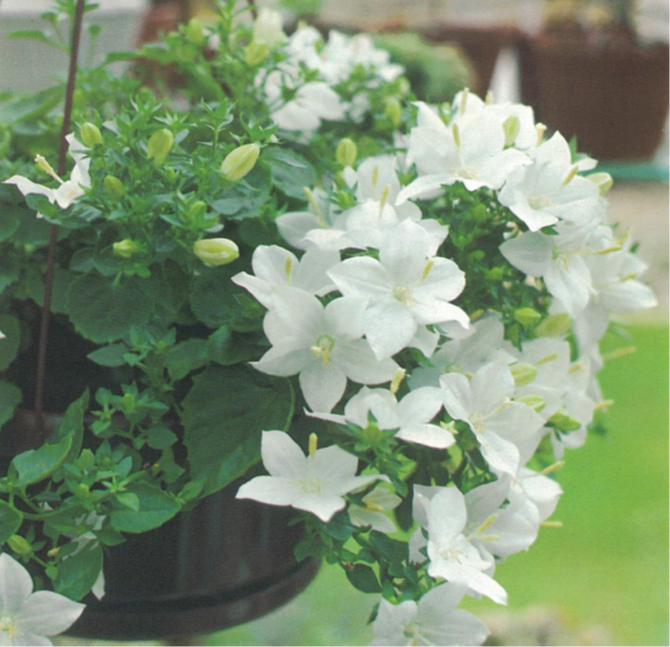
Light and Temperature
In the summer the plant will thrive between 59°F and 68°F, and in the winter from 46-50°F. In February raised the temperature to 61-64°F to get growth started. Hot summer temperatures can be alleviated with frequent watering and growing in shaded areas.
Watering and Feeding
These plants tolerate hard water, and the potting soil must be kept evenly moist in summer. In winter only give a little water. During the growing cycle, and while flowering, give half strength liquid plant food every second week.
Transplanting, Propagating and Grooming
Repot after flowering ceases, and nutritious standard potting soil with a little sand added.
During summer, remove old trailing stems and pinch back new ones for bushiness. A couple of months after flowering ceases, cut back the stems of about one to two inches and length, and when the plant begins growing again in spring, take cuttings.
Propagate by division when repotting, or from cuttings taking in the spring. Plant five or six cuttings in each pot.
Size, Growth and Flowering
The Italian Bellflower and Riviera Bellflower are both profuse hanging plants which quickly conceal their pots. They won't grow very tall unless the trailing stems are supported with a frame, trellis or strong stake.
When this plant is thriving, it will bloom profusely from July to September period Italian Bellflower has a white flower, the Riviera Bellflower has blue ones; they are unscented.
Dipladenia
Mandevilla
sanderi
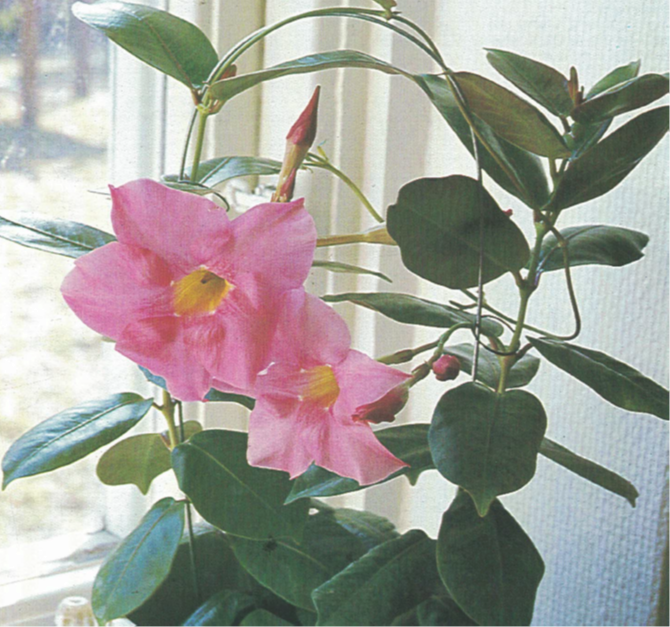
Light and Temperature
Give the plant as much light as possible but avoid the burning sun. The ideal summer temperature is around 70°F and the winter temperature should not drop below 60°F.
Watering and Feeding
Water well in the spring and summer but only when dry in the winter period high humidity is essential. Feed with a weak fertilizer solution every other week in summer. No feeding in winter.
Transplanting, Propagating and Grooming
Part each spring or when the roots are forcing their way out of the hole in the base of the pot. Use regular potting soil and keep the plant on the dry side until growth resumes.
Cut back severely after flowering if you want a bushier rather than a vining plant. Trim side shoots back to a pair of leaves about two inches from the main stem. Trim large vining plants back about half to 1/3 to two new buds.
Use 4–5-inch stem cuttings with at least two pairs of leaves to propagate. Rooting hormones is essential.
Size, Growth and Flowering
Dipladenia is a climber, if you let it grow unpruned in a greenhouse the vines can reach lengths of up to 15 feet. You can keep it bushy by constantly trimming back to about two feet. Medium to fast growing.
This plant produces large, trumpet shaped flowers in the summer. They are either pink or white with a yellow throat, depending on the variety. Very faint fragrance.
Goldnet Honeysuckle
Lonicera
japonica ‘Aurea-reticulata’
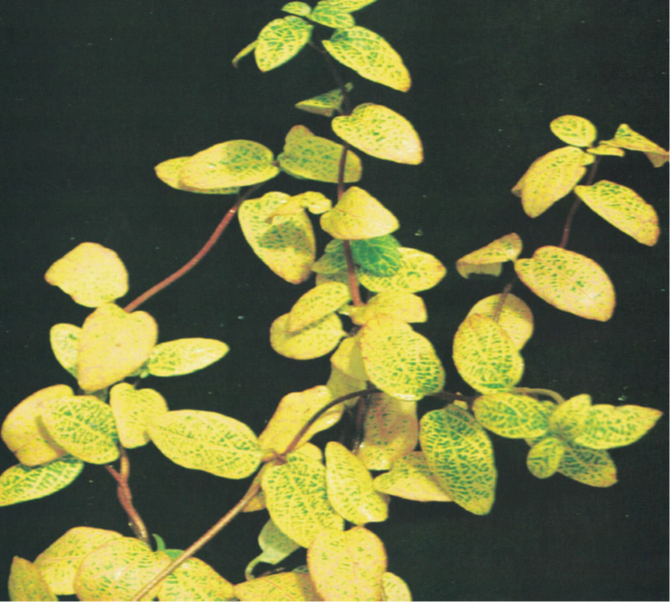
Light and Temperature
This plant needs bright light all year to preserve its leaves but cannot tolerate burning sunshine. It prefers light shade. In the summer it can grow outdoors or in a cool, airy room. In the winter it will do best around 50-55°F but can tolerate several degrees of frost.
Watering and Feeding
Do not let your plant dry out too much in the summer, which is when you should also feed it regularly. Water sparingly and do not feed in the winter.
Transplanting, Propagating and Grooming
Regular potting mix is fine. Provide good drainage in the base of the pot. Plant in the spring if the plant has outgrown its pot.
Cut back in February to promote fresh, new growth.
Propagate by cuttings.
Size, Growth and Flowering
This plant is a handsome climbing plant grown for its long oval leaves with radiant yellow veins. The plant grows quickly during the summer and needs regular pruning to keep it compact.
This plant rarely flowers in containers.
Inch Plant
Callisia fragrans & Callisia elegans
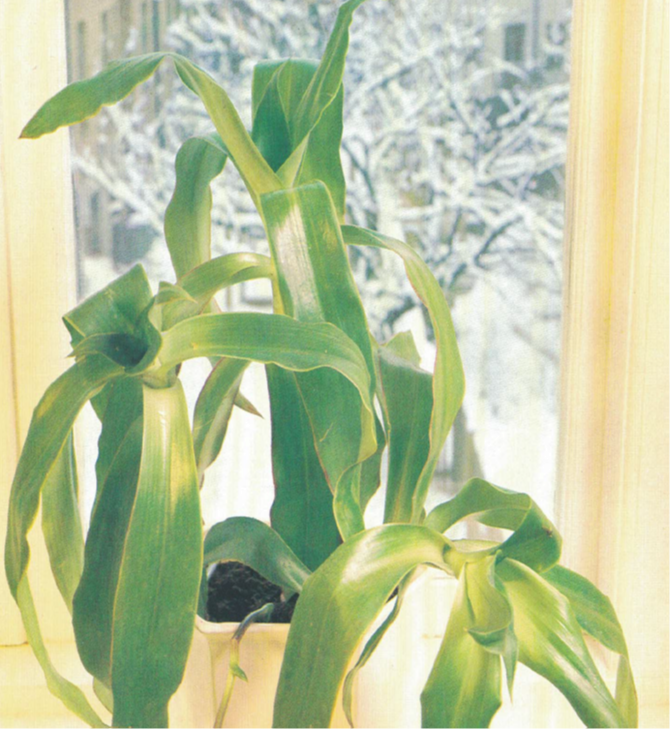
Light and Temperature
Regular room temperature is fine. Bright, indirect light is best; no burning sun.
Their lush growth improved humidity in a room for both plants and humans.
Watering and Feeding
Water regularly in the summer and feed weekly a weak fertilizer solution. Do not over-water especially in the winter when the soil should dry between watering. Frequent misting is beneficial.
Transplanting, Propagating and Grooming
It is easier to rejuvenate plants through cuttings than by repotting. Regular well drained potting soil is fine.
Remove older stems that have begun to get brown, dry leaves.
Propagate by new cuttings.
Size, Growth and Flowering
Grown mostly as a hanging plant. Stems and leaves will continue to grown "inch by inch", hence the name.
Some will have small white flowers. Callisia fragrans had violet scented flowers.
Stephanotis/Madagascar Jasmine
Stephanotis
floribunda
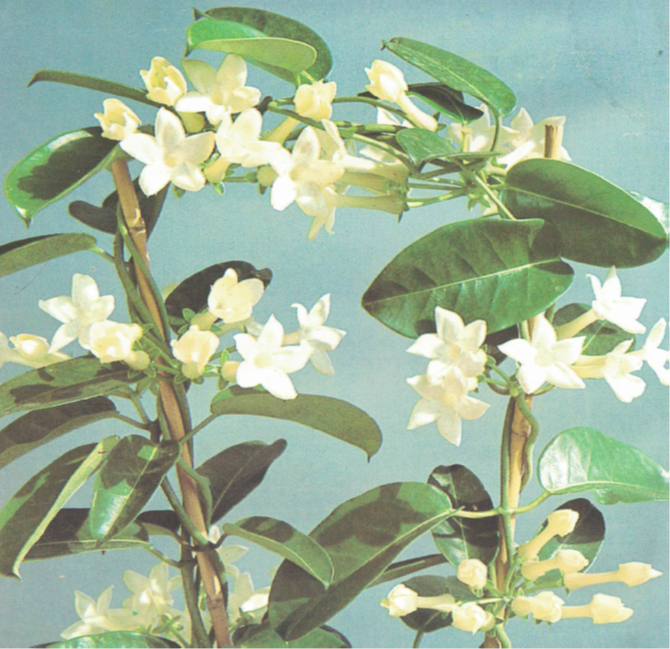
Light and Temperature
It grows best in an east or West facing window without strong direct sunlight. The summer temperature should be about 65-74°F. The temperature should be lower in the winter, about 60-65°F.
Watering and Feeding
This plant should never be allowed to dry out when flowering and should be given liquid fertilizer every other week. A daily misting with lime free water is a good idea at the warmest time of the year. Do not feed in the winter and be sparing with water.
Transplanting, Propagating and Grooming
It should be repotted only every second or third year at most. The soil should consist of 25% coarse sand, 25% peat Moss and 50% good garden soil.
If the plant is to grow up and down a wire hoop, prune it to shape. Remove long shoots without leaves and trim back side shoots back to two to three inches.
Side shoots with well-developed leaves can be taken and planted and the recommended soil mixture in January through March. Put three cuttings in each pot and they should root easily at about 68°F. This usually takes about 6 to 8 weeks. Ensure high humidity by keeping cuttings under a plastic bag with two or three holes for air circulation.
Size, Growth and Flowering
This plant is a climbing plant which can grow 16-32 feet in ideal conditions. It can grow two to three feet per year.
In good conditions the flowering can last all summer long period the lovely white flowers have a scent similar to Jasmine
Pathenocissus
Parthenocissus
inserta
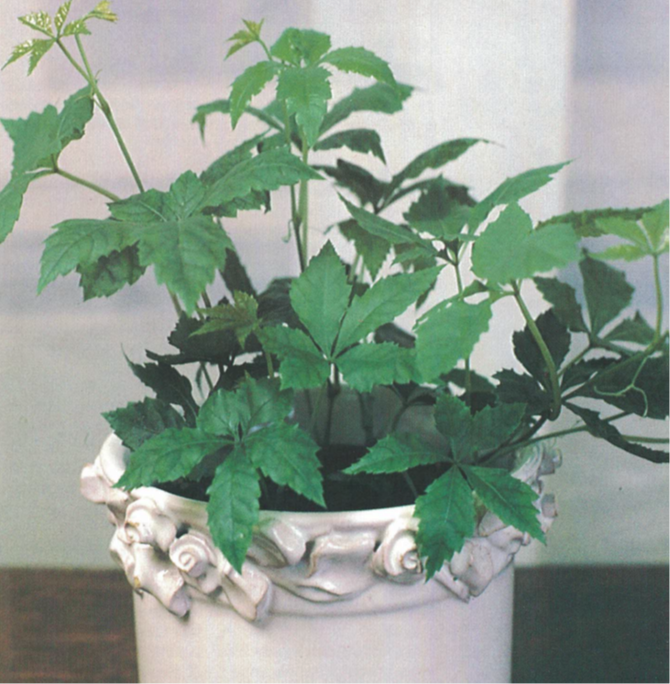
Light and Temperature
A good place for this plant is a north or West facing window. It thrives particularly well if the temperature is not too high. It could be over wintered in a bright room at 45-50°F.
Watering and Feeding
In the winter, water only when the soil begins to dry out. During the rest of the year, water regularly enough to keep the soil consistently moist but never soggy. In summer, liquid fertilizer may be added to the water every two weeks.
Transplanting, Propagating and Grooming
When the roots have filled the pot, repotting is in order. Repot after pruning in spring. Standard potting soil is fine.
Propagate by cuttings.
Size, Growth and Flowering
This plant is a fast-growing climbing plant which is held by tendrils. Only with extremely smooth surfaces should a wooden stick or trellis be installed to aid climbing.
The small, inconspicuous balloons are hardly worth mentioning. They are not fragrant.
Angel Wing Begonia
Begonia
corllina
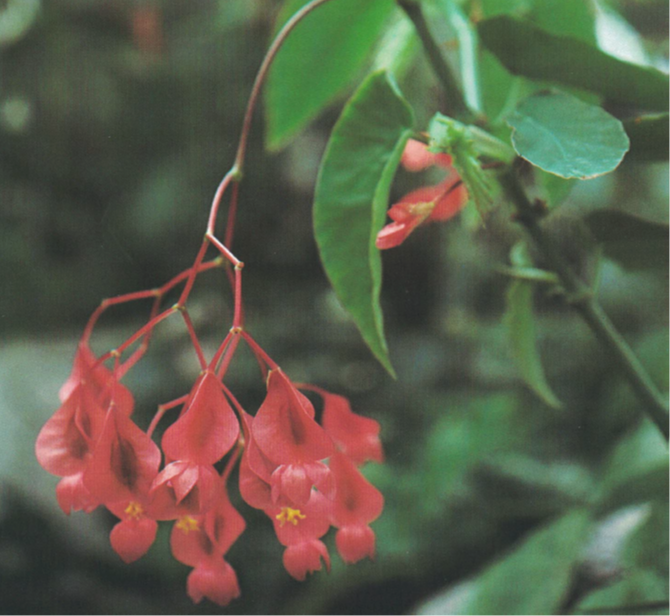
Light and Temperature
Begonias need good, bright light, but no leaf scorching direct sun. Plants thrive with winter temperatures in the 60s and summer readings of above 70 or above.
Watering and Feeding
Like all begonias, these need regular feeding and watering to thrive. Feed lightly with every watering in summer; Not at all in winter period keep plants evenly moist.
Transplanting, Propagating and Grooming
Angel wing begonias must have well drained soil. Use a top-quality commercial potting mix or make your own from equal parts peat Moss, sand, leaf mold and rich compost.
Trim stems to force side branching and make a bushier looking plant. This can be done at any time of the year. Use trimmings to start new plants.
Easy to propagate with either stem or leaf cuttings.
Size, Growth and Flowering
Angel wing begonias may reach 3-4 feet long in as many years. Plants grow vigorously, producing pairs of leaves on slender stalks. Leaves are shiny and marbled with reddish undersides.
In the summer this plant flowers profusely with clusters of pinkish- red blooms. They are scentless.
Climbing Bell
Littonia
modesta
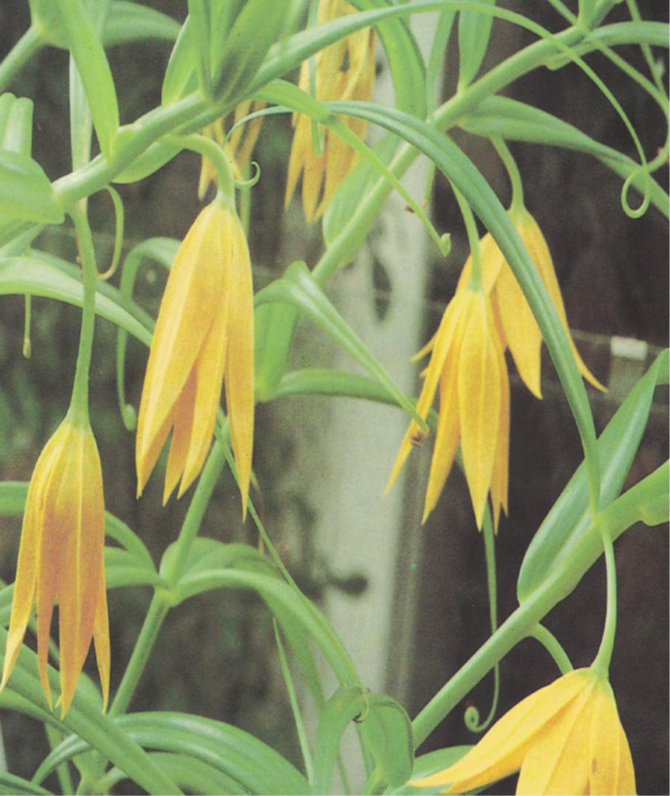
Light and Temperature
This plant needs plenty of light, preferably full sun. For this reason, you can also try to keep it outside in a sun and wind protected spot on the patio if you don't have a suitable spot indoors. Keep the dormant bulbs in a cool spot indoors in the winter.
Watering and Feeding
When the shoots begin to grow in spring, water sparingly, and then later water more frequently with increasing leaf and shoot formation. Use lukewarm water. During the growing Season, which is approximately may through August, provide these plants with dilute liquid fertilizer every two weeks.
Transplanting, Propagating and Grooming
Regular potting soil is fine if mixed with sand. Cactus soil is also fine. The tubers should be repotted every two or three years as needed.
In late fall, allow shoots to weather completely before cutting them off.
The most effective method of propagation is by division. Propagating by seed can also be successful.
Size, Growth and Flowering
This plant is a climber that has thin, usually 3-foot-long shoots and leaves with tendrils at the tip. The ‘Keitii’ variety is larger in all respects and more branching. The above ground foliage Withers in fall.
Between June and August, the orange- yellow, bell-shaped flowers appear. They reach a diameter of 1 to 1 1/2 inches and have no fragrance.
Creeping Charlie/Artillery Plant
Pilea
depressa
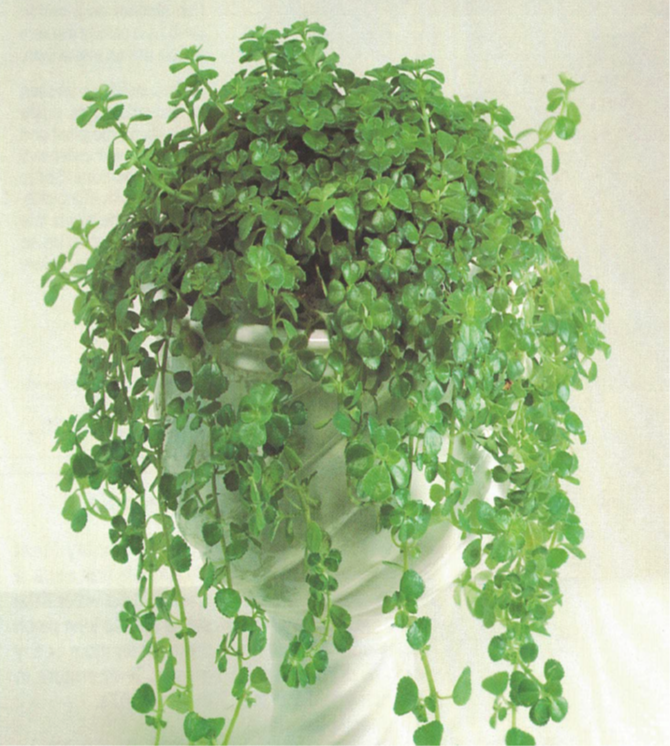
Light and Temperature
This plant likes bright light but no direct sun. Regular room temperature is fine but never below mid 50s in the winter.
Watering and Feeding
The soil should be moist, but the surface should be allowed to dry out before watering. Water less in the winter than in the summer. Feed every week in the summer and mist frequently. Give the leaves time to dry out before nightfall to avoid fungus diseases.
Transplanting, Propagating and Grooming
Pot in spring and good peaty soil.
Pinch back long stems for bushy growth period, cut the whole plant back in the spring.
Propagate with cuttings in spring.
Size, Growth and Flowering
The plants are all low - rarely over 8 to 12 inches, and many have a hanging growth.
The flowers are rather insignificant. They are either pale pink or green and usually appear in spring or early summer. When the pods are ripe they explode and send a cloud of white through the room period no scent.
Flame Violet
Episcia
hybrid
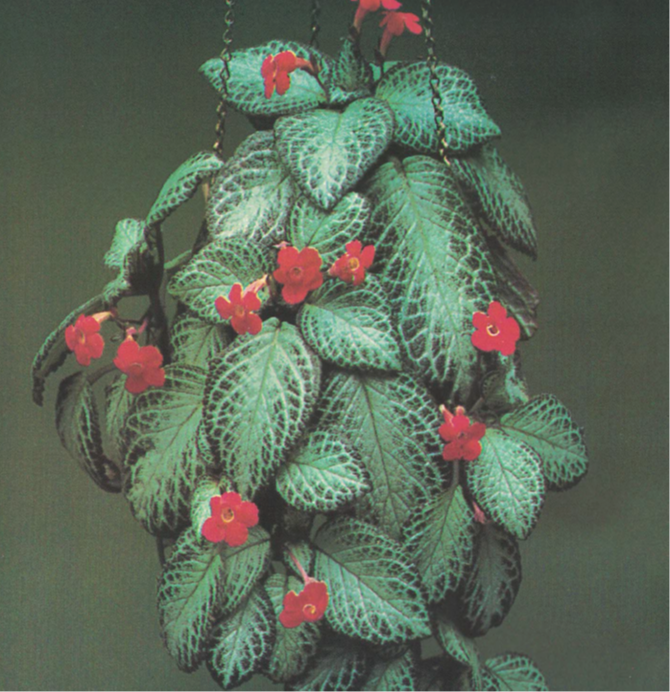
Light and Temperature
These plants appreciate plenty of light but cannot tolerate the strong rays of the sun. They are tropical plants which can live in normal room temperature all year round. Keep them warm at night, and out of cold drafts.
Watering and Feeding
Too much water is usually a greater problem than drying out. Water with moderation in the summer and even more sparingly in the winter period let the soil dry out slightly between waterings. This plant loves high humidity but cannot tolerate water on its leaves. Try placing the pot on damp gravel in the summer or put the plant together with other plants. Give small doses of weak plant food every two weeks in the summer.
Transplanting, Propagating and Grooming
Report in March through April. Use porous, well drained potting soil and mix in a little sand or gravel.
Some varieties can have long bare stems. These can be cut back.
Propagating is easy with the small new plants which grow at the end of the runners. Put a little pot beside the parent plant and let the runner take root. After a while you can separate the new plant from its parent.
Size, Growth and Flowering
The flame Violet is really a creeping plant, but most varieties are suitable as hanging plants. None of the varieties grow to any great size.
This plant can bloom all summer long, from June to September. Although the small flowers have no scent, they are dainty and attractive.
Tahitian Bridal Veil
Gibasis
geniculate
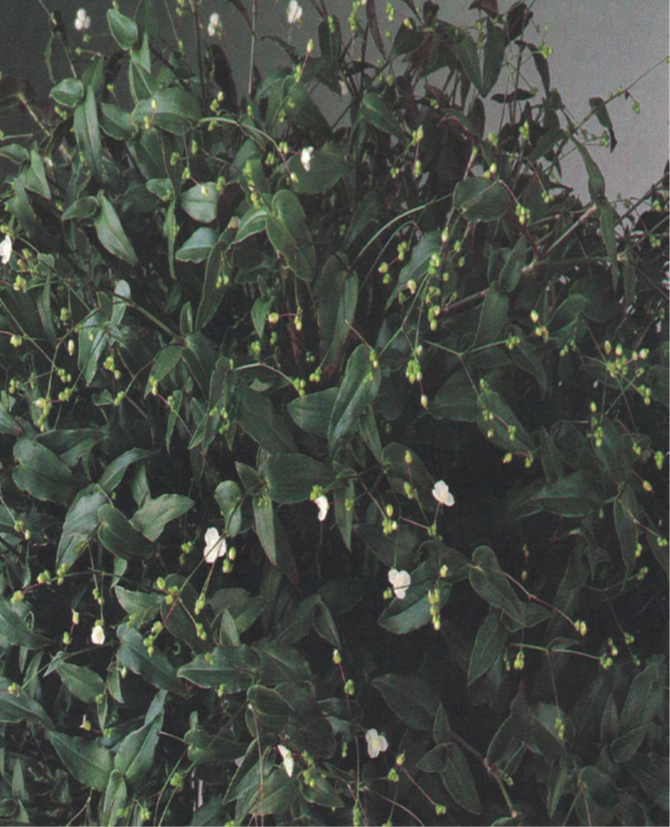
Light and Temperature
Medium light is best, but the brighter light is fine in the winter period normal room temperature year-round and not below 50°F In the winter.
Watering and Feeding
Water regularly throughout the year slightly less in the winter period do not allow soil to remain soggy or get excessively dry period high humidity is preferred, so mist often. Feed every four weeks except in winter.
Transplanting, Propagating and Grooming
Regular potting soil is fine. Repotting is unnecessary as plants are usually renewed every few years.
Remove completely any straggly, bare stems.
Propagate by cuttings.
Size, Growth and Flowering
Wiry, purple, trailing stems about 12-18 inches, turning up at the ends. Thin, dark green leaves are purple underneath. Fast growing.
Tiny white flowers on long wiry stems appear on and off throughout the year. They close up at night. No fragrance.
Kalanchoe
Kalanchoe
manginii
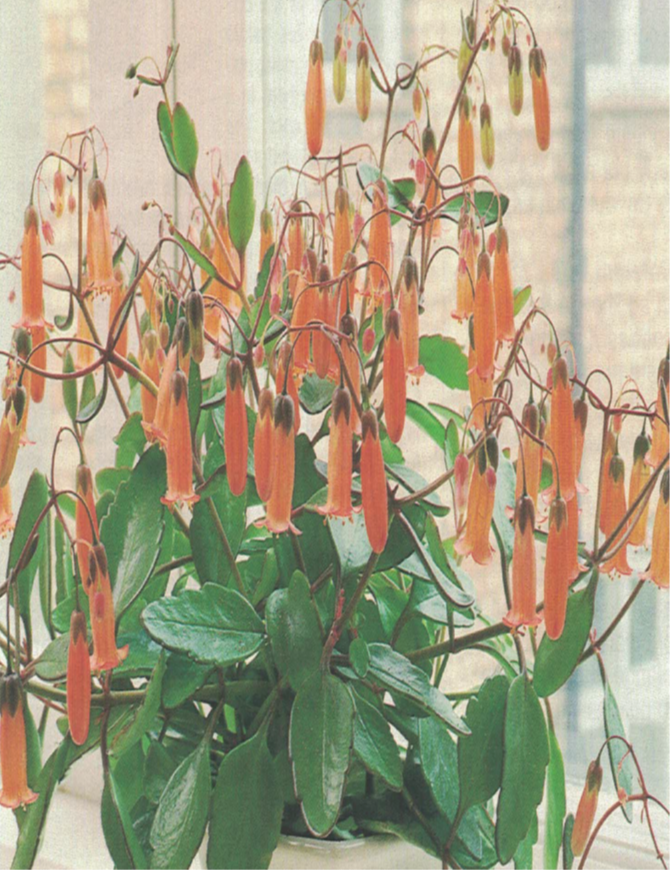
Light and Temperature
Kalanchoe needs plenty of sunlight or the flowers will be pale or even fall off. Warm in summer, somewhat cooler in winter period a plant which is not in bloom at the time can be overwintered at around 50°F.
Watering and Feeding
Kalanchoe lakes ample water but the soil should dry out a bit between waterings. Water regularly through the summer and feed with a weak fertilizer solution. Water less in the winter according to temperature and do not feed.
Transplanting, Propagating and Grooming
Use cactus mix or regular potting soil with added perlite. Older plants should be repotted in early spring.
Remove withered blooms. Pinch out young plants to prevent leggy growth period prune back at least 1/2 after flowering to get optimum bloom the following year.
Easiest propagation with stem or leaf cuttings, but you can also sow seeds.
Size, Growth and Flowering
Kalanchoe is a small trailing plant suitable for hanging baskets it has Oval, serrated, dark, green succulent leaves. Fast growing.
The hanging tubular flowers grow in clusters at the end of long, wiry, branched stems. They are orange- red to pale Peach in color depending on the variety. No scent.
Comlumnea
Columnea
hybrid
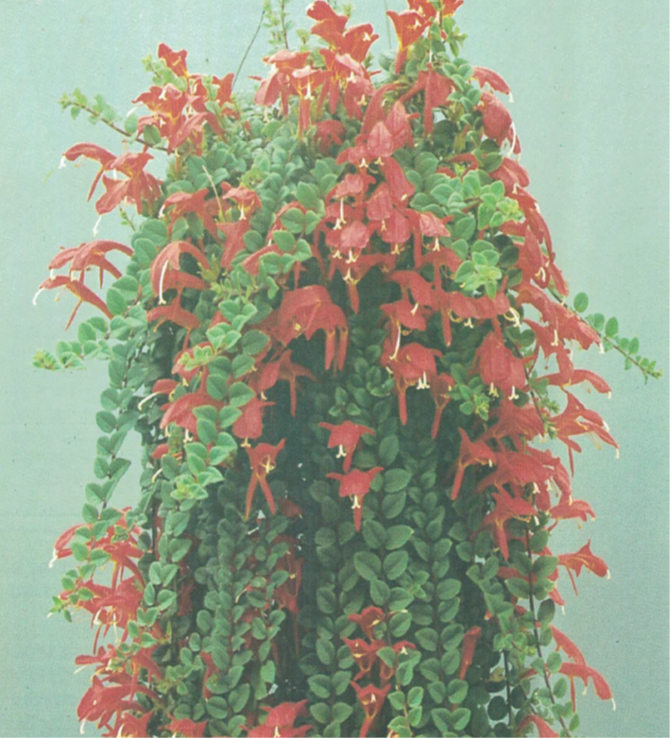
Light and Temperature
Choose a South facing window in winter and a less sunny window in summer. Summer temperatures are fine for this plant but if it gets really warm, mist every day to maintain humidity.
Watering and Feeding
This plant should be kept evenly moist although it can tolerate drying out in between each watering. Good flowering requires high humidity. This is best achieved by standing the pot in a saucer of wet gravel. Hanging plants should be misted regularly. Add half strength liquid plant fertilizer to the water.
Transplanting, Propagating and Grooming
Repot once a year in March through April. Remove all withered blooms. Use a good peat moss-based soil mix.
Cut the stems back by half after flowering to encourage new growth. Tip pinching will produce bushier, healthier plants.
Propagate by taking tip cuttings and plant in peaty soil.
Size, Growth and Flowering
Stems can grow up to 40 inches long and annual growth can be as much as 16-20 inches. The small, oval leaves have an attractive shape and color and are often quite velvety.
The flowers look like small tongues of a flame or parrot beaks in red, orange, or yellow. They grow from the leaf axils and can almost cover the plant in spring and summer. They have no scent.
Bulrush
Scirpus
cernuus
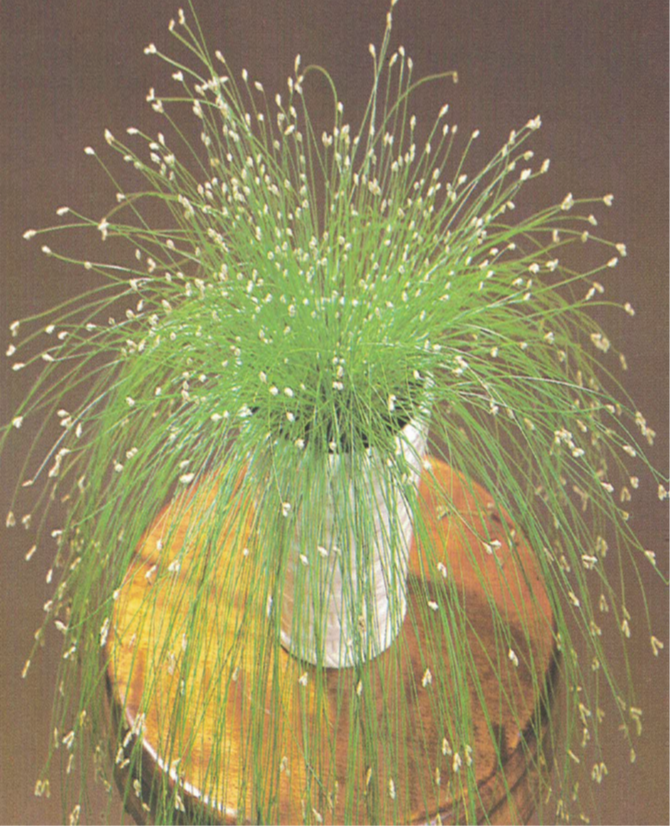
Light and Temperature
This plant must not stand in direct sunlight. If you have it on a broad window seal, it is better to grow it in a little shade of other plants. Turn the plant every now and again so that it has a good even shape. This plant grows well all year at a moderate to warm temperature.
Watering and Feeding
This plant needs a lot of watering, and the roots must always stand in water. If you can, water with rainwater or water that is free of alkalinity. Feed regularly in the summer months, but not at all in the winter.
Transplanting, Propagating and Grooming
The soil should be strong and rich in hummus. You can use commercial potting soil. Repot in February and remove any yellow centered shoots.
This plant should not be pruned, but all yellow and withered shoots should be removed when repotting.
Propagate by division.
Size, Growth and Flowering
This plant is a fast-growing hanging plant. In the course of only one season, you may find that it has grown to some 10-12 inches long period the plant has a rather tufty shape.
The axils of the flowers make the plant longer in the summer. The axils of the young plants are quite small, but the older plants can have them up to 28-30 inches. The small whitish flowers have no scent.
String of Hearts/Rosary Vine
Ceropegia
woodie
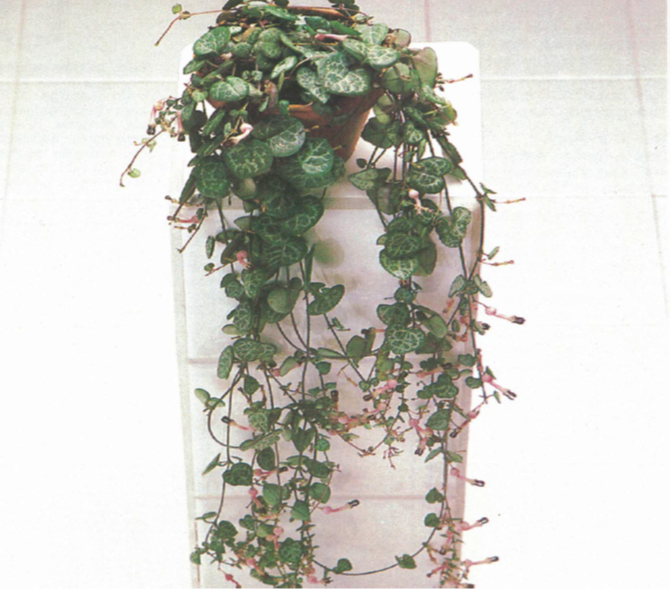
Light and Temperature
This plant grows well in a normal room temperature in the summer and prefers a slightly cooler position in the winter, about 60-65°F. It can stand in full sunlight all year round as long as it is protected from the burning rays of the midday sun.
It grows well is a window and dills out the space well between other plants.
Watering and Feeding
Water carefully, so the soil is kept just moist, but never wet.
Feed with a diluted fertilizer from May to August.
Transplanting, Propagating and Grooming
Repot in April and use a porous, well-draining soil.
This plant is not damaged by hard pruning and can easily be trimmed to keep it the size and shape preferred.
Propagation is easiest from cuttings, or from the growth buds that appear at the base of the leaves. Sow the buds like you would seeds.
Size, Growth and Flowering
This is an especially good hanging plant. It has small, heart-shaped leaves and thin, hanging stems which can easily be a couple feet long.
It can flower at any time of the year, but is best in summer and early fall. The flowers are a brownish-pink and have a weak, not particularly pleasant smell.
Codonanthe
Codonanthe
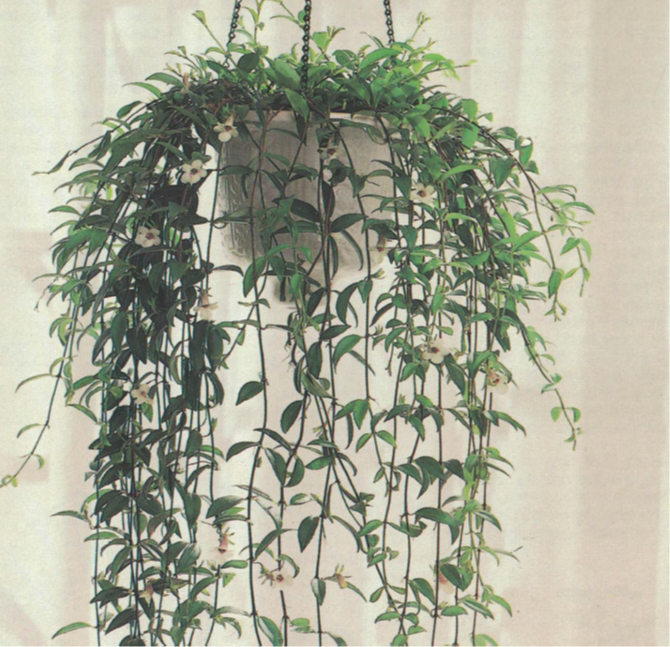
Light and Temperature
This plant cannot stand direct sunlight; 1/2 shaded location is better period temperatures throughout the year should be 65-70°F.
Watering and Feeding
Water only when the soil feels dry. During the growing season, feed every other week.
Transplanting, Propagating and Grooming
Use a lightweight potting soil such as peat moss/perlite mix. Repot in spring.
Shoots which have grown too long can be cut back as desired.
Propagate by seed, cuttings, or division.
Size, Growth and Flowering
This plant has long hanging or creeping shoots which are branched but very thin. The Oval leaves are thick and leathery, almost succulent.
Most common are varieties with white, funnel shaped blossoms whose throats are spotted with red. There are also varieties with yellow, lilac, or pink blossoms.
Asparagus Fern
Asparagus
densiflorus
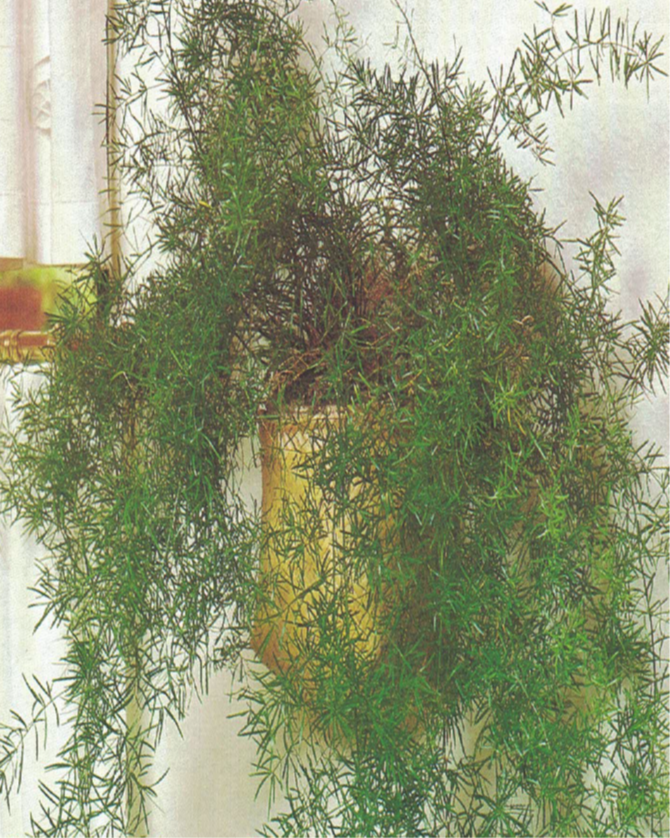
Light and Temperature
The asparagus Fern thrives best hanging in an east or West facing window. It likes to be out in the fresh air in a warm and shady spot in the summer but will happily grow indoors all year round. If hung in a cooler spot for the winter, the temperature should not drop below 46°F.
Watering and Feeding
Let the asparagus friend dry out a little before watering. It may be necessary to water it up to two to three times a week in the summer. Feed regularly. Adjust the amount of water to suit the plant in the winter, depending on where it is hanging. Too little water will cause shedding of leaves.
Transplanting, Propagating and Grooming
The soil should be light and well drained. Use a coarse blend of loam and non-enriched peat.
Clip out old, brown stems. By cutting the asparagus Fern right back to the ground level, it will grow again from the base.
Propagate by seed or division of older plants.
Size, Growth and Flowering
The asparagus Fern is a bushy, green plant with naturally hanging stems which can grow to three feet long. With good care a plant will develop many new shoots every year.
The tiny white flowers come in late summer or early fall and have no scent. They may be followed by berries.
Creeping Fig
Ficus
pumila
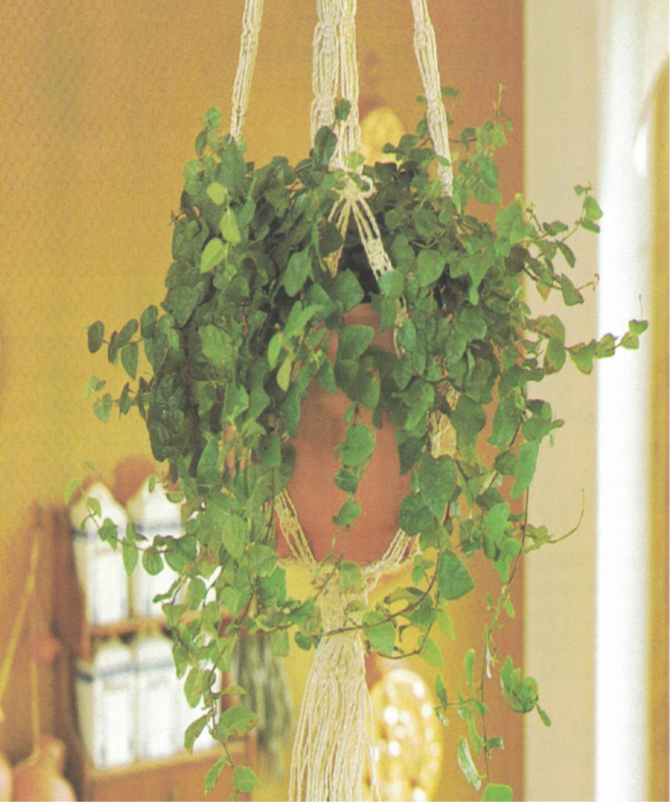
Light and Temperature
Creeping fig prefers to grow in the shade and is therefore a useful plant for rooms where other plants may not thrive. Ideally, summer temperatures should be in the 70s, winter temperatures in the 60s, and high humidity constant.
Watering and Feeding
Water well in the growth season, about one to two times a week. Never let water remain in the saucer. If the air is dry, mist it weekly. Fertilize every 3rd watering.
Transplanting, Propagating and Grooming
Smaller plants should be repotted every other year in a rich and porous planting mix. Use a clay pot. Larger plants should be repotted only when absolutely necessary. Do this very carefully.
Groom and cut back when needed.
Use cuttings to propagate.
Size, Growth and Flowering
This plant is capable of growing at an astonishing rate. Older plants, especially on a trellis can produce shoots of more than three feet in one year. Fortunately, it is easy to trim the plant back again.
Creeping figs do not normally flower in the home, but they might if grown in a greenhouse or on a sun porch. The flowers are insignificant and have no scent.
Pouch Vine
Dischidia
pectenoides
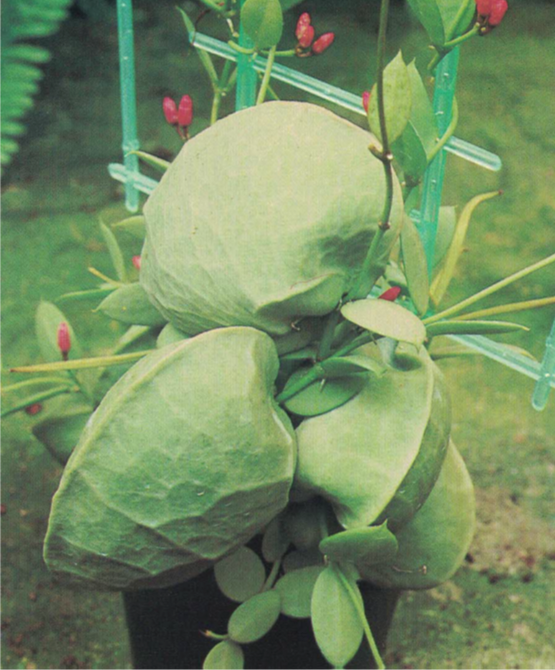
Light and Temperature
Pouch vine likes heat and light, but does not tolerate strong, burning light. It is a tropical plant that needs high heat and humidity.
Watering and Feeding
The potty mix should be kept moist but not wet. Humidity must be kept high, either through evaporation or by surrounding it with several other plants. Shower and mist the plant often. Feed with a weak solution of a balanced fertilizer during the spring and summer months.
Transplanting, Propagating and Grooming
Use a loose orchid mix. Repot carefully only if necessary. The roots are sensitive, and it is often better to merely apply a top dressing rather than repotting the plant. Pouch vine can also be grown in Moss baskets or on tree Fern poles.
No grooming is necessary. Wind at the long vines carefully around A-frame or other support.
Use cuttings to propagate.
Size, Growth and Flowering
Pouch vine is not a particularly large plant but is very decorative and interesting with its two types of leaves-small succulent ones and large inflated pouches.
The flowers are small and red, and shaped like small urns. Very often the plant is in flower when you buy it but later, in your home, it will not flower again. Practically no fragrance.
Miniature Grape Vine
Cissus
striata
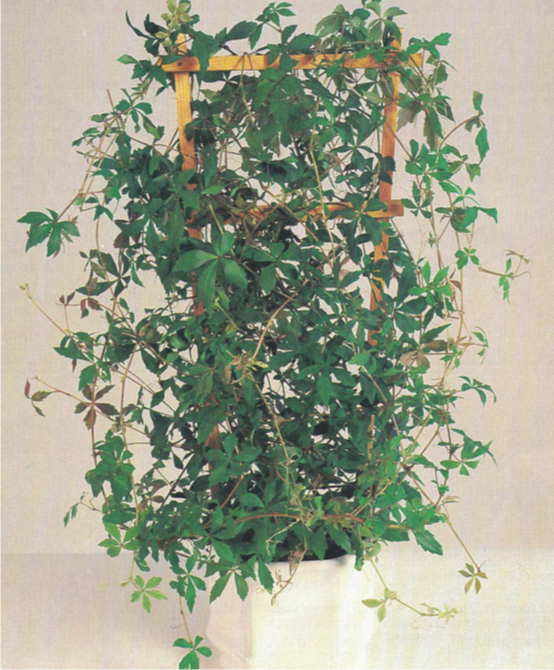
Light and Temperature
Cannot tolerate direct sunlight but thrives in an east or West facing window on a wall in a winter garden or Conservatory. Room temperature in the summer and should not be lower than 60°F in the winter.
Watering and Feeding
Water well and feed once a week in spring and summer. Less water and no feeding in the winter. Like high humidity so mist often with purified water.
Transplanting, Propagating and Grooming
Pot young plants each spring, older plants every other year. Plant several young plants together for a full bushy plant. The soil should be fertile, well drained, and not too acidic. If the plant is not repotted, just change the topsoil in the original pot.
Pinch young plants out to make them bushy. Cut back long straggly stems on older plants.
Use cuttings to propagate.
Size, Growth and Flowering
The miniature grape Ivy is a long- stemmed climber or trailer but it is smaller and more delicate than other members of its family. Fast growing
No flowering.
Jasmine
Jasminum
polyanthum
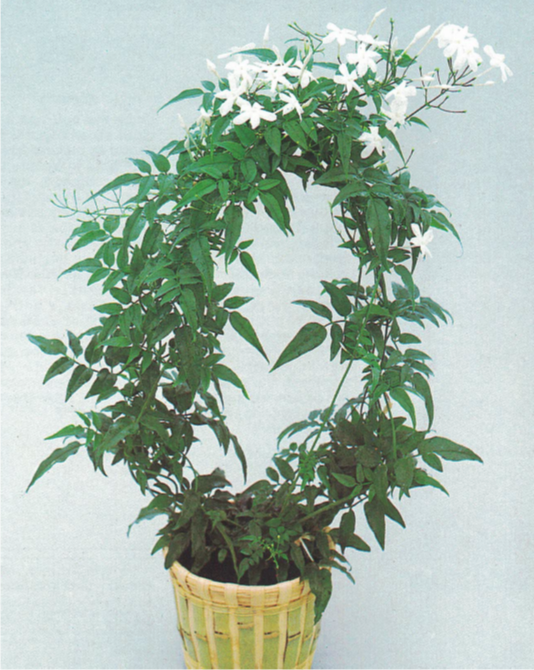
Light and Temperature
The Jasmine needs lots of light, but not direct sunlight, and prefers not to be in too high a temperature. Do not let the winter temperature drop below 50°F. In order for the Jasmine to flower, the winter temperature should not be less than 60-65°F.
Watering and Feeding
Water the Jasmine regularly all year round and mist it every day in the summer. Add liquid plant food to the water once every 14 days from March to September.
Transplanting, Propagating and Grooming
Repot in spring after the flowers have died down. Use airy and nourishing soil or a good potting compost.
Jasmine grows very vigorously and should be cut back after it has flowered. Pinch out the tops of the young shoots regularly in the beginning of July.
To propagate use cuttings in March.
Size, Growth and Flowering
Although the Jasmine has long vines it is not a very strong climber. Potted Jasmine's are often tied to a large hoop which is fixed to the pot and supports the plant. If the Jasmine is growing in a greenhouse or glass porch, it can grow along an espalier or trellis.
The flowers all appear at about the same time, the Jasmine will only flower once or twice a year. The buds are pink, and the flowers are white and have an intensely sweet fragrance.
German Ivy
Senecia
mikanoides
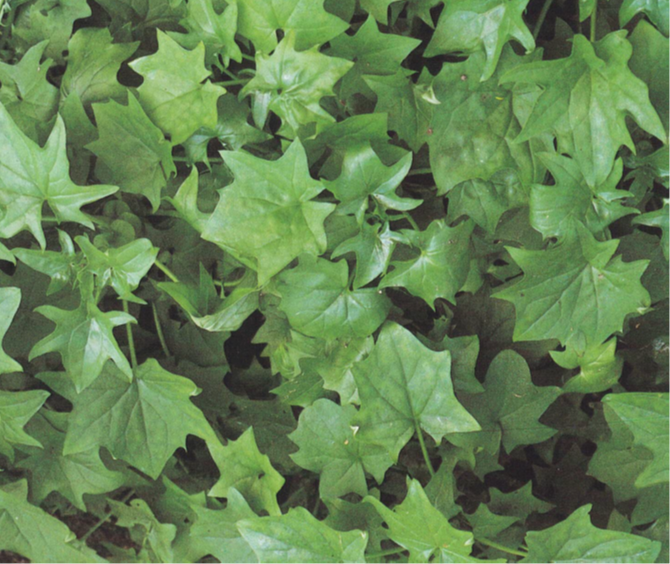
Light and Temperature
German Ivy prefers a light spot with no direct sun. It will thrive with temperatures in the lower 60s in the summer and should be protected from frost in the winter period. It is a good idea to take it indoors for the winter.
Watering and Feeding
Water and food regularly from March through September period keep fairly dry for the rest of the year to avoid rot.
Transplanting, Propagating and Grooming
German Ivy grows best in a well-drained, rather coarse soil. It responds well to repotting each spring.
Groom only if growth has been very vigorous or when you take your plant in for the winter.
Propagate with tip shoots in early spring. Plant them in a mix of peat Moss and either perlite or coarse sand.
Size, Growth and Flowering
In good conditions German Ivy can be 3-4 feet tall. You can also keep it as a hanging plant. It will produce long hanging stems.
German Ivy flowers except in areas with a mild climate. The flowers are small delicate daisies with no scent.
Strawberry Geranium
Saxifraga
stolonifera
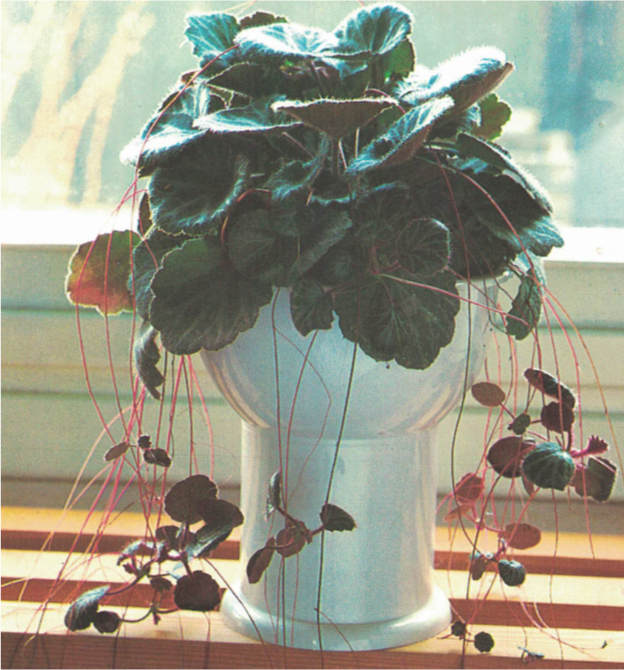
Light and Temperature
Place in a hanging window with plenty of light, or the colors of the variegated leaves will disappear. It grows well in the summer with the temperature in the 60s but prefers to be cooler in the winter with the temperatures in the mid-40s to lower 50s.
Watering and Feeding
Water regularly in the summer and feed every two weeks. It does not matter if the plant dries out a little between watering. Water less and do not feed in the winter.
Transplanting, Propagating and Grooming
This plant grows well in a peat and rich soil and is not very demanding. Does not usually get so old that it needs to be repotted, but it sometimes grows so big that it needs a larger pot.
Remove the offsets as they wither. Take away dead, ugly leaves.
Propagate from the runners at the ends of the vines.
Size, Growth and Flowering
The strawberry geranium is a small, undemanding house plant which can grow whole curtains of runners. It is not very tall, but the flower stems can be up to 10 inches long.
Chestnut Vine
Tetrastigma
voinieranum
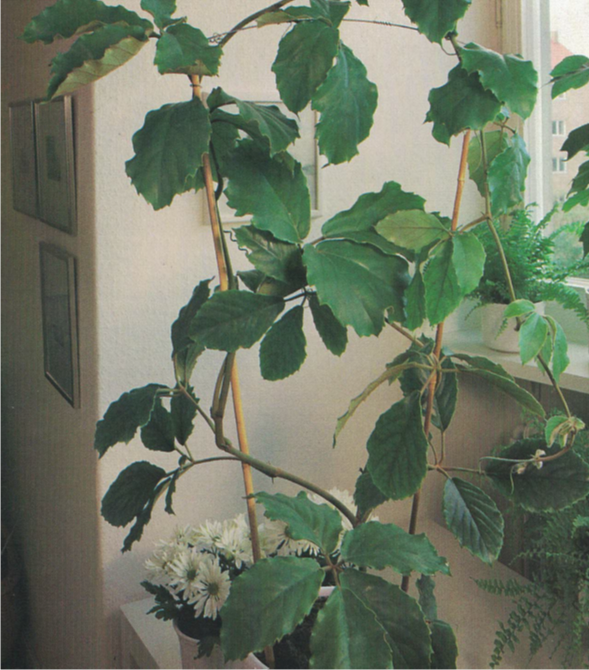
Light and Temperature
It's plenty of light through the year, but protection from strong spring sunshine. Summer temperatures of mid to upper 70s in the day, lower at night. Cooler in winter but not below 55-60°F.
Watering and Feeding
Plenty of water regularly through the summer months. Let the soil dry out a little each time, but never allow it to become completely dry. Feed once a week from March through August. No feeding in winter and less water.
Transplanting, Propagating and Grooming
Regular potting soil with good drainage is preferred. Repot each year in March.
Groom only if stems are unsightly or too long period cut back in the rest season only.
Use cuttings to propagate. This is not easy since they need bottom heat and constant, high humidity.
Size, Growth and Flowering
Chestnut vine is an extremely vigorous climbing plant. The five- lobed leaves have brown hairy undersides. The vines are also somewhat hairy. The plant needs strong support.
This plant rarely blooms indoors. The flowers are small and have no scent.
Kiwi
Actinidia
chinensis
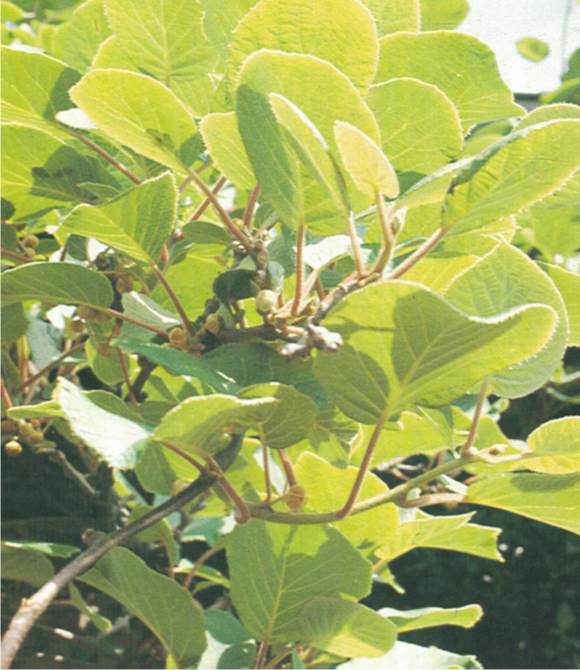
Light and Temperature
Needs full sun. Cannot tolerate temperatures lower than 5°F; keep indoors during winter months if grown in cold climates.
Watering and Feeding
Vines need plenty of water in the summer and very little in the winter period during the growing season plants need frequent feeding as well.
Transplanting, Propagating and Grooming
Use a rich well drained soil. For container plants use top quality potting soil. For garden growing Kiwis enrich the soil with plenty of compost.
Trim the stem ends to control and direct new growth period prune plants in the winter to shape and train vines.
Try collecting seeds from store bought fruits or start cuttings from established plants.
Size, Growth and Flowering
The Kiwi is a rambling, twining climber that may grow 5-8 feet in a summer.
Kiwis flower in may or June. Plants are either male or female, and at least one of each is needed to grow fruit. Flowers are yellow and small.
Cup-and-Saucer Vine
Cobaea
scandens
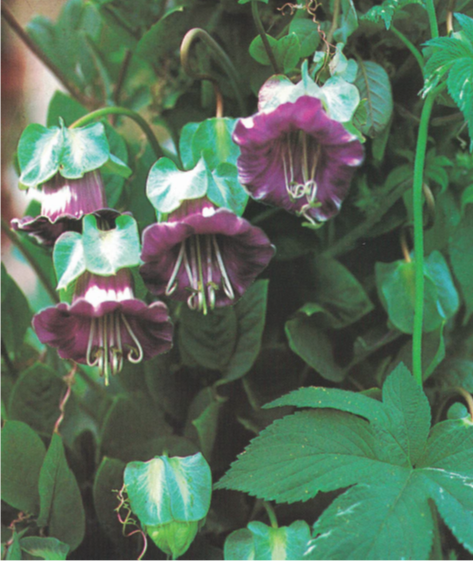
Light and Temperature
This plant flowers best and good white and can tolerate direct sunlight. Normal room temperature in the summer; 45-50°F in the winter.
Watering and Feeding
Give plenty of water in the summer, but water sparingly in the winter. For vigorous growth, water the plants once a week from March through September with the solution of liquid plant food. If you don't want the plant to grow prolifically, give a weaker plant food solution once every 14 days.
Transplanting, Propagating and Grooming
Young plants should not be grown in too rich soil. Sandy potting soil is fine. For older plants use regular potting compost mixed with a little garden soil. Older plants should be repotted in March.
For a good show of flowers, remove some of the side sheets in spring. Older plants should be cut back in February.
Propagate by seeds.
Size, Growth and Flowering
The cup and saucer vine is a vigorous, rapidly growing plant with lots of branches. It can grow 24 feet long if allowed. It clings by its tendrils as it climbs.
In its first year the plant is in flower between July and September. Older plants or plants grown from cuttings come into bloom a month earlier. The large, hanging flowers are usually Violet in color, but sometimes white, with yellow stamens. They have no scent.
Grape Ivy
Cissus
rhombiflora ‘Ellen Danica’
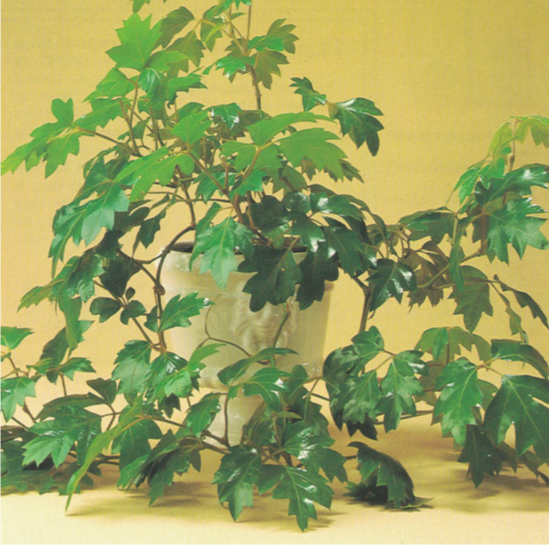
Light and Temperature
This plant can tolerate swings of temperature between 50-74°F. This plant will adapt to available light, it is compact and bushy and strong light and open and airy in poor light.
Watering and Feeding
Since the grape Ivy grows all year it will need regular watering, three to four times per week in the summer and one to two times per week in the winter. Feed once or twice weekly from March through November.
Transplanting, Propagating and Grooming
Loose, porous soil is best. As the sphagnum in the pot is broken down, new layers of fresh soil should be added to the surface at intervals. It is often difficult to repot and establish climbing plants.
Grooming by pruning to achieve a nicely shaped plant. Large, shapeless plants can be cut back in the spring so new shoots have the rest of spring and summer to grow.
The soft tip shoots are not suitable cutting material. Choose shorter mature side shoots with three leaves each and plant one to three together in light potting compost. Cover the pots with a plastic bag at first to prevent excessive evaporation.
Size, Growth and Flowering
Grape Ivy grows rapidly and will soon fill the space provided. It clings to wire or netting and will make a compact, green pillar around a free-standing pole.
This plant is grown for foliage, not flowers. Will seldom bloom as a house plant.
Chilean Bellflower
Lapageria
rosea
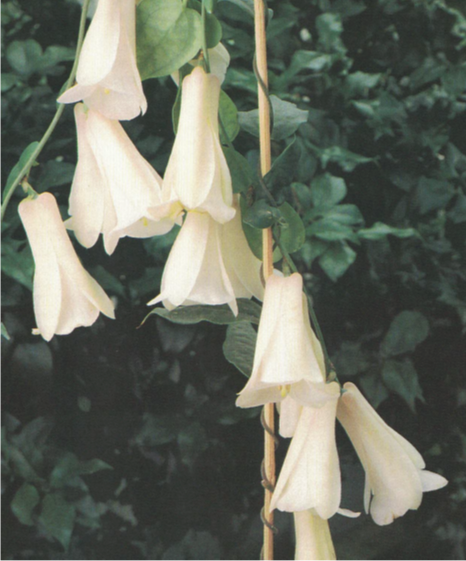
Light and Temperature
Plenty of light but protection from direct sunlight. Normal, but not hot, summer temperatures, and 50-55°F in the fall and winter.
Watering and Feeding
Water with purified water if tap water is alkaline. Feed with half strength liquid plant food during the brighter months of the year.
Transplanting, Propagating and Grooming
Use a light, fast draining soil mix. Provide good drainage in the base of the pot. Repot only when absolutely necessary. Whenever the root system is disturbed, it takes a long time for the plant to recover.
Small plants can be tip pinched a few times to stimulate bushy growth period otherwise no grooming until the plant gets too big.
Propagate by seed or cuttings.
Size, Growth and Flowering
A slow growing, climbing Evergreen with stems up to 15 feet long period the stems need to be trained on a support. The green, leathery leaves are 2-3” long. The heavy, waxy flowers are about four inches long and look like bells.
The flowers come in shades from dark red through pink and also all white. Flowery incurs in the summer and fall. No special fragrance.
Swedish Ivy
Plectranthus
australis
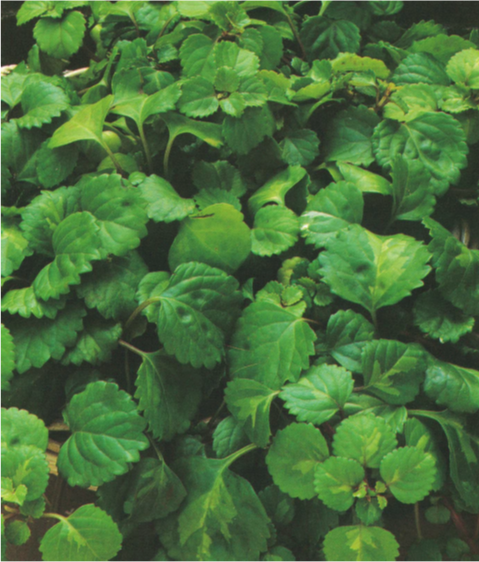
Light and Temperature
Bright light with some sun but provide shade from midday sun in the summer. Normal room temperature all year but cooler is better in the winter, 55-60°F.
Watering and Feeding
Plenty of water at all times, but the soil can be allowed to dry slightly in the winter if plants are kept cool. Fertilize monthly with liquid fertilizer except in the winter.
Transplanting, Propagating and Grooming
Standard well drained potting soil is fine. Annual repotting is unnecessary but pot bound plants can be repotted as needed anytime of the year.
Pinch tips and cut back older stems frequently to maintain lush bushy appearance.
Propagate by cuttings.
Size, Growth and Flowering
These are fast growing plants with 1 1/2- to 2-foot-long trailing stems. P. australis Has round, fleshy, scalloped leaves. P. oertendahlii has rounded bronzy green leaves variegated with silver along the veins. O. coleoides ‘Marginatus’ has rounded green leaves with white margins.
Small unscented white or pale purple flowers in sprays up to 8 inches long in the summer. Some varieties have aromatic foliage.
Scindapus
Scindapsus
pictus
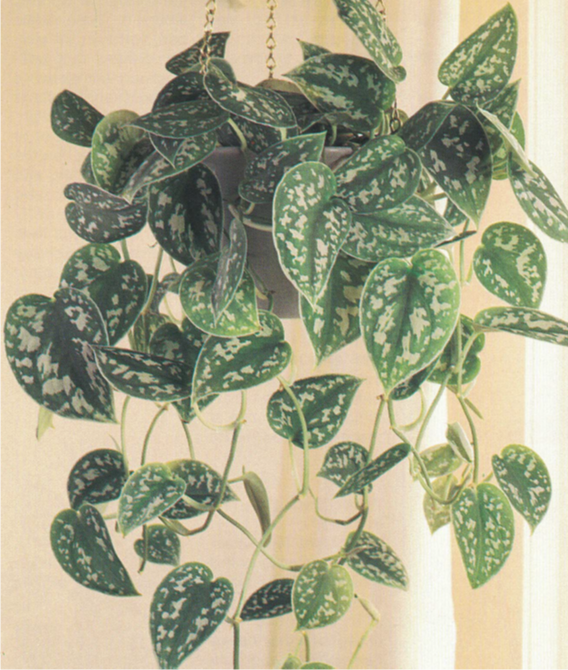
Light and Temperature
Likes
bright light but not in direct sun. 1/2 shady spot will also do. Regular room
temperature is fine, but humidity must be kept high. Winter temperatures should
not sink below 55°F.
Watering and Feeding
Similar to pothos
Transplanting, Propagating and Grooming
Use well drained potting soil with drainage material in the base of the pot. Repot in fresh soil each spring.
Cut off too long or unattractive stems.
Very easy to propagate from cuttings. any piece of stem with a couple of leaves can grow into a new plant.
Size, Growth and Flowering
A climbing foliage plant with stems that can reach a length of several yards. Thick leaves are heart-shaped, velvety green and have grey or silvery spots and, occasionally, silver edging. Aerial roots grow on the stems. Medium slow growth rate.
Ground for its elegant foliage. Will not bloom in cultivation.
Ground Ivy
Glechoma
hederacea
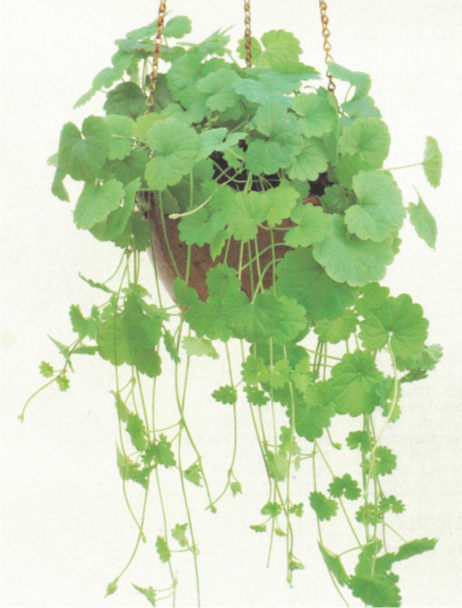
Light and Temperature
Ground
Ivy best thriving in bright light, but out of direct sun. It prefers
temperatures on the cool side all year round and will grow well at a normal
room temperature. It is important that the temperature does not exceed 55°F at night during the winter. If it is too warm
the plant will become leggy and straggly.
Watering and Feeding
Water regularly all year and never let the soil dry out completely. Feed once a week in the summer but not in the winter period the plant needs plenty of nitrogen to keep it green.
Transplanting, Propagating and Grooming
Repot each year. Regular potting soil is fine. Small newly rooted cuttings can be planted 4 to 5 in a six-inch pot.
Cut old, straggly stems completely back to the pot edge. This will encourage the plant to bush out.
Propagation is easiest with cuttings or by division. Do this in spring or early fall. Cuttings can be planted in regular potting soil and will root quickly.
Size, Growth and Flowering
If ground Ivy is grown in a hanging basket the stems can reach a length of up to six feet. As a creeper, it will not reach a height of over 4-6 inches. Sometimes the plant may present a surprise and change from a creeper to a more upward climbing growth where it can reach a height of two feet.
Ground Ivy will produce several small blue flowers throughout the year. The flowers are scentless, but the plant has a faint, aromatic fragrance.
Passion Flower
Passiflora
caerulea
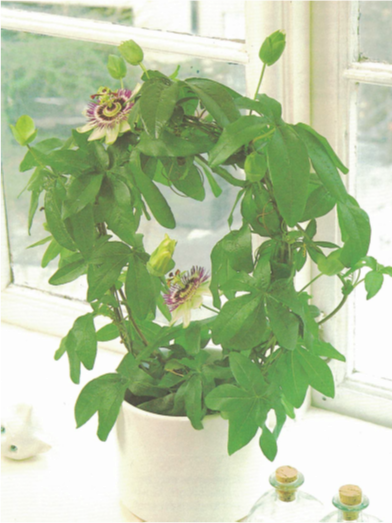
Light and Temperature
Passion flowers thrive best between 56-65°F. More warmth doesn't hurt them but encourages spider mites. Provide plenty of fresh air. Flowering will depend on the plants to get a lot of light.
Watering and Feeding
Throughout summer, feed and water weekly. Always keep the soil moist and use warm water. Plants should winter in a cool spot with moderate watering and no feeding.
Transplanting, Propagating and Grooming
Passion flowers like heavy, limey, nutritious soil if they are to bloom profusely. Repotting every year isn't necessary.
Thinning out the weakest branches in summer will enhance flowering. In fall cut the plant back to about 8 to 20 inches.
Plant cuttings in a pot. You can also bend shoots into soil.
Size, Growth and Flowering
All passion flowers have tendrils. They can grow to almost unlimited heights.
Continuously in flower from May to September. Some are mildly fragrant.
Black Pepper
Piper
nigrum
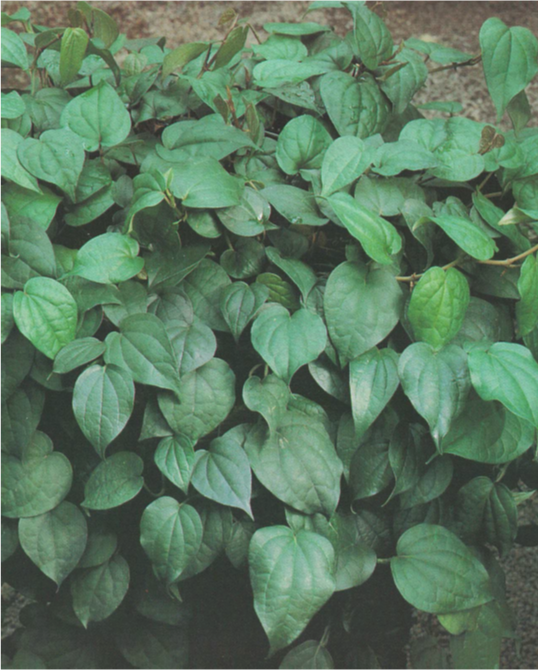
Light and Temperature
Best and bright light, but not full sunshine. Summer temperature from 70-80°F and cooler in the winter, but not less than 50-55°F.
Watering and Feeding
Water regularly several times a week in the growing season. The soil should be evenly moist but never wet. Feed regularly, more in the summer and less in the winter.
Transplanting, Propagating and Grooming
A fast-draining potting soil is best. Repot in the spring.
Remove unwanted stems at any time. Thinning or cutting back is best carried out at the end of the growing season, or just before new growth starts.
Will usually propagate with cuttings.
Size, Growth and Flowering
The pepper is a woody climber, but fairly compact and manageable as a house plant.
The rather unobtrusive flowers grow in clusters, but the plant rarely blooms in cultivation. Regular room temperature is not high enough to bring the plant into bloom.
Pellionia
Pellionia
pulchra
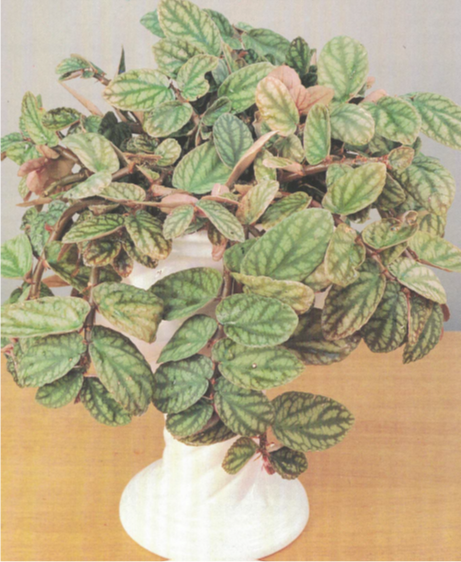
Light and Temperature
These plants need light, but they can tolerate neither direct sunlight nor drafts. They flourish in regular room temperature, even in winter. They must never be allowed to get colder than 55°F.
Watering and Feeding
These plants always need light, moist soil, and good humidity. They grow best over other plants in a window or a greenhouse. They can also grow in a pot over wet pebbles or on an upside-down pot over a dish of water.
Transplanting, Propagating and Grooming
If the plant fills the pots, repot them in early spring. Use an airy blend of peaty potting soil, possibly with a little added perlite.
Leggy plants could be trimmed back in spring and encourage the breaking of new, fresh stems, and leaves. Over long stems can be pinched back at any time.
Use trimmings and prunings for cuttings to propagate.
Size, Growth and Flowering
Pellionias are low plants, seldom over 8-10 inches tall, but the hanging stems can be quite long. The leaves are attractive and marbled with clearly visible veins.
These plants are grown for their handsome foliage. They may flower in summer but the flowers themselves are rather insignificant. They can take too much energy and nourishment from the leaves, and it is often best to pinch them out. No fragrance.
String of Beads/String of Pearls
Senecio
rowleyanus
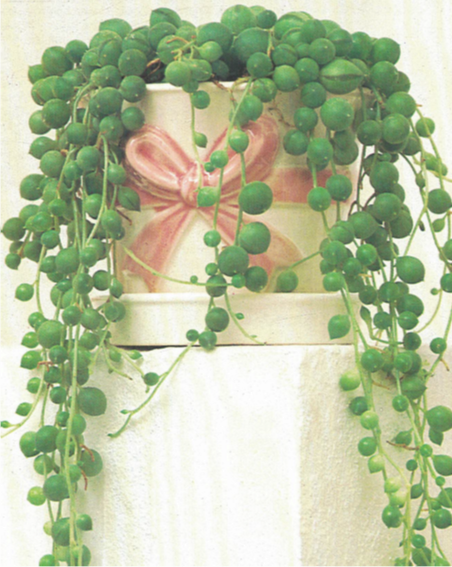
Light and Temperature
This plant should be kept in as much light as possible, preferably full sunlight. Keep it warm in the summer and cool, 50-55°F, in the winter, with plenty of light.
Watering and Feeding
Water with care and never let water remain standing in the dish. Give moderate amounts of plant food in the growing season (winter).
Transplanting, Propagating and Grooming
A string of beads grows best in a sandy, rich mixture which should contain a little clay. Repot once a year at most, or when the soil becomes depleted.
Cut the stems back if they are too long period use this as an opportunity to take cuttings.
This plant only propagates with cuttings. They grow best in the fall and will quickly strike roots when planted in small pots.
Size, Growth and Flowering
String of beads is in an unusual plant with creeping or hanging stems. Believes are being shaped, with a translucent stripe.
String of beads will occasionally produce small, white flowers. They have a faint, spicy scent.
Velvet Plant
Gynura
scandens
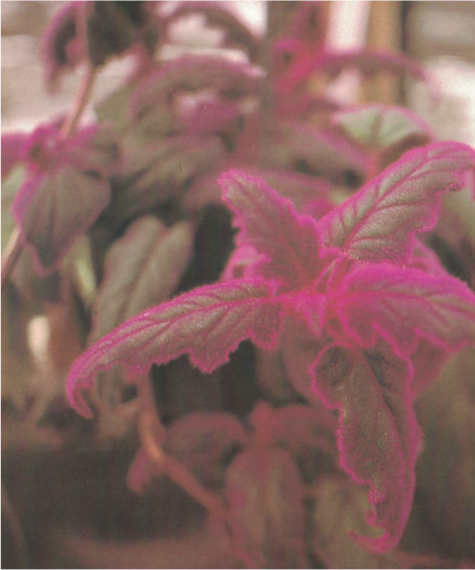
Light and Temperature
Velvet plants can tolerate a lot of light in regular room
temperatures. Lower the temperature to the lower 60s in winter and water less.
Watering and Feeding
Water well in spring and summer and add a weak fertilizer solution to the water every two weeks. Water sparingly in the winter and do not feed.
In warm weather the velvet plant appreciates being misted
with tepid water but shake it gently afterwards to prevent water spots from appearing
on the leaves.
Transplanting, Propagating and Grooming
Repotting spring and regular potting soil.
You can cut old plants back severely when they become leggy, but it is better to make new plants from the cuttings.
Propagate by cuttings in the spring.
Size, Growth and Flowering
The velvet plant is a rather delicate climbing or creeping plant with soft stems up to 20 inches long period the entire plant is covered with purplish velvety hairs. Fast growing.
Older plants can bloom from April through September period.
The orange flowers have an unpleasant scent and should be removed while still
in the bud stage.
Kangaroo Treebine
Cissuc
antartica
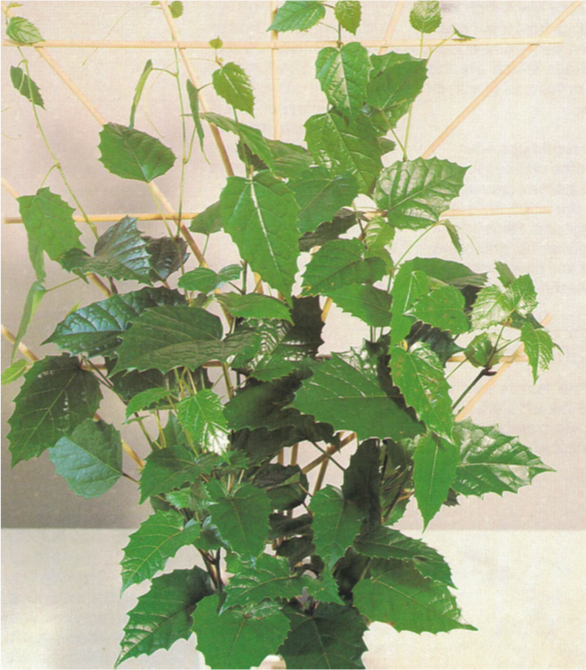
Light and Temperature
This plant needs plenty of space but cannot tolerate full sunlight. Summer temperatures in the 70s is fine but in winters it should be cool, around 60°F is best.
Watering and Feeding
Do not let this plant dry out in the summer. Water it well once or twice weekly but half as much in the winter period feed every second or third watering in the summer.
Transplanting, Propagating and Grooming
Always use a nourishing, well drained compost report once a year unless growth is so vigorous that it is necessary to change the pot more often. Trim the roots at the same time.
Groom often especially in the middle of the growth season. Pinch the plant out to encourage bushy growth period cut the plant back in spring, if desired
Propagation is easy with cuttings.
Size, Growth and Flowering
This plant can grow 10-14 feet in height and the same in width is not unusual period it can grow 2-3 feet in one year.
Older plants may flower. These flowers are very small and insignificant and have no scent.
Smilax
Asparagus
asparagoides
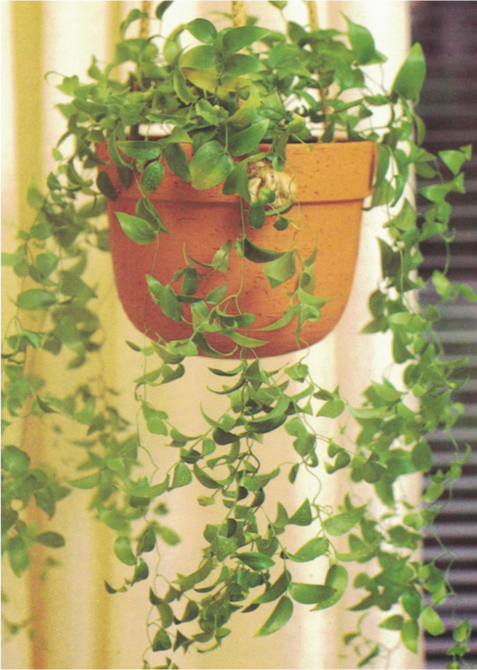
Light and Temperature
This plant grows well in both sun and shade and can be grown outside in the summer. Most plants prefer a winter temperature of around 50°F but S. rotundifolia is hardier and can survive several degrees of frost.
Watering and Feeding
Water and feed regularly in the summer. Water only when the soil is dry in the winter and do not feed.
Transplanting, Propagating and Grooming
This plant grows best in light, porous soil. Regular potting or garden soil is fine. Repot when the roots start to grow through the drainage holes, or when you want to divide your plant.
Pick off any unsightly leaves and cut the plant back if it has become too straggly and unattractive. Normally, let the stems wind their way and do not groom too much.
Propagate by dividing older plants.
Size, Growth and Flowering
These plants are climbing plants with stems that can grow to a length of several feet. The pointed leaves are often spear or heart-shaped, though one variety has almost round leaves. The stems have tendrils and sharp prickles.
The small green flowers are insignificant. They grow in pairs or clusters on the small stalks and have no scent.
Purple Heart Plant
Setcreasea
pallida
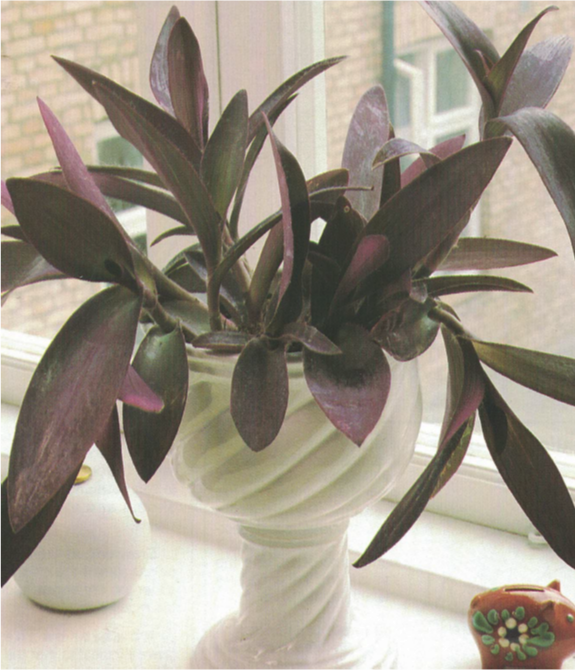
Light and Temperature
The Purple Heart thrives if the temperature is on the cool side, about 64°F in the summer and 53°F in the winter. However, this is one plant that can easily adapt itself to regular room temperature. It should be provided with plenty of light and sheltered from the sun. Too little light will cause the foliage to fade.
Watering and Feeding
Water well in summer. Although these plants must never dry out, they do not like excess water. Do not overwater in the winter period feed every other week in spring and summer.
Transplanting, Propagating and Grooming
Repot Purple Heart in the spring, or even better, make new plants from cuttings placed in moist, sandy potting soil.
Pinchback growing tips to encourage bushier growth.
Propagate by cuttings in the spring and summer.
Size, Growth and Flowering
Although only a few inches high, the Purple Heart is usually grown as a hanging plant because of its long trailing stems. It may grow 2 feet or more in a season.
The Purple Heart bears small purple flowers at any time of the year, but it is mainly grown for the sake of its beautiful leaves. The flowers have no scent.
Bleeding Heart Vine
Clerodendrum
thomsoniae
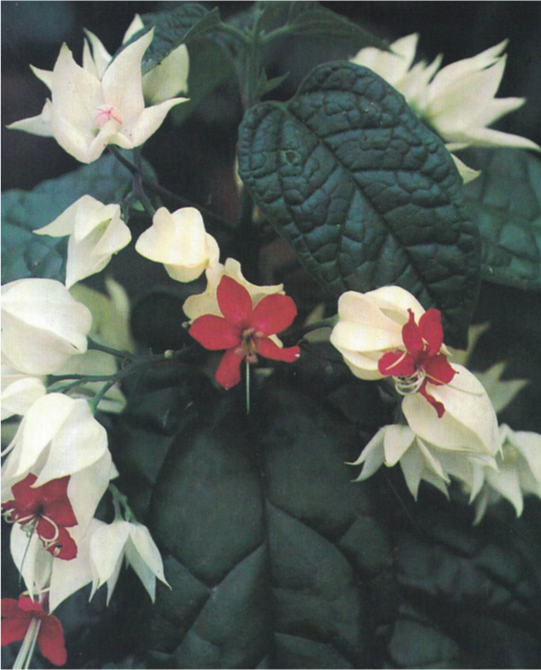
Light and Temperature
This plant needs plenty of light but protection from the burning sun. A heat loving plant needing a temperature in the upper 70s- 80s in the summer and not less than about 60°F in the winter.
Watering and Feeding
Water and feed regularly through the summer, especially when in flower. Bleeding heart vine loves high humidity so mist often. Give diluted liquid fertilizer every other week. Apply iron chelate if leaves become chlorotic (pale areas between veins). Winter is a rest season during which the plant needs less water and no feeding.
Transplanting, Propagating and Grooming
This plant needs plenty of room in its pot and should be potted in late winter before it comes into flower. The soil should be well drained and acidic. Use regular potting soil with added peat Moss.
If you want a bushy, compact plant, prune side shoots back to 2-3 leaf pairs each year when flowering is over or in late winter.
Propagation is easiest with cuttings.
Size, Growth and Flowering
The bleeding-heart vine is an Evergreen climbing shrub. If left to grow along an established wall it can reach a considerable height, but in a pot, it usually only reaches 4-5 feet. Medium growth rate.
This plant blooms in early spring through early fall, or even all year in a warm greenhouse. The lovely crimson flowers are surrounded by a white calyx. Although C. thompsoniae is scentless, many other varieties such as C. phillipinum, are highly fragrant.
Glory Flower
Eccremocarpus
scaber
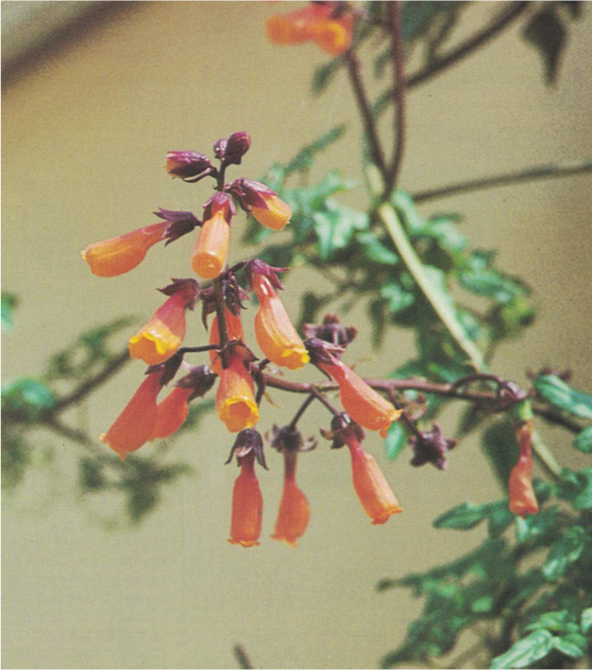
Light and Temperature
Glory flowers can be cultivated on a warm and sheltered balcony or under the roof of an airy veranda. The warmer the summer, the better the plant likes it.
Watering and Feeding
Water the seedlings well so they don't dry out. Water regularly and feed once a week through the season.
Transplanting, Propagating and Grooming
Sow the seeds in sandy, porous propagating soil. Older plants are fine in regular potting soil. No transplanting, except when the small seedlings are potted on and later planted out in their permanent home.
No grooming is necessary.
Propagate by seed. Sow in March through April for planting out in early June.
Size, Growth and Flowering
The glory flower is a perennial climber usually grown as an annual. It Withers down each year and survives by its roots. However, it cannot survive winters in most areas and is mostly grown as an annual summer plant on a balcony or veranda. The stems are usually 7 to 8 feet long, but in especially good conditions they can reach a length of 15 feet. Fast growing.
Blooms in the summer through early fall. If seeds are sown in early March, the plants can flower from June onwards. The trumpet shaped flowers are orange, scarlet, or yellow and grow in small clusters from the stem tips. They have no fragrance.
Costa Rican Nightshade
Solanum
wendlandii
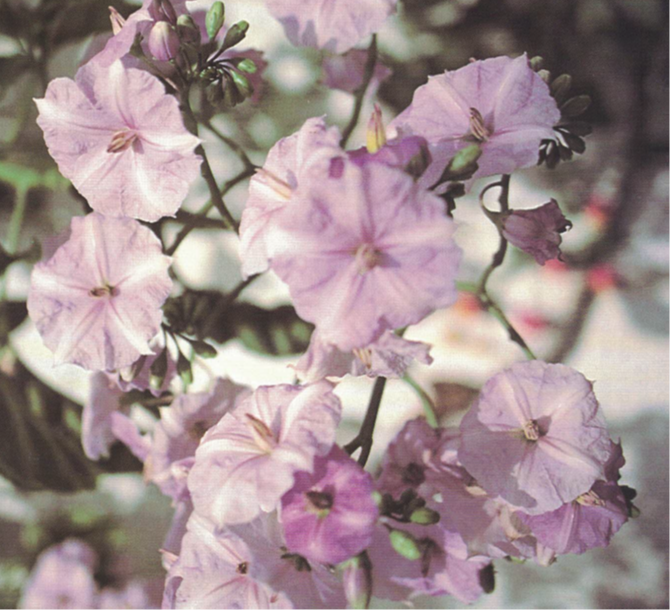
Light and Temperature
Costa Rican nightshade thrives in a bright, warm window poor greenhouse. I love sunshine and light but need some protection from the burning rays of the midsummer sun. Stand plants outside in the summer when the ideal temperature is in the lower to middle 70s.
Watering and Feeding
This is a greedy plant that needs plenty of food and water in the spring and summer months. The surface of the soil may be allowed to dry before it is watered again, but the soil itself must never get too dry period water less in winter and do not feed from November through mid-February.
Transplanting, Propagating and Grooming
Use regular potting soil when repotting each year in February. Mix a little sand in the soil for starting cuttings or seed.
Pruned back plants hard in February; Trim to control growth at any time of the year.
Take cuttings with a bit of bark in February. Seeds can also be sown.
Size, Growth and Flowering
This plant is an Evergreen climbing vine with large, pale green leaves. In ideal conditions it will grow four to six feet in one summer.
Flowers are purplish and about 2 - 2 1/2 inches across; They have no fragrance.
Convovulus
Convovulus
mauritanicus
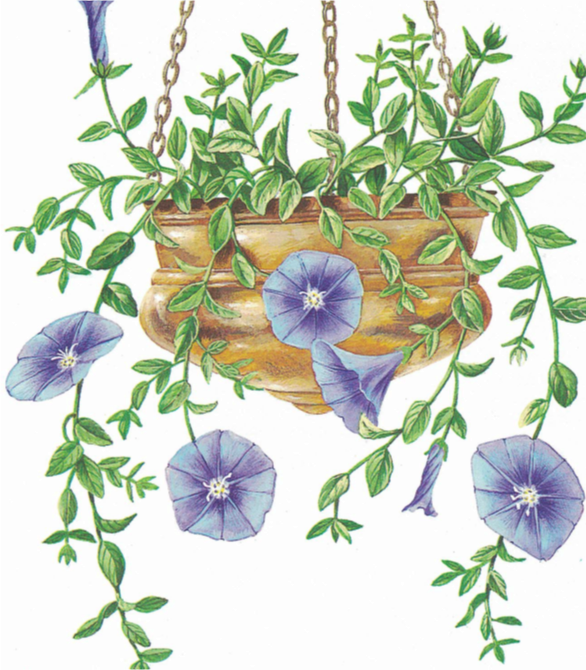
Light and Temperature
Needs a warm and sunny spot during the growing season. No special temperature needed. Overwinter in a bright, cool, frost-free place.
Watering and Feeding
During the growing season, water regularly but always let the soil dry somewhat before watering again as this plant is sensitive to overwatering. Feed once a week. Do not feed in the winter and only water sparingly.
Transplanting, Propagating and Grooming
This plant needs good drainage. Ordinary potting soil with some added pumice is fine. Pot each year in spring if grown as a perennial.
Groom this plant only to restrict growth period plants overwintered indoors should have the old stems cut all the way back, about midwinter.
Propagate by seeds. Also, use 4-inch cut tips taken in the summer. Root them in well drained propagating mix under high humidity such as a plastic bag with some air holes. Once rooted they can be overwintered indoors and will be large enough to plant in spring.
Size, Growth and Flowering
Mostly grown as a climbing or hanging plant on balconies and patios. In good conditions, it grows fast and can become quite large in just one season. Although mostly grown as a one season plant, it can be overwintered.
Normally blooms from June until the first frosts. The pleated, trumpet shaped lilac flowers have a sweetish fragrance.
Silverbush
Convolvlus
cneorum
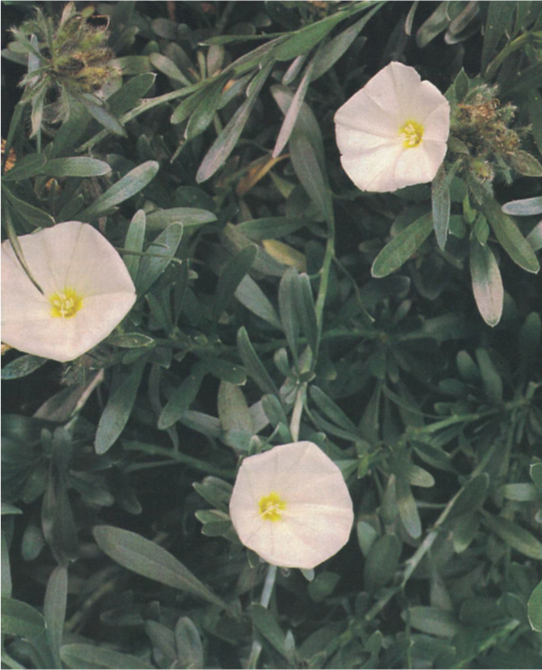
Light and Temperature
During the growing season these plants should be kept in a warm, sunny place. If keeping them indoors through the winter they should be kept in a bright, cool place but well protected from frost.
Watering and Feeding
Keep the plants regularly watered all through the summer. Do not let them dry out. Feed once a week with liquid fertilizer. Water sparingly and do not feed at all during the winter.
Transplanting, Propagating and Grooming
Loose, fast draining potting soil is best. If cultivating this plant as a perennial, you should repot in the spring.
In the late fall you can cut the plants back completely prior to moving them to their bright but cool winter quarters.
This plant is easy to propagate from seed sown in the spring. The seeds will germinate within a week or two. You can also take stem or root cuttings during the spring. Use the same soil mixture as is recommended for transplanting.
Size, Growth and Flowering
This plant is a shrubby plant with trailing stems and can be grown in a hanging pot. The silvery leaves are covered with fine silky hairs. It is often cultivated as an annual summer flower but can be kept through the winter if it is protected from frost.
This plant will flower all summer outdoors in a sunny spot away from the wind or indoors in a bright window. The trumpet shaped flowers are white or light pink and have a sweetish fragrance.
Spanish Moss
Tillandsia
usneoides
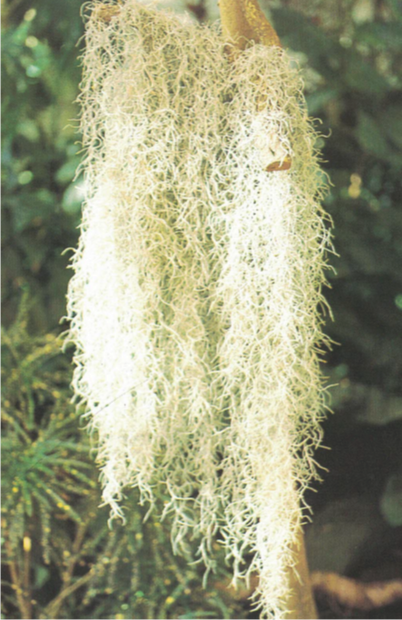
Light and Temperature
Grows best in spots with plenty of light, such as a south facing window. Summertime temperatures in the 70s suit it well, as do winter temperatures in the 60s.
Watering and Feeding
Water by misting the plants regularly with lukewarm water. If plants are growing in a humid greenhouse, you may not need to water at all. Plants are able to make use of small traces of food in the air.
Transplanting, Propagating and Grooming
Spanish Moss is an epiphyte and needs no soil and no transplanting. Just hang it on a piece of bark.
Groom only if the plant is too long, or you would like some more plants.
Propagation is easy by taking a small cutting of the plant and hanging it.
Size, Growth and Flowering
Spanish Moss is a hanging plant. In the right conditions, plants may be a yard or longer period leaves have a gray- green appearance.
Seldom flowers and cultivation
October Plant
Sedum
sieboldii
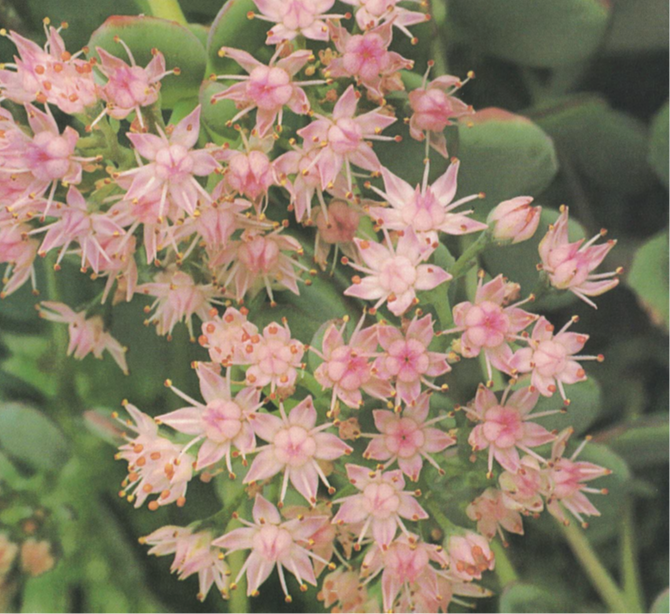
Light and Temperature
Outdoor grown plants are winter Hardy. Indoor grown plants need a cool rest period from December through the rest of March each year when they would preferably stand at about 45-50°F. Move them to a warm window in March to start off new, spring growth period they like a place in a South facing window for the summer and will appreciate an outdoor vacation.
Watering and Feeding
Water sparingly in winter period once the new shoots start to grow start watering regularly and feed every two weeks until fall.
Transplanting, Propagating and Grooming
Regular potting soil is fine for young plants, but older plants could do with slightly heavier soil.
Cut outdoor plants back to the base when growth has ceased for the year. If the plant is growing indoors in a cool, bright room cut off the weathered flowers only and leave the stems until the following spring.
Propagate by either snapping young stems off at the base or dividing older stems into two to four pieces with a couple of whirls of leaves each. Plant three to five cuttings in each pot. They will soon root but these young plants are not winter hardy and must be kept frost free until they are later planted out in spring.
Size, Growth and Flowering
A deciduous perennial with 6-8-inch-long annual stems. The rounded leaves are 1/2 to 1 inch across and grow in threes. Medium growth rate.
Every fully developed shoot will produce flowers in late summer. They last for over a month period no fragrance.
Spanish Flag
Mina
lobata
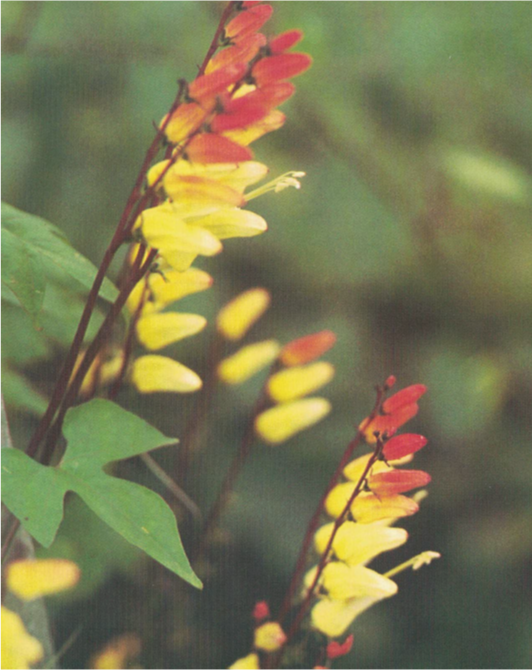
Light and Temperature
This plant needs plenty of sun and shelter from strong winds. It loves warm summer weather but can grow inside the house as well. Provide bright but cool conditions if overwintering the plant in areas with very cold winters.
Watering and Feeding
Spanish flag needs frequent watering and regular feeding all through the summer. Plants and pots need watering every day, while plants growing in the ground can manage with watering every other day. Feed with liquid fertilizer once a week. Water moderately in the winter and do not feed.
Transplanting, Propagating and Grooming
Ordinary potting soil is fine, or good garden soil if grown in the ground. Repot overwinter plants in the spring.
These plants grow rapidly in one season and can be cut back if they become too tangled. Cut overwintered plants back in the spring.
Propagate with seeds sown in the early spring.
Size, Growth and Flowering
Spanish flag is a perennial climber in the same family as morning glory. It can reach a height of over 15 feet in the course of only one summer. It is often cultivated as an annual.
The characteristic flowers have the same color as the Spanish flag and our first clear red later turning to orange red. They are shaped like small trumpets made of five petals and have a sweet fragrance, especially in the sun.
Black-Eyed Susan Vine
Thinbergia
alata
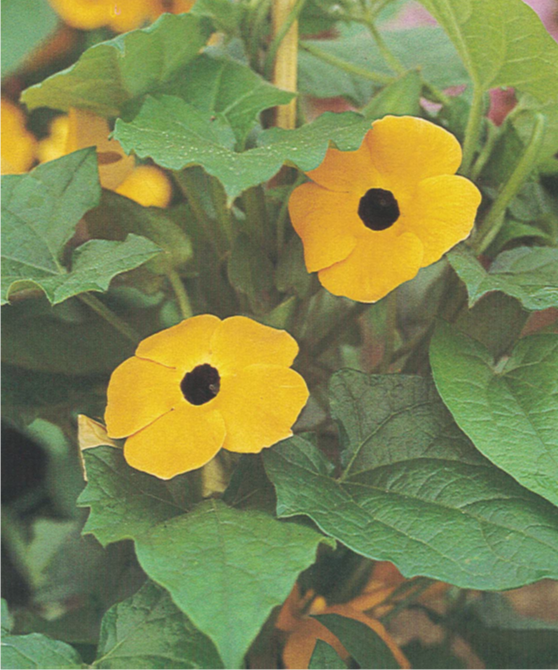
Light and Temperature
This plant needs plenty of light but does not have to grow in a South facing window. The bright east or West facing window will do just as well. Regular room temperature is fine except for the very young plants which need a slightly cooler start, about 60°F.
Watering and Feeding
Since this plant grows very fast it needs a constant supply of food and water. Feed at least once a week, older plants twice a week.
Transplanting, Propagating and Grooming
Sow in regular propagation soil. As soon as young plants can be handled, pop them in commercial potting earth. Give the plants a large pot so that they don't have to be moved while they are in bloom.
Pinch off faded leaves or flowers.
Use seeds and sow in April or May. Cover the plants while they are germinating and when they are very small to keep in the moisture. Transplant to larger pots.
Size, Growth and Flowering
An attractive fast-growing climber with heart-shaped leaves and masses of flowers on slender stems.
The flowers begin in June and continue for the rest of the summer. They are normally orange but can be white or yellow. They have a dark velvety, brownish purple eye at the center.
Syngonium/Nepthytis
Syngonium
podophyllum ‘White Butterfly’
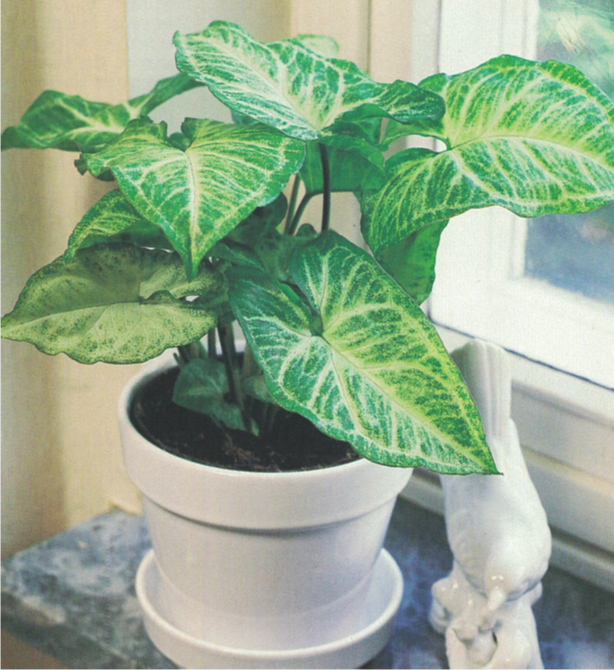
Light and Temperature
Keep Syngonium at temperatures in the mid-70s year-round. It prefers low to medium light. Too much direct sunlight can cause the leaves to become pale.
Watering and Feeding
The large, thin leaves lose a lot of water through transpiration and the leaves will droop soon. Don't allow soil to become too dry period weekly feeding from March to September.
Transplanting, Propagating and Grooming
Regular potting soil is fine, perhaps with a little added perlite and coarse peat Moss. Repotting should be done in spring, but only once every two to three years period top dressing is otherwise sufficient.
Shape the plant by trimming unwanted or long straggly vines. If grown on a hoop or Moss pole, you may need to assist it.
Syngonium often has aerial roots growing from the vines, and cuttings will rapidly root. They can be placed in a pot of moist sphagnum and protected from drying out by a ventilated plastic bag until the root system is sufficiently developed.
Size, Growth and Flowering
Syngonium is a vigorous climbing or trailing plant with aerial roots. The arrowhead shaped leaves are usually variegated. Fast growing.
Very rarely flowers in cultivation.
Heart-Leaf Philodendron
Philodendron
scandens ssp. Oxycardium
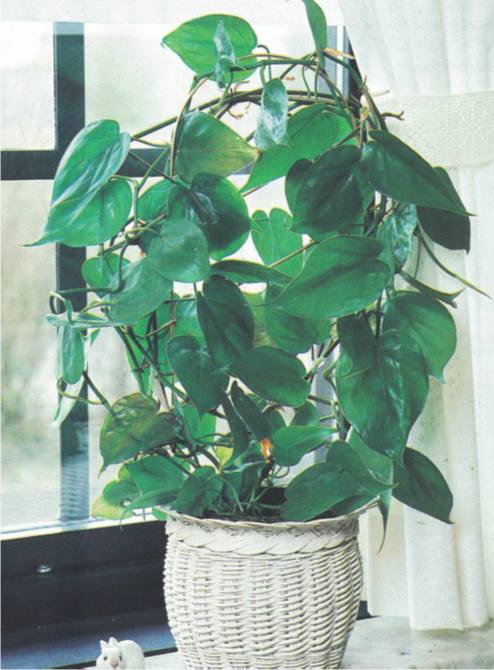
Light and Temperature
Philodendrons do well in both sunny and shady areas, but direct sunlight behind glass can bleach or scorch the leaves. Temperatures in the growth season should be around 66-76°F. Winter temperature should be approximately 59-66°F.
Watering and Feeding
Water regularly through the growth season, about twice a week. Cut watering in half during the winter.
Transplanting, Propagating and Grooming
Use good, rich potting soil that drains well. Older plants need repotting every 3-4 years while younger plants need repotting every spring.
It may be necessary to cut back heart leaf philodendron to conserve space.
Stem cuttings are best for propagating. Take these in May or June and leave them to strike root at about 70-75°F.
Size, Growth and Flowering
Heart-Leaf philodendron has an extremely vigorous growth but is, at the same time, extremely attractive with long stems which can grow several feet in one season alone.
Flowers are rare in cultivation.
Velvet-Leaf Philodendron
Philodendron
scandens ssp. Scandens forma micans
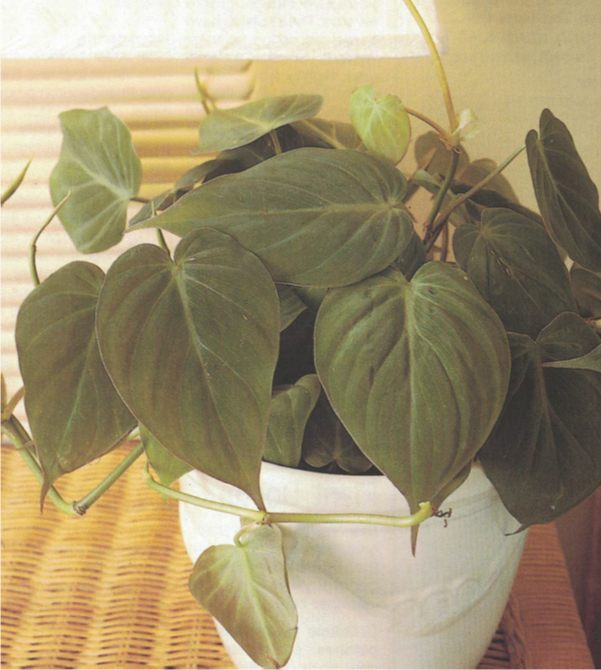
Light and Temperature
Regular watering all year, somewhat less than winter according to temperature. Allow soil to dry slightly between waterings. Use tepid water for the best results. Feed with dilute liquid fertilizer every 3-4 weeks except in winter.
Watering and Feeding
Medium to bright indirect light; Never direct sun. Low light is also tolerated with the plants can eventually get straggly. Normal room temperatures in the 70s to 80s range all year; Perhaps a little cooler in winter but never below 55°F.
Transplanting, Propagating and Grooming
A rich peat-based soil is recommended such as a commercial potting soil with extra peat and perhaps some perlite. Report only when the plants have outgrown their pots at any time of the year.
Cut back all the way to the pot stems that have become too long or straggly looking.
Propagate by cuttings.
Size, Growth and Flowering
Velvet leaf philodendron have been trailing stems and heart-shaped, velvety, olive- green leaves. It grows fairly quickly. Black- gold philodendron is an upright grower with much larger leaves that hang vertically. It is a little slower growing.
Variegated Yam/Air Potato
Dioscorea
discolor
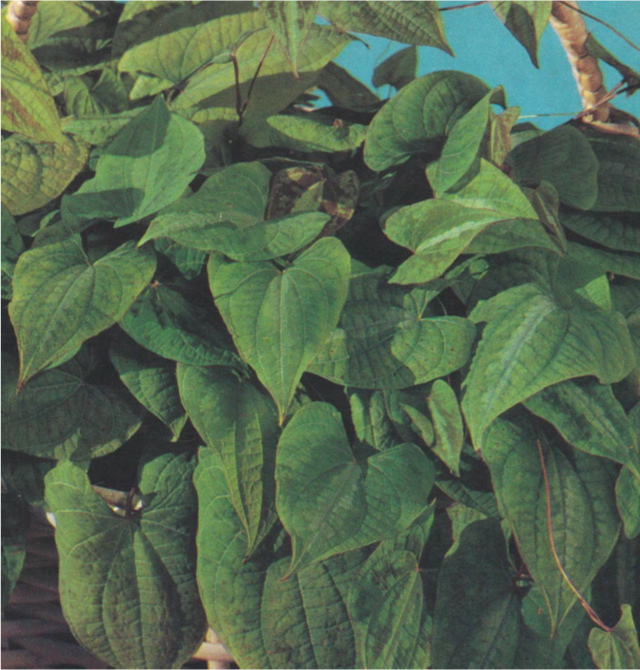
Light and Temperature
Bright light, but no midday sun during the growing season; Light is not critical during the dormant season. Prefers warm temperatures during the growing season, especially in the spring. Keep cool, but not below 55°F in the winter.
Watering and Feeding
Water regularly and feed every two weeks during the growth period. Reduce watering and stop feeding as the plant goes dormant. No watering or feeding in the winter. Occasional misting during the growth period is beneficial.
Transplanting, Propagating and Grooming
Use well drained regular potting soil with 25% extra pumice or perlite. repot in the spring before growth starts.
Remove withered stems and fall.
Propagate by cuttings or tubers.
Size, Growth and Flowering
Both D. discolor and D. bulbifera are fast growing twining vines that can grow as much as 15 feet in one season. D. bulbifera has large, heart-shaped leaves up to 10 inches long by 7 inches wide with a prominent pattern of veins. D. discolor has leaves a similar shape and size that are purple underneath and olive- green mottled with light green and silvery Gray above, with silver or pink veins.
Small insignificant flowers in late summer. No scent.
Morning Glory
Ipomoea
tricolor
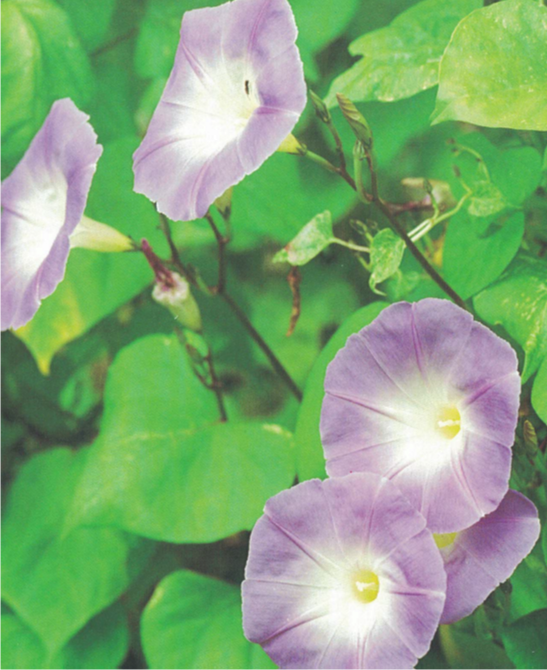
Light and Temperature
Morning glory needs plenty of light and thrives in the sun. Grow outside in places with both sun and shelter. The tropical plants will curl up and die at the first sign of frost.
Watering and Feeding
Water well all through the growth and flowering season. Feed with liquid plant fertilizer once a week.
Transplanting, Propagating and Grooming
Sow seeds and special propagating soil. Separate seedlings out into individual pots. The final pot should be large enough to contain the plant for the rest of its short life.
No grooming is necessary.
Sow seeds every year in spring.
Size, Growth and Flowering
Morning glory is a climbing plant which can grow over 7 feet in one summer by 20 extends around a support. Without a trellis, stick or string to wind around it is totally unable to climb.
The trumpet shaped flowers are extremely large and lovely. They can be blue, Violet, white or red. Each flower opens out in the early morning and closes and withers away in the afternoon, living only a single day, but the next day masses of new flowers will again open out. Morning glory will continue blooming from June until the first frost when it dies. No particular fragrance.
Teddy Bear Vine
Cyanotis
kewensis
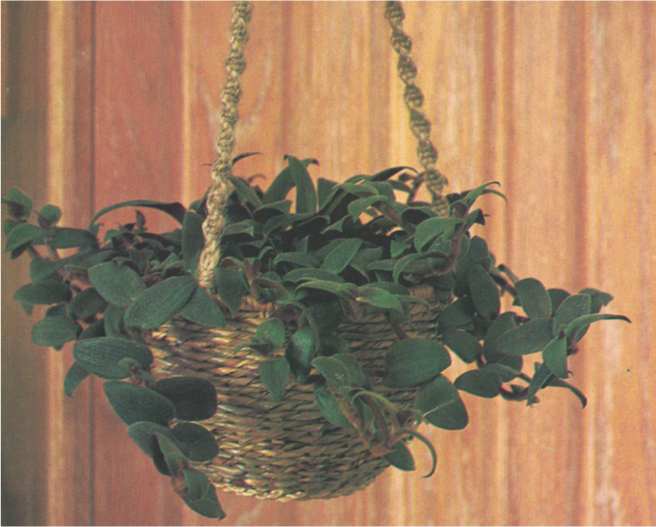
Light and Temperature
Place the plant in a position where it will get some direct sunlight. Average summer temperature should be in the upper 60s. In winter it must not go below mid-40s.
Watering and Feeding
Water freely in spring and summer, sparingly in winter. Spray leaves in summer to increase humidity. Feed with liquid fertilizer once every two weeks in summer.
Transplanting, Propagating and Grooming
Repot once a year in spring. Use regular potting soil. Take care not to damage the fleshy roots while removing old soil.
Remove old bare stems; These could be used as cuttings. Pinch out new growth to promote bushiness.
Propagate by cuttings.
Size, Growth and Flowering
This is a trailing plant with succulent leaves covered with soft hairs. Stems are weak and break easily. Fast growing.
Tiny purple- blue flowers on upright stems in winter through spring (C. kewensis) or early summer (C. somaliensis).
Bougainvillea
Bougainvillea
hybrid
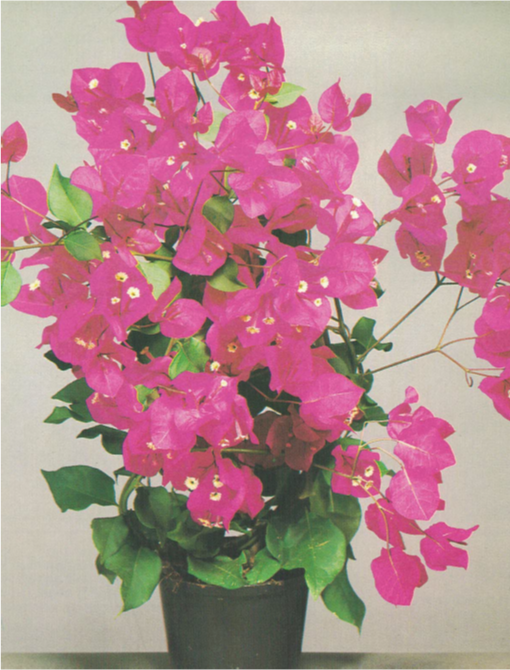
Light and Temperature
This plant can never get enough sun in the summer. A south facing window is ideal. Move it to a cool (46-54°F) position in the fall and winter.
Watering and Feeding
Do not let the plant dry out during the flowering season. Water daily and at the same time, give it a weak solution of plant food. It likes a good soaking every once in a while. Try standing it out in warm rain.
Transplanting, Propagating and Grooming
February is the month for repotting. Do not use too large of a pot. The potting soil should consist of 1/3 hummus. It is better to have too much sand than too little.
This plant is not really groomed but cut back in February through March. Unwanted or weak branches are removed. It blooms on new growth, and if this is kept sheared, there will be few blossoms.
Propagating is difficult in this case. It is easier to buy a new plant instead.
Size, Growth and Flowering
This plant is a typical rambling plant which can have branches of up to 70-100 feet long when left to grow naturally. When cultivated as a house plant is usually trained along a trellis or a wire hoop. It can grow 3-6 feet in one year.
The main flowering begins in spring and then continues for the whole summer. The bracts can be purple, pink, white or almost orange. The flower at the center is yellow and has no scent.
Orchid Vine
Stignaphylllon
ciliatum
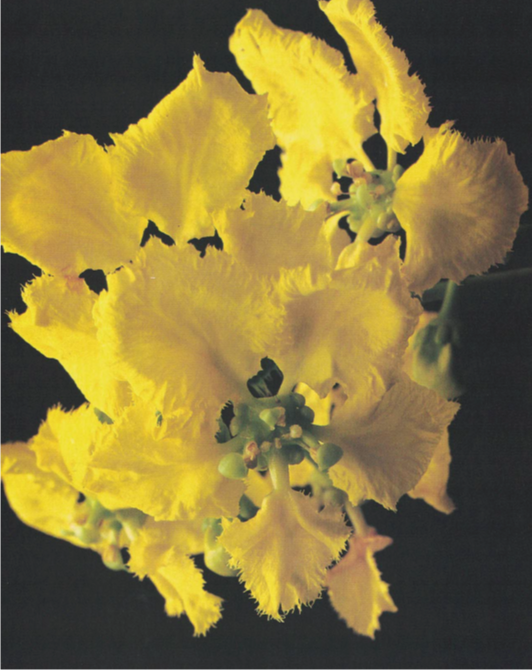
Light and Temperature
Bright light indoors, and full sun to part shade outdoors. Daytime temperatures of 75-85°F with nighttime temperatures of 10-15°F cooler. Outdoors, vines are frost tender, but will recover from a mild frost.
Watering and Feeding
Should be kept evenly moist, not over water. Regular feeding is important for best flowering. Average to high humidity will promote greater pest resistance and healthier foliage.
Transplanting, Propagating and Grooming
Repot in spring, using a fast-draining potting soil.
Train the twining vines on a trellis, or any other support. Plants may be pruned severely when repotting and pruned lightly throughout the year.
Propagating is easiest by soil layering, also by cuttings.
Size, Growth and Flowering
Orchid vine is fast growing but does not grow overly large. It may be trained on a trellis. Plants grown in bright light will be compact.
Bright yellow flowers appear throughout the year, with the heaviest bloom in the summer. No scent.
English Ivy
Hedera
helix cv.
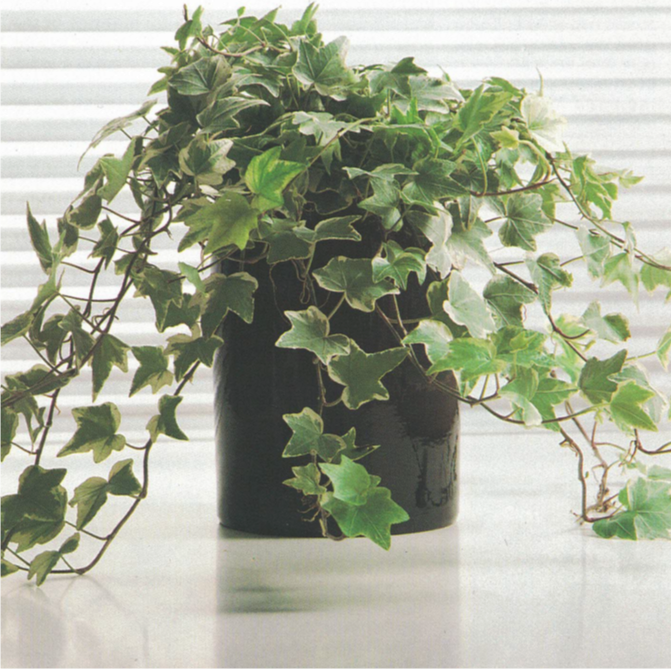
Light and Temperature
Ivies can tolerate shade, but variegated types need somewhat brighter growing conditions, if the leaves are to keep their variegation. Direct sunlight can scorch the leaves. Ivy thrives best in cool surroundings, in the 60s to 70s and in winter from the 40s to 50s.
Watering and Feeding
Keep the soil moist. Water frequently and regularly from spring to fall, But sparingly in the winter. Add liquid plant food every other week during the growing season.
Transplanting, Propagating and Grooming
Standard potting soil is fine. Pot every other year, always into a bigger pot. Add a fresh layer of topsoil once in a while.
Can be pruned all year long period pruning gives compact, well-formed plants with many branches.
Propagate by layering side shoots into new pots or by top cuttings.
Size, Growth and Flowering
Most Ivy plants are quite small when they are sold. Hanging, creeping, and climbing runners can grow several yards long if they are not pruned. Some varieties are shrubby, however, and will naturally stay quite compact.
Ivies first begin to flower when they reach a certain age in size, about 8 to 10 years. At this stage, flowering shoots develop oval leaves. These chutes lose their ability to develop the IV sucker like aerial roots.
The individual flowers are green and developing clusters. The effect is decorative. The fruit matures into black berries which are poisonous. The fragrance is rather unpleasant, but not too flies and other insects.
Algerian Ivy
Hedera
helix ssp. Canariensis
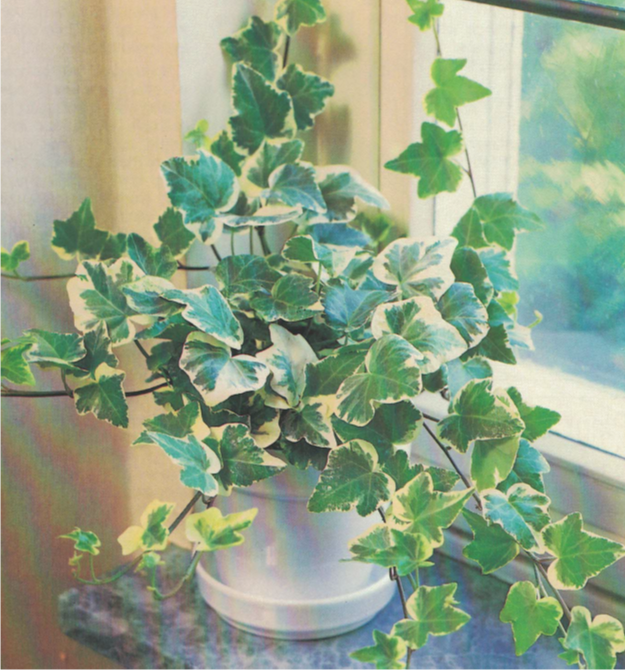
Light and Temperature
A bright position is just as good as a slightly shadier one, but strong sunlight is to be avoided. Plain green varieties need cool overwintering while the variegated types will do better at normal room temperatures.
Watering and Feeding
Water regularly in summer but sparingly in the winter, especially if the plant is in a cool position. Feed monthly in the summer but not in the winter.
Transplanting, Propagating and Grooming
Repot young plants each year, older plants less frequently. Use regular potting soil.
Trim overly long stems.
Cutting this can be taken at any time of the year, and is very easy, since there are often young roots on parts of the stems already. In this case the cuttings can be planted right away without having to stand in water first period
Size, Growth and Flowering
This ivy either creeps along the ground or grows upward if given the chance. The reddish, slightly hairy stems can grow several yards long period the leaves are normally more oval pointed than those of the smaller leaved. English ivies are less indented. There are both variegated and plain green varieties.
Older plants may produce yellow, faintly scented flowers in the fall. Indoor plants bloom only rarely.
Wax Plant
Hoya
carnosa/Hoya Bella
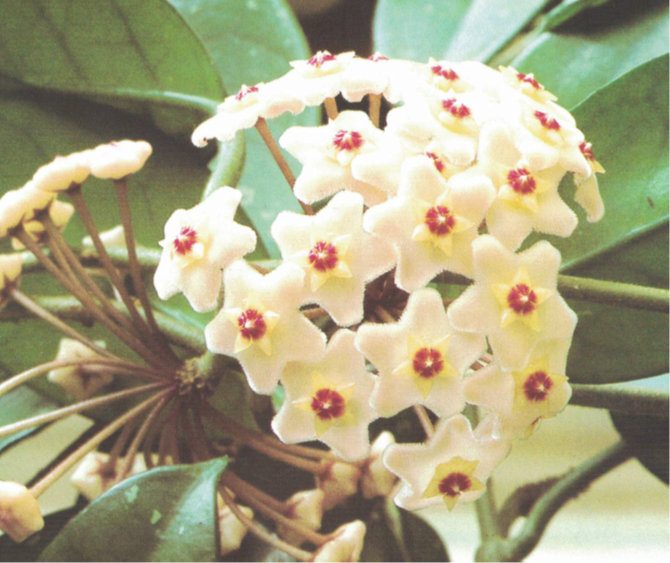
Light and Temperature
Hoya likes to be in a bright position but not in strong sunlight. It grows well in a normal room temperature but would rather have slightly cooler temperatures in its rest season from fall until early spring.
Watering and Feeding
Water normally, plenty in the summer and less in the winter, and mix liquid plant food with the water in the summer. Water sparingly in the rest period and give absolutely no fertilizer. Overfeeding causes the buds to drop.
Transplanting, Propagating and Grooming
Use any good commercial potting mix. Repot young plants in the spring, older plants only when absolutely necessary.
Keep the leaves free of dust and remove the yellow leaves.
Take cuttings in spring and summer.
Size, Growth and Flowering
Hoya carnosa can grow to be a very large plant indeed, with branches up to more than 10 feet long. Hoya Bella Is an endearing little plant with 16-inch branches.
Both varieties have white- pink flowers with a waxy appearance which makes them look almost artificial. The flowers grow in an attractive cluster with a small red center, and smell of nectar and honey, there is even a distinct drop of honey in each flower. It may drip down onto the leaves or below.
Hindu-Rope Plant
Hoya
carnosa ‘Krinkle Kurl’
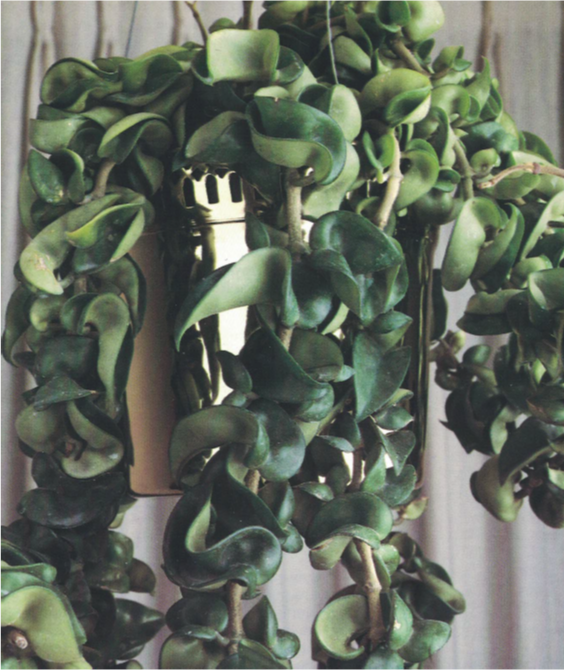
Light and Temperature
Grow in bright light but avoid burning sun. Normal indoor temperatures are fine, perhaps a little cooler in the winter.
Watering and Feeding
Water and fertilize regularly in spring and summer. Keep on the dry side in the winter and do not feed. Do not overfeed.
Transplanting, Propagating and Grooming
Regular potting soil is fine. Repot young plants and spring. Older plants should be repotted only when absolutely necessary.
Keep the leaves clean and free of dust.
Propagate by taking cuttings in spring and summer.
Size, Growth and Flowering
The Hindu rope plant is a curly leaved form of Hoya carnosa. It grows slowly, but stems can eventually attain several feet in length. Contorted, waxy leaves densely covered the stems.
The flowers are the typical Hoya carnosa flowers. They are pink and white, waxy, and star shaped, forming round chandelier like clusters. Long live spurs produce new flowers each year, and so should not be removed.
Beautiful Green Plants
Palms & Ferns
Cacti & Succulents
Orchids
Vegetables & Herbs
Everlasting & Cut Flowers
Exotic Plants
Water Loving Plants
Forcing Plants & Branches
Citations
Care guides
Success with Houseplants,
International Masters Publishers BV/International Masters Publishers
, 1988
Pet safe plant lists
Poisonous Plants, https://www.aspca.org/pet-care/animal-poison-control/toxic-and-non-toxic-plants